


In industries ranging from food processing and pharmaceuticals to chemicals and battery material production, the safe, efficient, and contamination‑free transfer of dry bulk materials is a critical operational challenge. The pneumatic vacuum conveyor (also known as a vacuum feeder or pneumatic vacuum loader) has emerged as the industry‑leading solution for this task.
Unlike mechanical conveyors that rely on moving parts such as screws or belts, a pneumatic vacuum conveyor uses compressed air to generate suction, transporting materials through a fully sealed pipeline. This design offers distinct advantages: it eliminates dust emissions, prevents product contamination, reduces maintenance costs, and ensures operator safety—particularly when handling toxic, potent, or explosive materials.
This article provides a comprehensive, step‑by‑step explanation of how a pneumatic vacuum conveyor works, breaks down its core components, and explores the key benefits that make it an indispensable asset in modern production lines.
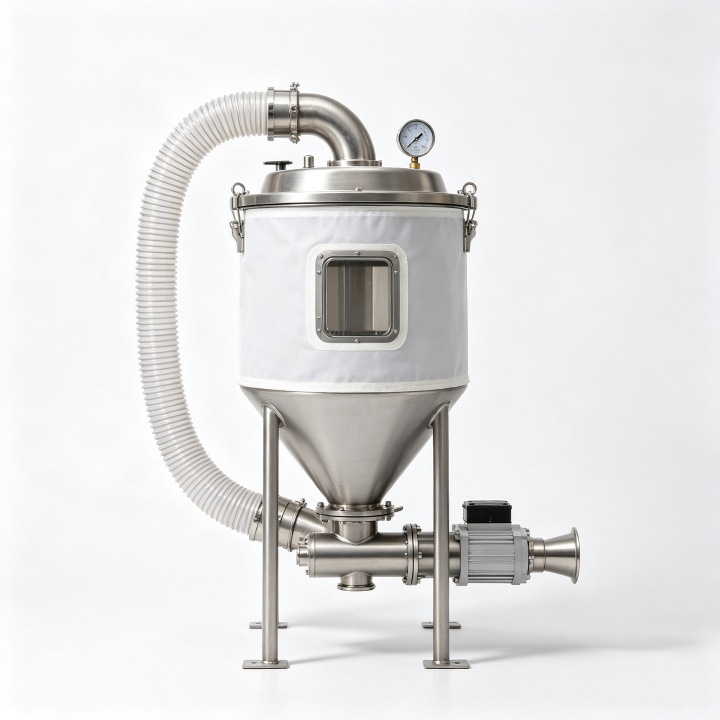
A pneumatic vacuum conveyor is a material handling system that uses negative pressure (vacuum) to pull dry powders, granules, pellets, and other bulk solids through enclosed pipes or hoses from a pickup point (e.g., drums, silos, or bags) to a discharge point (e.g., mixers, tablet presses, reactors, or packaging machines).
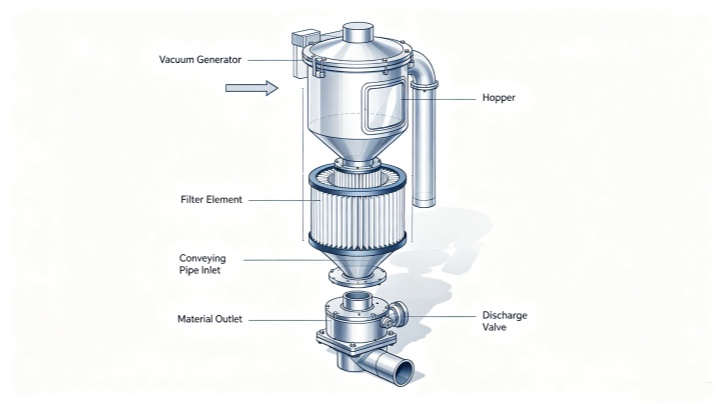
The system is powered by compressed air, typically at 0.4–0.6 MPa (58–87 psi), which drives a vacuum generator—often a Venturi‑type ejector—to create suction. Key components include a vacuum pump, a filtration system, a receiving hopper, and a PLC‑based control system that automates the conveying cycle.
| Component | Function |
| Vacuum Generator (Pump) | Powered by compressed air, it creates negative pressure using the Venturi principle. |
| Suction Hose/Pipe | The sealed conduit through which material is drawn from the source. |
| Filter Element | Separates fine dust and product from the airflow; options include PE, PTFE‑coated, titanium, or sintered stainless steel. |
| Receiving Hopper | Collects the conveyed material before discharge. |
| Discharge Valve | A sanitary flap or butterfly valve that opens to release material into downstream equipment. |
| PLC Control Panel | Manages suction time, discharge time, and filter cleaning cycles automatically. |
| Reverse‑Pulse Cleaning System | Uses a burst of compressed air to clean the filter, restoring suction power. |
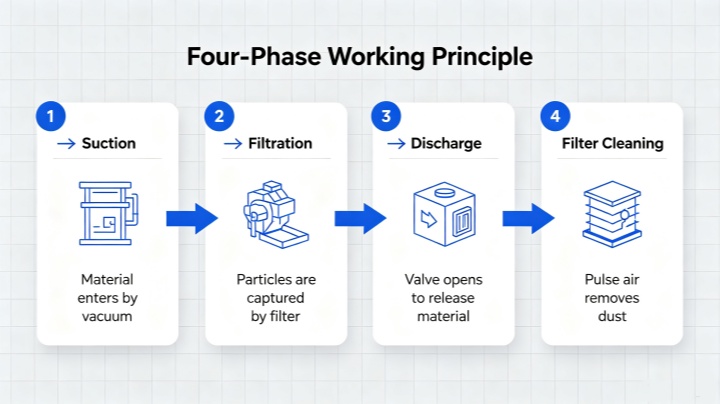
The operation of a pneumatic vacuum conveyor is fully automated and follows a continuous, four‑phase cycle controlled by the PLC.
Phase 1: Suction (Material Loading)
The cycle begins when compressed air is supplied to the venturi vacuum generator. This creates a strong negative pressure inside the sealed hopper. With the discharge valve firmly closed, the suction hose draws material from the source container directly into the hopper. The material flows through the hose in a stream of air, and the design of the hopper inlet often directs the flow tangentially to reduce impact and minimize particle degradation.
Phase 2: Filtration & Separation
As the material‑laden air enters the hopper, it passes through a high‑efficiency filter element. The filter separates the conveyed solids from the airstream: clean air passes through the filter and exits via the venturi exhaust, while the material drops by gravity and accumulates at the bottom of the hopper. The filter retains even sub‑micron dust particles, ensuring zero emissions to the surrounding environment—critical for applications involving potent APIs or explosive dusts.
Phase 3: Discharge
After a preset "suction time" (or when a material level sensor indicates a full hopper), the PLC cuts off the compressed air supply to the venturi, instantly dropping the vacuum inside the hopper to atmospheric pressure. The discharge valve then opens, and the accumulated material is released into the downstream receiving equipment. The discharge duration is adjustable to ensure complete emptying.
Phase 4: Filter Cleaning (Reverse‑Pulse)
Simultaneously with the discharge phase, a short, high‑pressure burst of compressed air is directed in reverse flow through the filter element (reverse‑pulse cleaning). This shock dislodges any fine dust particles adhering to the filter surface, restoring full filtration efficiency for the next cycle. The dislodged dust falls back into the hopper and is discharged along with the main product—eliminating waste and preventing filter blinding.
Cycle Repeat
The discharge valve closes, the venturi re‑engages, and the entire four‑phase cycle repeats automatically. When downstream equipment does not require material, the system enters a standby state with zero compressed air consumption, saving energy during production pauses.
1. Dust‑Free & Contamination‑Free Conveying
The fully sealed conveying path eliminates dust emissions, protecting both the product and the working environment. This is essential for industries with strict hygiene standards, such as food and pharmaceuticals, and for handling toxic or allergenic substances. Studies show that pneumatic systems can reduce dust emissions by up to 50% compared to open mechanical systems.
2. Gentle Material Handling & No Product Degradation
Because there are no moving parts in contact with the product, pneumatic vacuum conveyors minimize particle degradation, abrasion, and segregation. This is particularly important for fragile materials, such as pharmaceutical tablets, coated granules, and food products like coffee beans or spices.
3. Low Maintenance & Reduced Operating Costs
With no gears, bearings, or seals in the product zone, maintenance requirements are significantly lower than those of mechanical conveyors. Typical annual maintenance costs are less than 2% of the initial investment. The optimized Venturi nozzle design also delivers up to 30% higher vacuum efficiency per unit of compressed air compared to generic ejectors, contributing to energy savings.
4. Intrinsic Safety for Explosive Environments
Since there are no electrical components in the conveying zone, pneumatic vacuum conveyors are inherently safe for use in potentially explosive dust atmospheres. ATEX‑certified configurations are available for hazardous environments, making them the preferred choice for handling combustible dusts like organic peroxides, metal powders, and carbon black.
5. Flexible & Scalable Design
Pneumatic vacuum conveyors are modular and scalable, easily integrating into existing production lines with minimal layout changes. Models are available with conveying capacities from 50 kg/h up to 6,000 kg/h, with horizontal distances up to 20 meters and vertical lifts up to 9 meters.
6. Sanitary Construction for Regulated Industries
All material‑contact parts are manufactured from SUS304 or SUS316L stainless steel with mirror‑polished interior surfaces (Ra ≤ 0.4µm). The crevice‑free welds and tool‑less disassembly (via tri‑clamp or quick‑release couplings) enable thorough cleaning and rapid product changeovers in under 5 minutes, fully complying with GMP, FDA, and EHEDG sanitary standards.
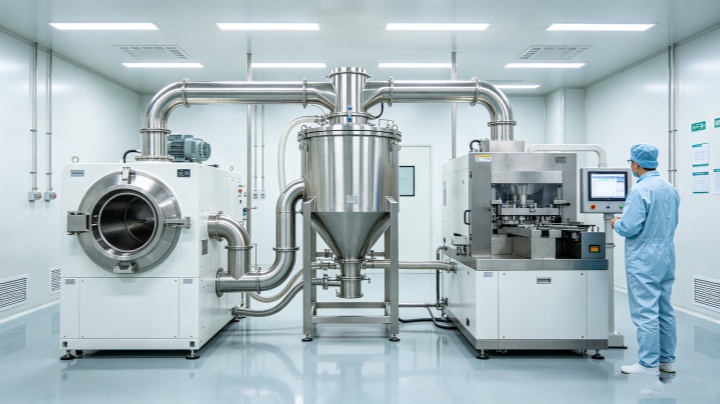
| Industry | Typical Materials Handled | Key Requirement |
| Food & Beverage | Flour, sugar, starch, milk powder, cocoa, spices, instant coffee | Hygienic, dust‑free, and contamination‑free transfer. |
| Pharmaceutical | APIs, excipients, lactose, vitamin premixes, tablets | Contained transfer of potent compounds, OEL compliance < 1 µg/m³. |
| Chemical | Pigments, carbon black, titanium dioxide, resin pellets, catalysts | ATEX certification for explosive dusts, corrosion‑resistant materials. |
| Battery Materials | Lithium cobalt oxide, LFP, graphite, conductive carbon blacks | Moisture‑sensitive, sealed conveying with dry‑air purge options. |
| Cosmetics | Talc, mica, titanium dioxide, zinc oxide | Sanitary design with mirror‑polished surfaces to prevent microbial growth. |
Q1: What is the difference between a pneumatic vacuum conveyor and an electric vacuum conveyor?
A: A pneumatic conveyor uses a compressed‑air‑driven venturi generator to create vacuum, while an electric version uses an electric motor‑driven blower. Pneumatic systems have no electrical components in the conveying area, making them safer for explosive (ATEX) environments. They are also simpler, lighter, and easier to install. Electric systems are generally more energy‑efficient for very high continuous throughputs.
Q2: What materials can a pneumatic vacuum conveyor handle?
A: It handles a wide range of dry bulk solids including free‑flowing powders, cohesive powders, granules, and small flakes. However, materials with > 15% moisture content or high oil content may require specialized configurations (e.g., heated hoppers or mechanical agitation).
Q3: How do I select the right model for my production line?
A: Key selection parameters include: material name and bulk density, required conveying capacity, horizontal and vertical conveying distances, number of pickup/discharge points, and any special requirements (ATEX, FDA, cleanroom, etc.).
Q4: Can the system be customized?
A: Yes. Customization options include hopper capacity, filter type, discharge valve design, surface finish level, gasket materials, connection sizes, and control panel interface.
The pneumatic vacuum conveyor is a proven, versatile, and highly efficient solution for automating the transfer of dry bulk materials. By understanding its working principle—the simple yet powerful 4‑phase cycle of suction, filtration, discharge, and filter cleaning—you can appreciate why it is the preferred choice in industries where hygiene, safety, and product integrity are paramount.
With benefits ranging from dust‑free operation and low maintenance to intrinsic safety and sanitary construction, investing in a pneumatic vacuum conveyor is a strategic decision that enhances productivity, reduces operational costs, and ensures compliance with the most stringent regulatory standards.


Address:China,Yanjin county forest park gate to the west 1000 meters north road.


 Online Chat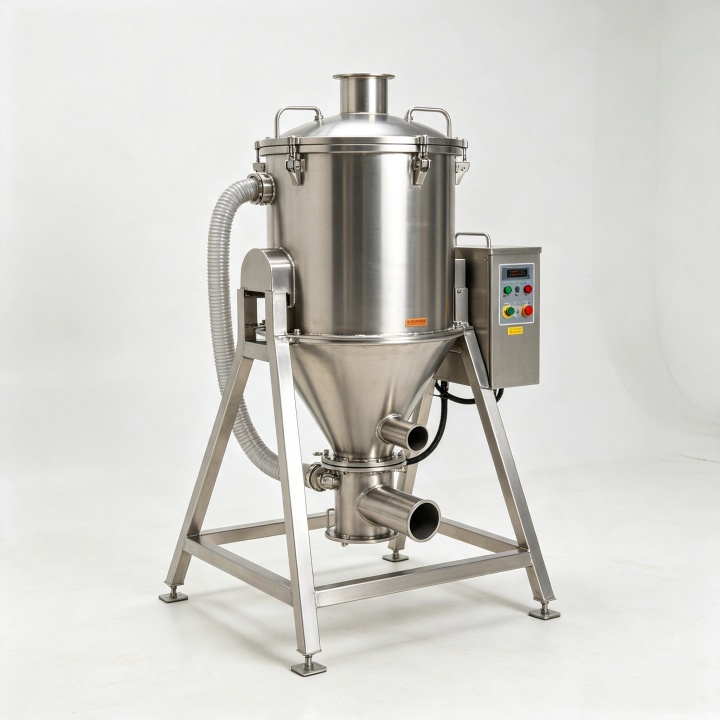
 Email
Email