


Elliptical and circular vibrating screens both use vibration to separate bulk materials, but their motion trajectories and material-flow characteristics are different. A circular vibrating screen is widely used for general-purpose screening and classification, while an elliptical vibrating screen can provide different material movement and stratification characteristics for difficult-to-screen applications.
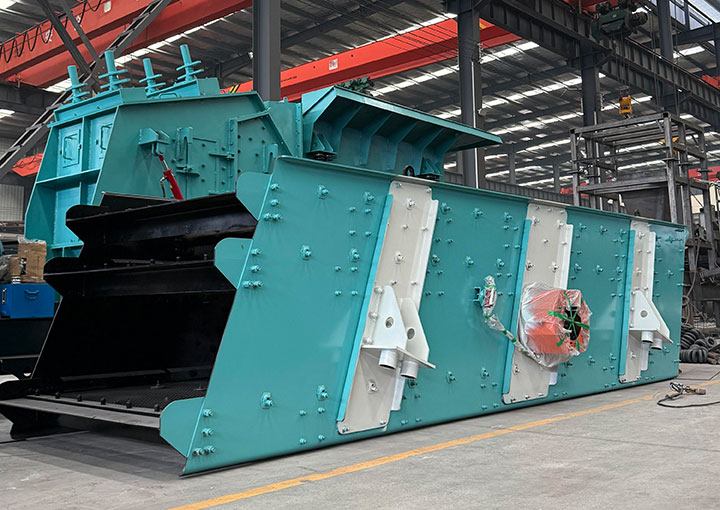
For sticky or wet material, however, the choice is not simply a matter of selecting an elliptical screen over a circular screen. Moisture content, material viscosity, particle size, feed rate, screen opening, and the tendency of the material to blind the screen can all affect screening performance.
This guide examines the Elliptical Vibrating Screen Versus Circular Screen by comparing their motion, material movement, screen blinding, applications, capacity, and key selection factors. It explains when an elliptical screen may be advantageous for sticky material, when a circular screen may be the more practical choice, and what to consider before selecting a vibrating screen for a specific application.
The main difference between an elliptical vibrating screen and a circular vibrating screen is the motion trajectory of the screen surface. A circular vibrating screen moves the material mainly along a circular path, while an elliptical vibrating screen produces an elliptical motion that can change how material travels, spreads, and stratifies across the screen.
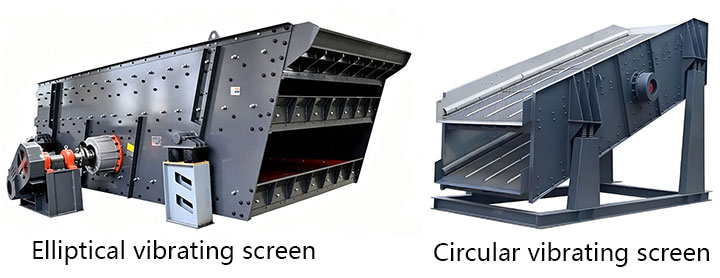
For general-purpose screening, circular motion is often a practical choice because of its simple and widely used operating principle. For materials that are wet, sticky, prone to agglomeration, or difficult to stratify, the elliptical motion may offer advantages depending on the material characteristics and screening conditions.
| Comparison Factor | Elliptical Vibrating Screen | Circular Vibrating Screen |
|---|---|---|
| Motion trajectory | Elliptical or oval movement | Circular movement |
| Material movement | Combines forward movement with elliptical vibration | Moves along a circular vibration path |
| Stratification | Can promote material spreading and stratification under suitable conditions | Effective for conventional screening and classification |
| Sticky or wet material | May be considered when material tends to agglomerate or blind the screen | Can be suitable when material remains sufficiently free-flowing |
| Typical use | Difficult-to-screen, sticky, wet, or challenging materials | General-purpose screening, classification, and sizing |
| Selection priority | Material behavior and required screening conditions are especially important | Capacity, particle size, screen opening, and general screening requirements |
The better choice depends on more than the vibration trajectory alone. Material moisture, viscosity, particle size distribution, required separation, feed rate, screen media, and operating conditions should all be evaluated before selecting the screen type.
When wet or sticky material is fed onto a vibrating screen, particles can adhere to each other or to the screen surface, making it more difficult to maintain an open screening area. The resulting agglomeration and screen blinding can reduce the effectiveness of particle separation.
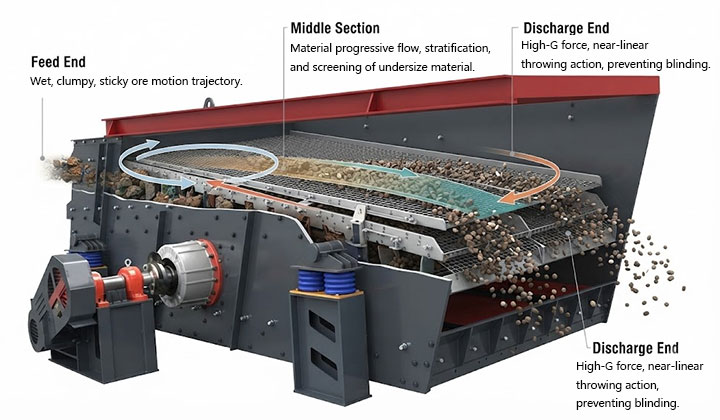
These effects do not mean that an elliptical vibrating screen will automatically prevent blinding. Moisture content, viscosity, particle size, feed rate, screen opening, screen media, and vibration parameters should be evaluated together when processing sticky or wet materials.
Screening capacity and efficiency cannot be determined by the vibration trajectory alone. When comparing an elliptical vibrating screen with a circular vibrating screen, the actual performance depends on the material characteristics, screen area, feed rate, screen opening, moisture content, and operating conditions.
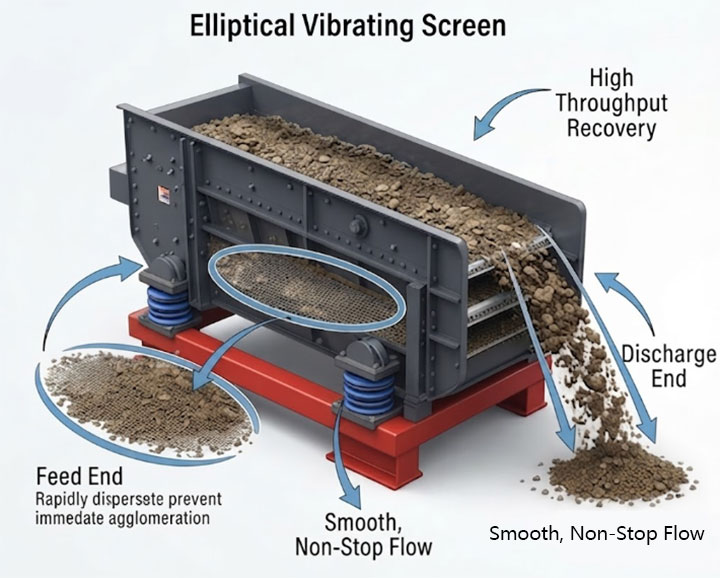
For wet or sticky materials, an elliptical vibrating screen may be considered when controlled material movement and distribution are important. Its motion can help move material across the screening surface while supporting stratification under suitable conditions. This can be useful when sticky feed tends to remain concentrated or form agglomerates on the deck.
A circular vibrating screen can remain a practical choice for many conventional screening applications, particularly when the feed is relatively free-flowing and the required separation can be achieved with a standard circular motion. Its suitability should be evaluated based on the material and required screening conditions rather than on motion type alone.
For either screen type, increasing capacity is not simply a matter of increasing vibration intensity. Screen dimensions, deck configuration, aperture size, material bed depth, feed rate, and moisture content can all influence the effective screening area and separation performance.Therefore, an elliptical vibrating screen should not be selected simply because it is expected to provide higher capacity. The better choice is the configuration that can maintain the required separation and material flow under the actual operating conditions of the application.
An elliptical vibrating screen is not always the better option. A circular vibrating screen can be a practical choice when the material is relatively free-flowing and the screening process does not involve severe moisture, stickiness, or agglomeration. A circular vibrating screen may be suitable when:
For these applications, choosing an elliptical vibrating screen may add unnecessary complexity if the material can already be screened effectively with a conventional circular machine.
The decision should therefore be based on the actual screening conditions. If the material is dry and free-flowing, a circular vibrating screen may be sufficient. If the material is wet, sticky, prone to agglomeration, or difficult to stratify, an elliptical configuration may be worth evaluating as an alternative.
Choosing between an elliptical and circular vibrating screen starts with the material and the required screening result rather than the screen type alone. The following factors can help determine which configuration is more appropriate for a specific application.
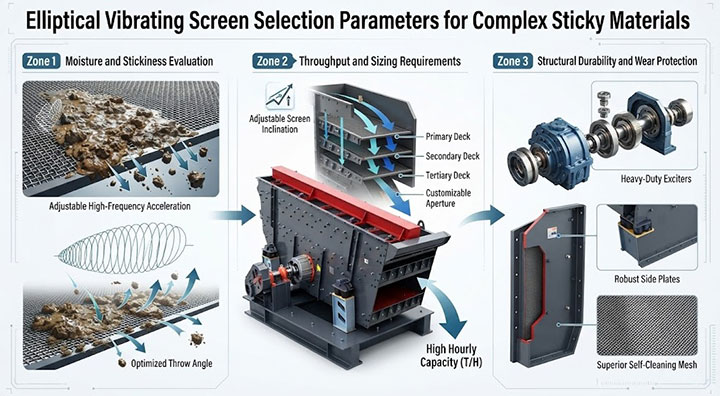
As a general guideline, a circular vibrating screen may be sufficient for dry, free-flowing materials and conventional sizing applications. An elliptical vibrating screen may be worth considering when material movement, stratification, or difficult screening conditions require a different motion pattern.
For materials that are particularly wet or sticky, the final selection should be based on the complete screening process rather than moisture content alone. Material samples, capacity requirements, particle size distribution, target separation, and screen media should be evaluated before confirming the machine configuration.
A circular vibrating screen moves along a circular path, while an elliptical vibrating screen produces an oval motion. The different trajectories affect how material moves, spreads, and stratifies on the screen.
It may be suitable for some wet or sticky materials because elliptical motion can improve material distribution and stratification. However, moisture, viscosity, feed rate, screen opening, and screen media also affect screening performance.
A circular vibrating screen may be sufficient for dry, free-flowing materials and conventional sizing applications. If these conditions meet the required capacity and separation, an elliptical configuration may not be necessary.
The right vibrating screen depends on your material characteristics, required capacity, particle size, moisture content, and target separation. Send us your material and screening requirements, and our engineering team can help you evaluate whether an elliptical or circular vibrating screen is more suitable for your application.


Address:China,Yanjin county forest park gate to the west 1000 meters north road.


 Online Chat
 Email
Email