


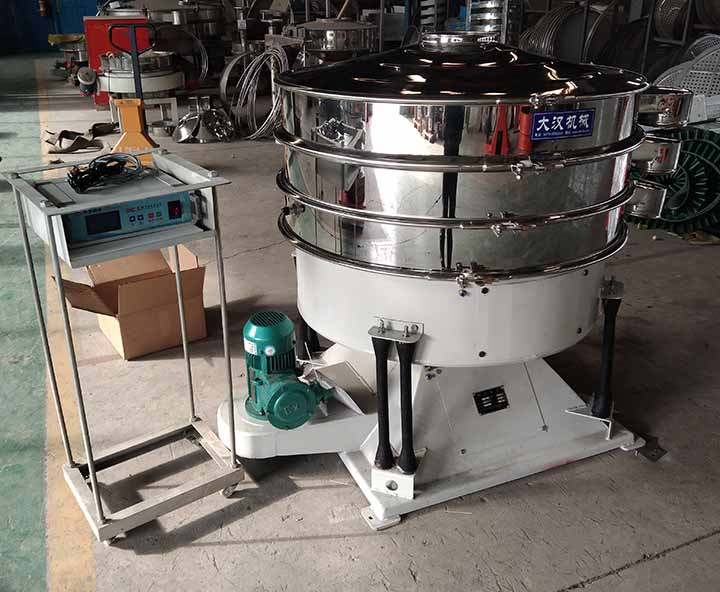
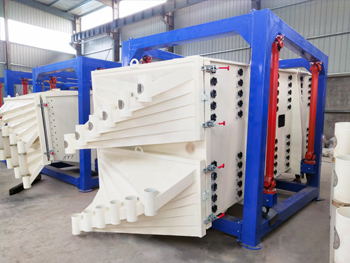
The Food Grade Sugar Tumbler Screening Machine is engineered for the particle grading of sugar powder and the separation of agglomerated sugar lumps. Materials such as icing sugar and glucose powder possess hygroscopic properties, making them prone to moisture absorption and caking when exposed to air, while friction between particles generates electrostatic accumulation. Intense frictional heat produced by traditional vibrating equipment causes localized melting of sugar powder, resulting in mesh blinding. This machine simulates the slow three-dimensional tumbling motion of manual screening, causing the sugar powder to move in a gradual outward spiral across the mesh surface, which diminishes frictional heat generation. The particle size classification range spans from 40 mesh to 300 mesh (corresponding to mesh apertures between 0.42 mm and 0.05 mm, or 420 to 50 microns). The single-layer hourly processing capacity of a single machine ranges from 500 kg to 3000 kg, determined by the specific model and mesh size. All components contacting the materials and the structural support frame are manufactured using 304 stainless steel or 316L stainless steel materials.
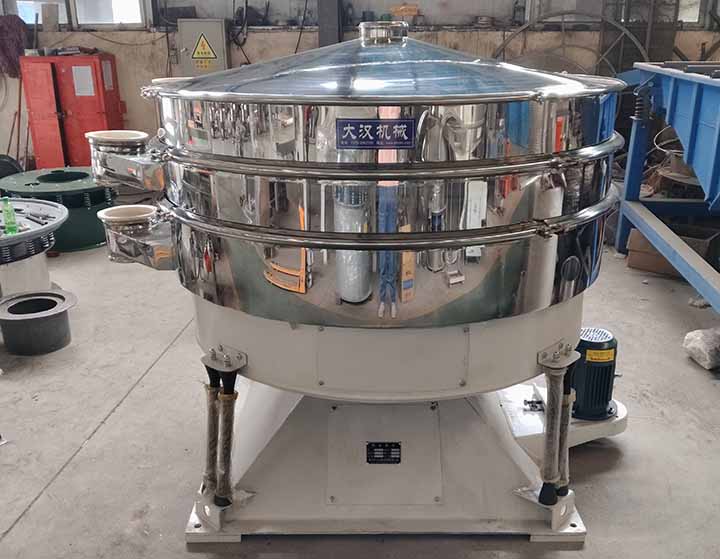
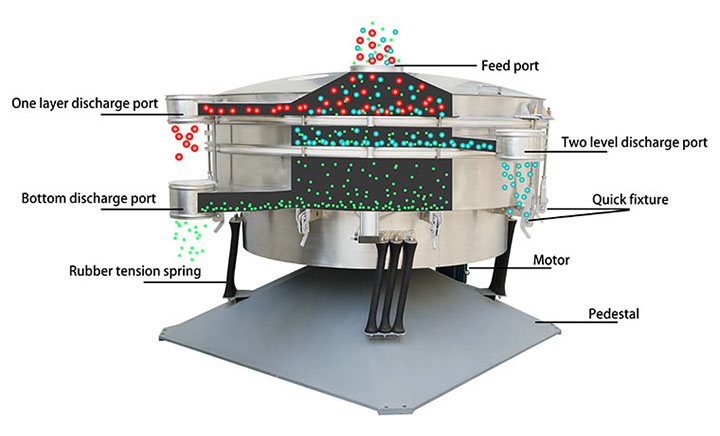
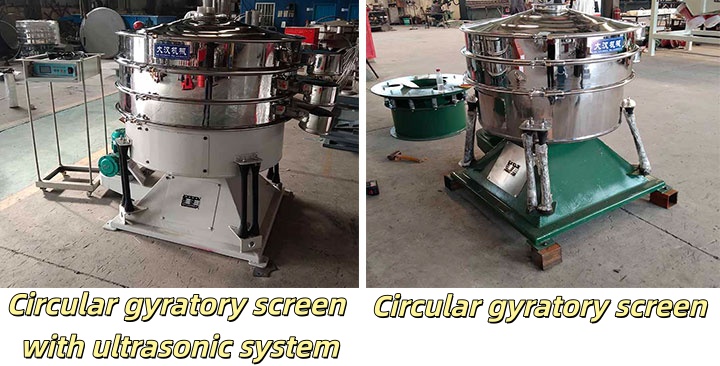
Dahan Machinery implements precise standards for stainless steel surface processing during the manufacturing of this equipment. Internal weld seams are ground and polished to achieve a surface roughness of Ra ≤ 0.4 μm, eliminating crevices and pits to prevent sugar powder stagnation and spoilage. White silicone sealing rings compliant with FDA criteria are utilized at the screen frame connections to maintain elasticity within a temperature range of -60°C to 200°C, preventing powder leakage. To address the tendency of sugar powder to blind the mesh, Dahan Machinery installs mechanical clearing devices, utilizing food-grade white bouncing balls positioned beneath the screen mesh to continuously strike the support grid during operation and dislodge fine sugar powder wedged in the apertures. Alternatively, an ultrasonic clearing module can be integrated, which converts electrical energy via a transducer into high-frequency vibrational waves transmitted directly to the mesh surface, breaking the adhesion of the sugar powder. The drive segment is equipped with a dust explosion-proof motor to isolate external dust from entering the motor interior and generating sparks.
| Model | Screen Diameter (mm) | Screen Layers (Layer) | Motor Power (kW) | Tumbling Frequency (r/min) | Material Requirements |
| DH-1000 | 1000 | 1 - 5 | 0.25 | 120 - 360 Adjustable | 304/316L Stainless Steel |
| DH-1200 | 1200 | 1 - 5 | 0.55 | 120 - 360 Adjustable | 304/316L Stainless Steel |
| DH-1600 | 1600 | 1 - 5 | 1.5 | 120 - 360 Adjustable | 304/316L Stainless Steel |
| DH-2000 | 2000 | 1 - 5 | 5.5 | 120 - 360 Adjustable | 304/316L Stainless Steel |
Within the icing sugar processing line of a bakery ingredient supply factory, Dahan Machinery configured a DH-1200 model featuring three layers and a dual processing path. After being pulverized by a grinder, the crystalline granulated sugar is directly conveyed through a sealed pipeline into the top inlet of the screening machine. The first layer of 60-mesh screen separates coarse particles and incomplete pulverized sugar lumps, with the coarse material returning to the grinder via the upper discharge port. The second layer of 120-mesh screen extracts the icing sugar conforming to finished product standards, discharging it directly into the hopper of an automatic weighing packaging machine below. The ultrafine powder from the bottom layer is discharged and collected separately via the lower product outlet. The system operated continuously for 8 hours without localized heating or melting of the sugar powder on the mesh surface, and the total suspended particulate concentration in the workshop was restricted below 10 mg/m³.
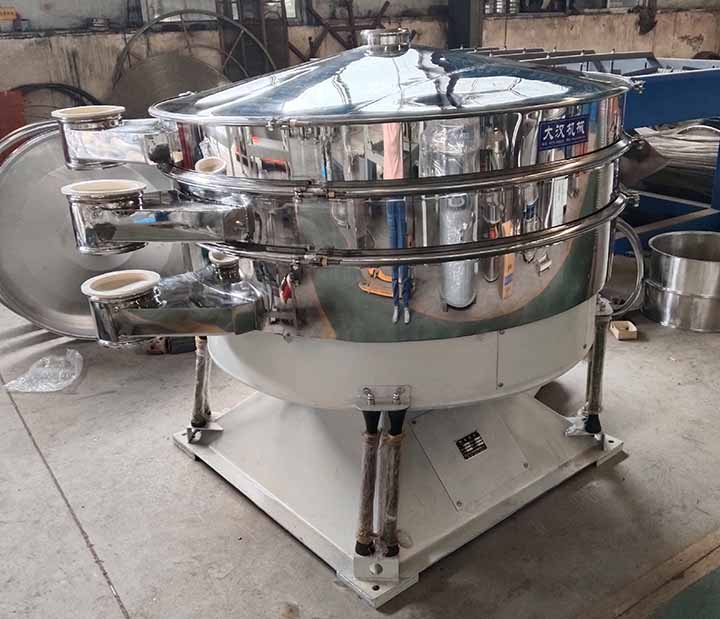
The price of this equipment is influenced by three factors: material selection, customized layer count, and the configuration of the mesh-clearing assemblies. Due to the addition of molybdenum, 316L stainless steel exhibits stronger resistance to chloride ion corrosion than 304 stainless steel, making its base material cost approximately 30% higher. Single-layer screen frames and multi-layer configurations (such as four or five-layer classification) differ in processing hours and material consumption. The choice of mesh-clearing device also affects the price: the basic configuration using bouncing balls requires lower manufacturing costs, whereas systems equipped with ultrasonic transducers and high-frequency power control boxes increase the overall ex-factory price of the equipment components. Dahan Machinery provides tailored quotations based on the throughput of the production line, material corrosiveness grade, and layer requirements, supporting itemized budget lists upon provision of specific process drawings.

During daily operations, technical personnel must check whether the locking bolts of the quick-release clamps on each layer are loose and ensure the flexible connection bags at the inlet and outlets are securely bound before starting the machine. Upon startup, the machine should run empty for 3 to 5 minutes to confirm the absence of abnormal noise and violent reverse oscillation before continuous feeding begins. Material feeding must be uniform to prevent sudden high impact loads from damaging the screen tension. For maintenance and cleaning, due to the solubility of sugar powder, the quick-opening clamps must be opened and the screen frames disassembled at the end of each shift. Use warm water at 60°C to flush the stainless steel mesh surface and silicone seals; scraping the mesh with rigid metal brushes is strictly prohibited. After cleaning, use clean compressed air to dry residual moisture to prevent the mesh from rusting or remaining sugar powder from dampening and molding after reassembly. Every 1500 operating hours, a composite lithium-based grease must be injected into the main shaft bearings.
Q: How should dust dispersion during the sugar powder screening process be resolved?
A: Inspection should be carried out to verify whether the white silicone sealing strips between the screen frames have failed due to compression deformation, or if the flexible connections are damaged. Additionally, a micro-negative pressure air induction dust removal pipe can be installed at the discharge port to balance the pressure differential between the interior and exterior of the machine.
Q: What should be done if the bouncing ball cleaning effect deteriorates when the screen mesh size exceeds 200 mesh?
A: The electrostatic adsorption force of ultrafine particles can exceed the mechanical impact force of the bouncing balls. In this scenario, the original bouncing ball support grid within the frame structure can be converted into an ultrasonic resonant ring, utilizing micron-level high-frequency vibrations to prevent fine powder from bridging at the edges of the mesh apertures.
Q: What causes abnormal shaking of the base during machine operation?
A: The machine must be stopped to inspect whether the rubber spring assemblies of the main shaft or the balance counterweights of the eccentric block have shifted. Severe wear of the eccentric bearing or loose foundation bolts will alter the trajectory of the three-dimensional tumbling motion, thereby triggering abnormal shaking.
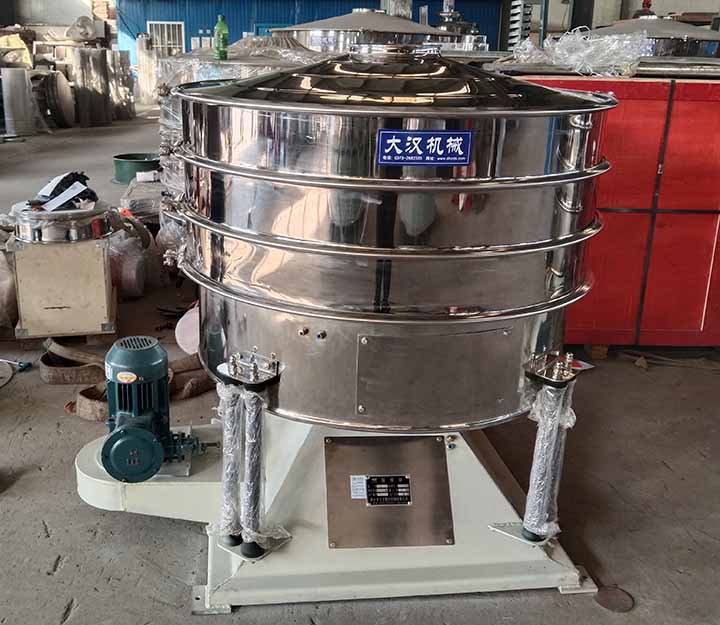
The Food Grade Sugar Tumbler Screening Machine addresses the physical characteristics of sugar powder, such as moisture absorption, flammability, and thermal melting, through its gentle, low-speed tumbling trajectory. Dahan Machinery's design details regarding internal wall smoothness, material compliance, and multi-schematic mesh clearing mechanisms fulfill the quality requirements of the powder classification process. By implementing standardized operational procedures along with regular cleaning and maintenance, this machine configuration cooperates with enterprises to complete enclosed production line operations ranging from crushing and grading to packaging.


Address:China,Yanjin county forest park gate to the west 1000 meters north road.


 Online Chat
 Email
Email