


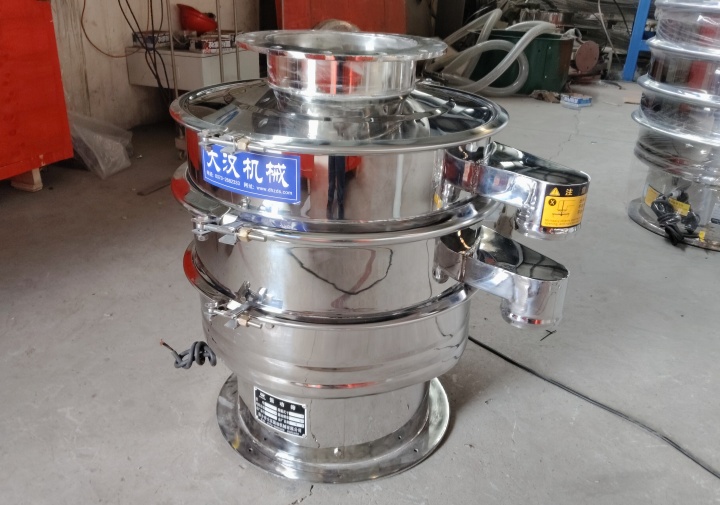
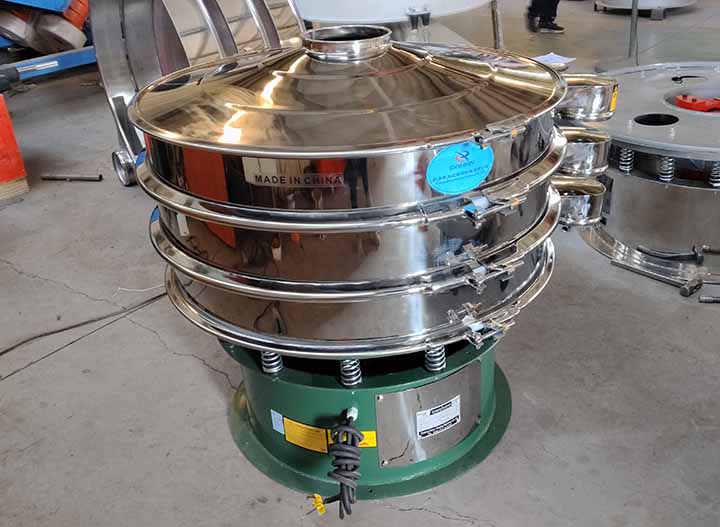
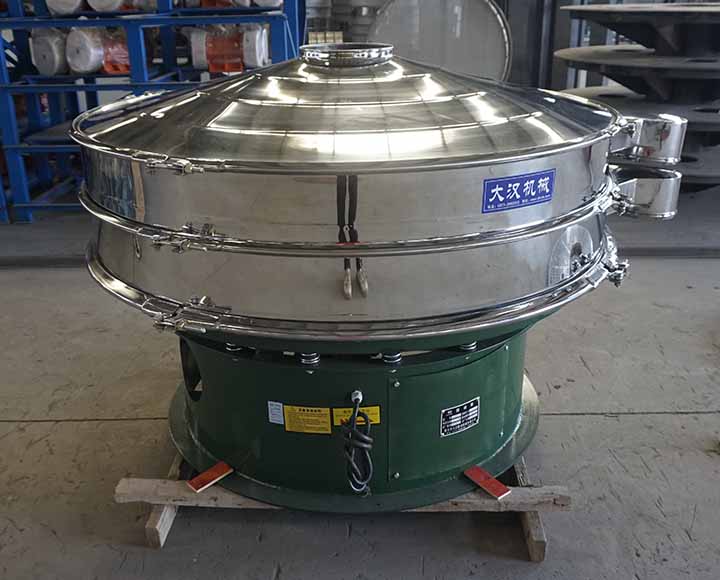
An industrial stainless steel circular vibrating separator is a vertical material grading and filtration device driven by eccentric weights that generate a three-dimensional vibrational motion path. The equipment structure consists of an inlet, dust cover, clamp ring, mesh frame, spring support assembly, and base, with all parts contacting the material fabricated from stainless steel plates.
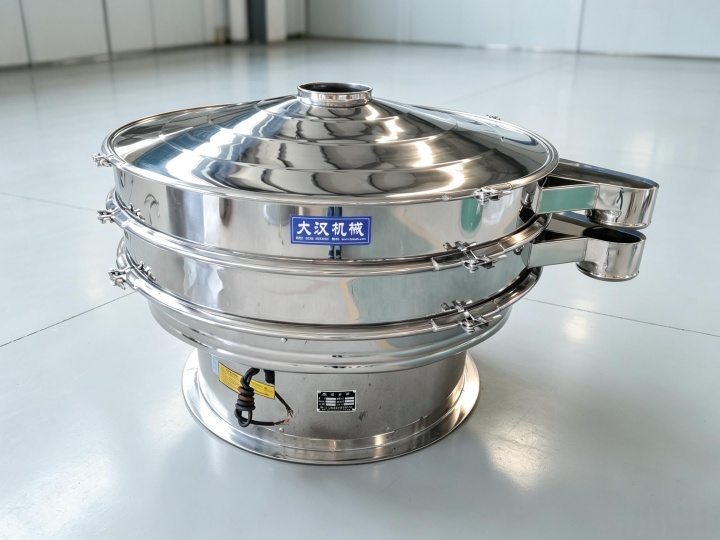
This machinery performs particle grading, impurity filtration, and solid-liquid separation within production lines. By adjusting the phase angle of the upper and lower eccentric weights on the motor shaft, materials exhibit a spiral motion path on the screen surface from the center toward the outer edge. This extends material retention time on the mesh surface, increasing the probability of passing through the screen.
In screening equipment manufacturing, stainless steel grade selection directly determines equipment corrosion resistance service life and material contamination risk. Processing plants typically specify steel grades based on the acidity/alkalinity (pH value) of the processed materials and chloride ion concentration.
304 Stainless Steel: Contains 18% chromium and 8% nickel. It exhibits stable performance in dry powder processing and room-temperature non-corrosive particle grading. When material pH values remain between 6 and 8, and without hydrochloric acid or high-concentration chlorides, 304 material provides reasonable oxidation resistance.
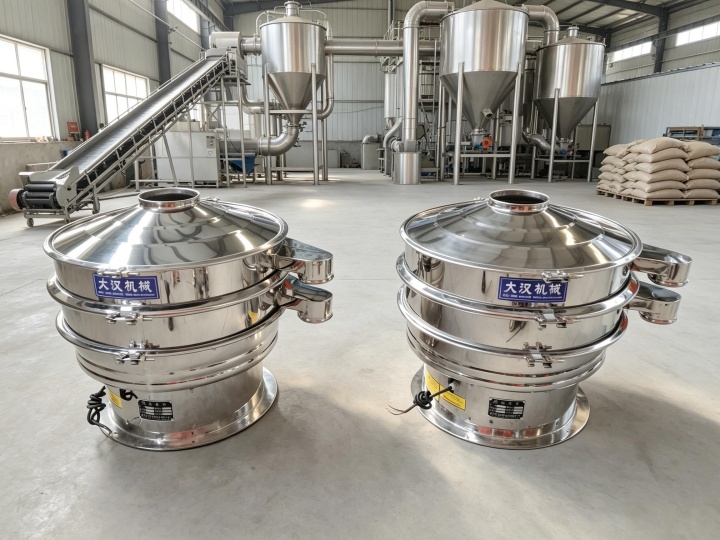
316L Stainless Steel: Adds 2-3% molybdenum (Mo) based on 304, while reducing carbon content. The addition of molybdenum enhances the material's resistance to pitting corrosion and crevice corrosion. When processing strong acid, strong alkali slurries, or high-salt dry powders, 316L prevents metal ions from precipitating into the material.
Beyond base metal grades, the surface finish inside the screen body also impacts material residue and bacterial growth:
Mechanical Polishing and Mirror Polishing: Processing the receiving hopper and screen frame to a mirror polishing standard of Ra < 0.4 μm eliminates microscopic voids, preventing powder accumulation or material adhesion.
Compliance Requirements: Weld seams must undergo continuous TIG welding and grinding to achieve a flat, dead-zone-free finish. Sealing rings and bounce balls are made from non-toxic silicone or fluoroelastomers compliant with FDA or GMP benchmarks to prevent plasticizer migration during operation.
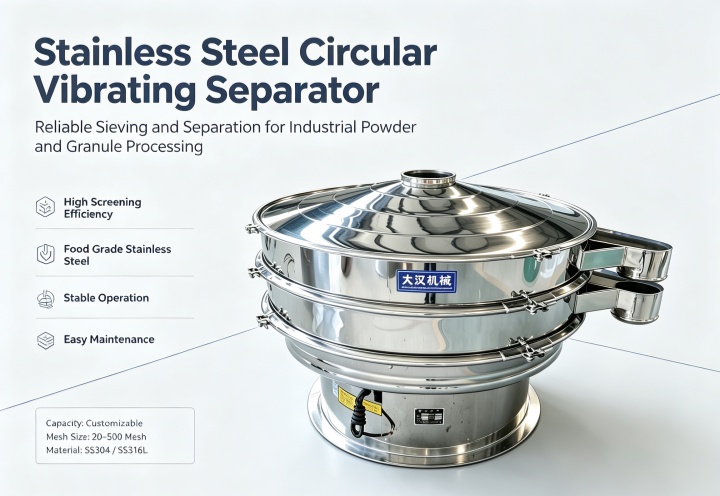
When formulating process selection plans, engineers need to distinguish the mechanical structure and action trajectory differences between a Vibrating screen separator (circular vibrating separator) and a Linear vibrating screen.
| Comparison Dimension | Circular Vibrating Separator | Linear Vibrating Screen |
|---|---|---|
| Motion Trajectory | Three-dimensional motion (horizontal, vertical, inclined) | Linear reciprocating motion (inclined throwing) |
| Screening Decks | 1 to 5 mesh decks can be stacked for multi-stage grading | Typically 1 to 3 decks |
| Suitable Material Types | Fine powders, viscous slurries, high-precision particle size control materials | Large dry particles, ores, large-capacity rough screening |
| Footprint | Small footprint, vertically extended structure | Longer footprint, horizontally extended structure |
| Dust Sealing | Fully enclosed structure with clamp ring tightening, no dust flight | Rectangular cover, long edge prone to minor leakage |
For fine powders or liquid slurry filtration between 20 μm and 5 mm, the circular structure provides a relatively long screening path. Conversely, linear screens suit processing large-tonnage, high-bulk-density coarse broken materials.
When using Industrial screeners and Industrial vibrating sieves to process fine powders or moisture-containing materials, mesh blinding reduces throughput. To address different material characteristics, industry applications utilize the following clearing technologies:
Silicone bounce balls with a diameter of 20–30 mm are placed inside the support tray under the mesh frame. After startup, the bouncing balls strike the bottom of the screen mesh, relying on impact force to dislodge near-size particles trapped in the mesh openings.
High-frequency electrical energy at 35 kHz converts into mechanical vibrations transmitted to the mesh frame, maintaining micron-level high-frequency vibrations on the mesh surface. This breaks electrostatic attraction and surface tension between fine powders, enabling powders above 38 μm (400 mesh) to pass through smoothly.
For wet materials containing fat or high viscosity, Teflon scraper blades on the mesh surface perform mechanical sweeping, flattening agglomerates and guiding materials through the screen holes.
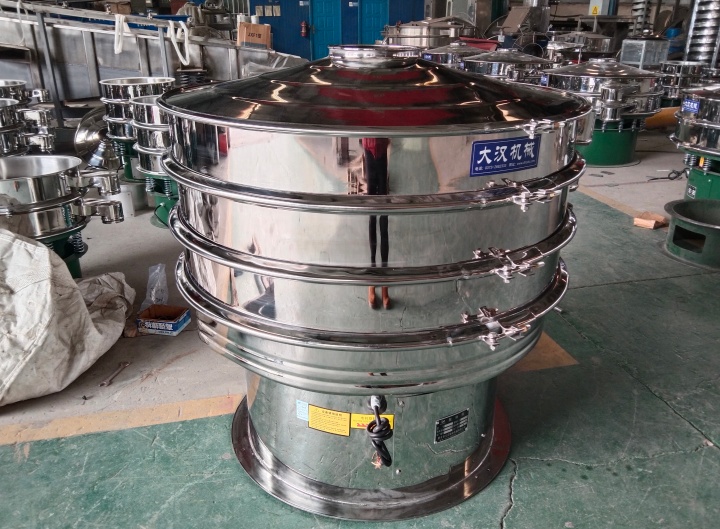
When evaluating a qualified Vibrating Screen manufacturer, it is necessary to inspect their production manufacturing details and quality control processes:
1. Plate Thickness Measurement and Spectral Analysis: Use a spectrometer to test chromium, nickel, and molybdenum content in stainless steel plates, and use a thickness gauge to verify equipment wall thickness meets design tolerances rather than substituting thin plates.
2. Weld Quality and Non-Destructive Testing: Inspect whether contact material welds adopt full welding and grinding, checking for gas pores, slag inclusion, or incomplete penetration on the surface.
3. Dynamic Balance and Amplitude Testing: Perform a 48-hour no-load test run before factory shipment. Use an infrared thermometer to monitor motor bearing temperature rise (typically not exceeding 70°C), and use an amplitude gauge to record amplitude uniformity across the four support springs.
4. Noise Reduction and Sealing Performance: Measure whether operational noise stays below 75 decibels (dB), and test clamp ring sealing strips under negative or positive pressure states for dust leakage.
Yes. Circular vibrating separators are routinely used for solid-liquid separation and slurry filtration. The equipment receiving tray includes a splash-proof discharge port, paired with silicone sealing rings to prevent liquid overflow. When filtering slurries, adjusting upper and lower motor weight angles to 15–30 degrees accelerates liquid penetration speed and ejects wet residue outward.
Mesh replacement cycles depend on material abrasiveness, mesh count, and daily operating hours. When processing highly abrasive materials like quartz sand, fine mesh (e.g., above 200 mesh) may suffer damage within 200 to 500 hours; when processing general polymer particles, lifespan can reach over 1,000 hours. Plants should conduct daily periodic checks on undersize particle distribution to judge if screen mesh damage has occurred.
Selecting mesh opening size requires reference to target particle size distribution (D50 and D90 data). Typically, the chosen mesh aperture size is slightly larger than the target particle's maximum limit size (for example, for a target particle of 75 μm, a 200 mesh screen with 74 μm aperture can be selected). For micro-powders prone to static electricity or agglomeration, add a margin of 1 to 2 mesh size grades and equip an ultrasonic system.


Address:China,Yanjin county forest park gate to the west 1000 meters north road.


 Online Chat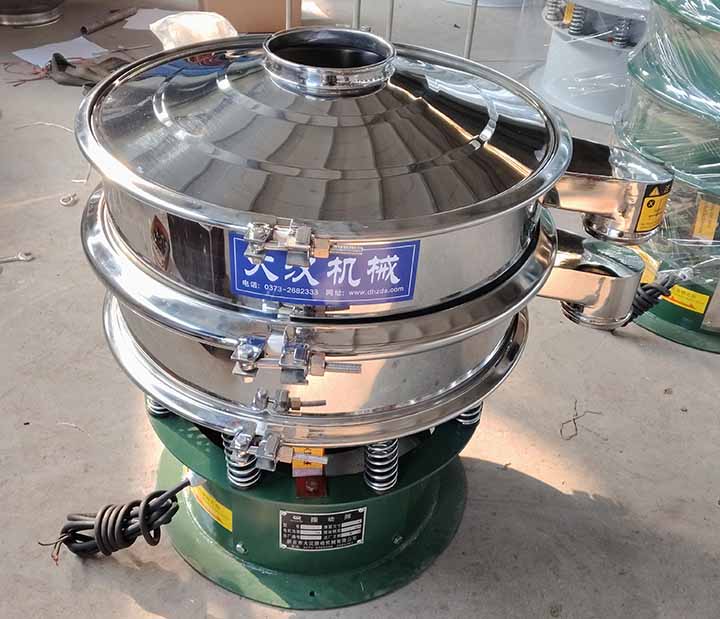
 Email
Email