


A high-frequency vibrating screen is an advanced industrial fine-screening machine that operates at an exceptionally high frequency (typically 50Hz, reaching 3000 RPM or more) combined with an ultra-low amplitude(≤2mm). Its core value lies in its ability to rapidly disrupt the surface tension of liquid-solid mixtures and fine powders, mitigating mesh blinding (clogging) and boosting throughput and precision for micro-fine materials where traditional screens struggle.
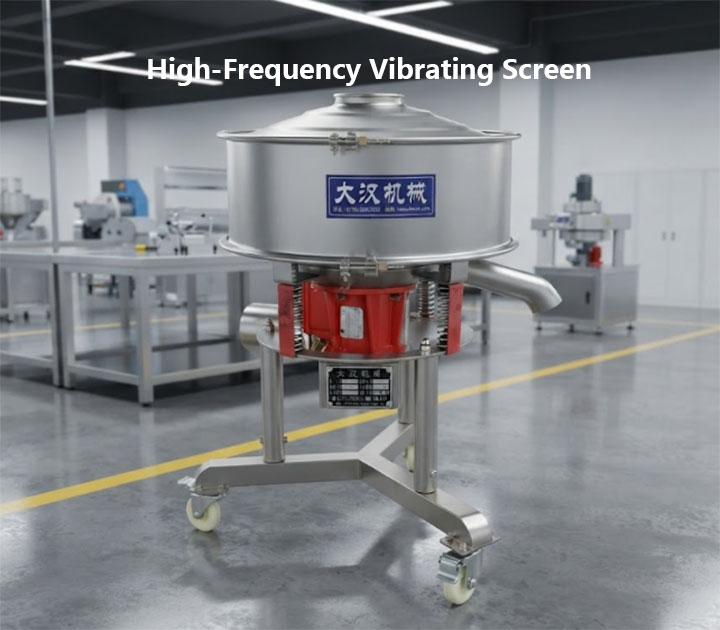
Unlike traditional screening equipment that relies on heavy structural momentum and low-speed, large-amplitude throwing action, the high-frequency vibrating screen is engineered around a distinct set of mechanical principles designed specifically to handle challenging fine particles.
Engineered specifically for high-speed micro-screening, the system relies on standard 2-pole high-frequency vibration motors operating at 3000 rpm/min. This configuration delivers rapid 50Hz micro-pulses with an ultra-low amplitude (≤2mm), concentrating intensive energy directly at the screen deck rather than moving heavy frames.
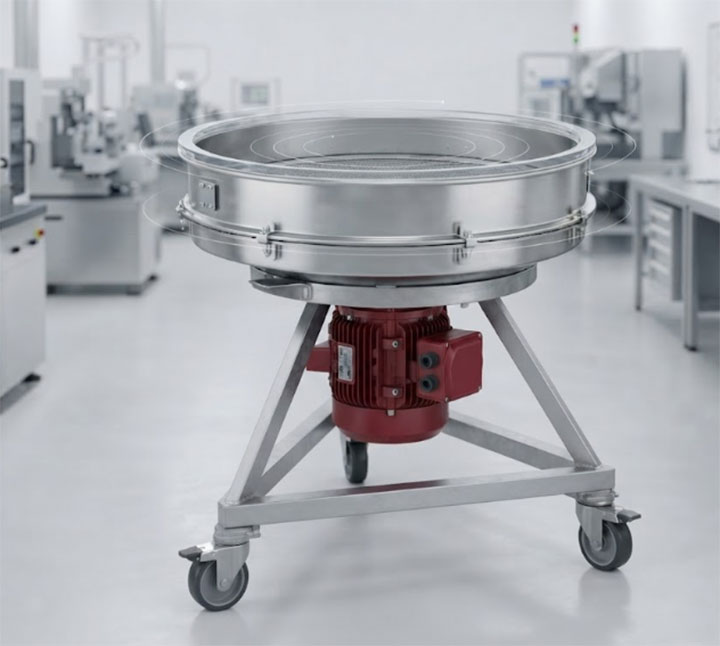
Tailored specifically to tackle capillary forces, the intense oscillations instantly break the surface tension holding micro-powders and slurries together. This allows individual particles to overcome agglomeration and pass through the mesh.
Built mitigate to eliminate mesh blinding, the rapid micro-vibrations prevent near-size particles from wedging into the weave. This minimizes operational downtime caused by clogged apertures and manual cleaning.
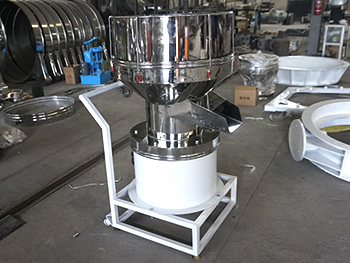
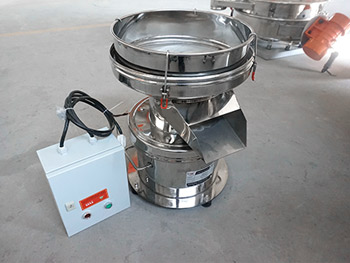
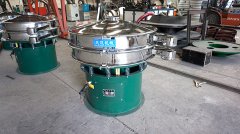
Optimized specifically for flexible plant floors, the dish-shaped structure prevents material splashing while offering clear visibility. Combined with a movable caster frame, it provides effortless height adjustment and workspace relocation.
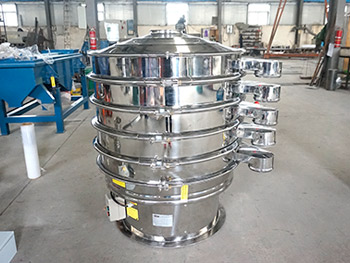
Although both high-frequency screens and standard rotary vibrating screens share a circular footprint, high-frequency and standard rotary vibrating screens serve distinct industrial roles. High-frequency units use ultra-low amplitudes to conquer challenging fine powders and moisture, whereas standard rotary screens rely on versatile 3-D motions for general multi-deck grading.
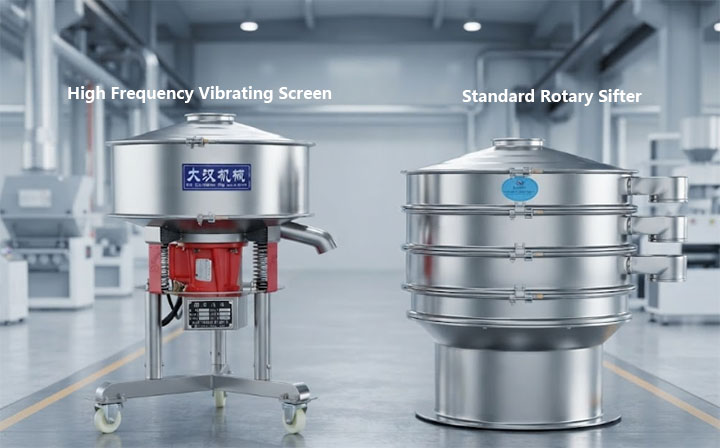
Driven by contrasting kinetic strategies, high-frequency units concentrate swift 50Hz micro-oscillations straight onto the screening surface to disrupt surface tension. Conversely, conventional rotary vibrating units deploy lower-frequency eccentric weights to produce a wider multi-axis projection movement tailored for standard material flow.
Designed specifically for challenging substances, high-frequency screens stop near-size particles from lodging inside the openings to reduce clogging. On the other hand, standard rotary units depend on optional mechanical clearance accessories (such as rubber bouncing balls or ultrasonic systems) to support net cleaning throughout routine dry sorting.
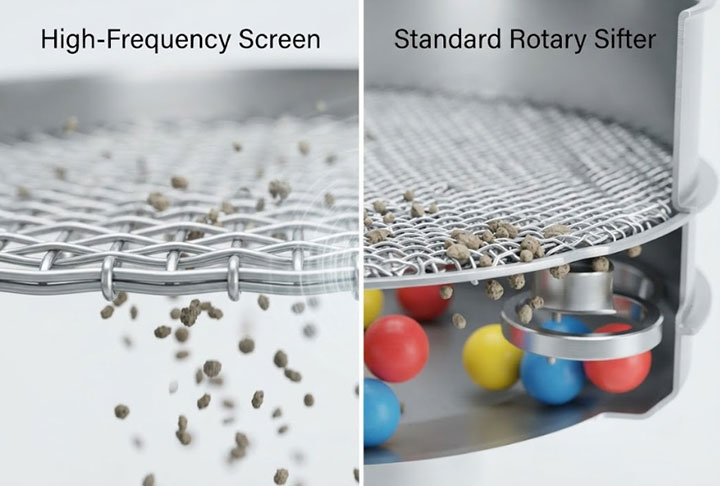
Engineered for specialized output, high-frequency screens stand out in micron-level sizing, viscous substance handling, and slurry drainage within space-saving layouts. Alternatively, traditional rotary equipment acts as a flexible workhorse built for high-throughput, multi-layer particle division across routine dry chemical and food manufacturing lines.
| Comparison Criteria | High-Frequency Vibrating Screen | Standard Rotary Vibrating Screen |
|---|---|---|
| Vibration Dynamics | High frequency, ultra-low amplitude (≤ 2mm) | Medium frequency, adjustable larger amplitude |
| Primary Engineering Focus | Breaking surface tension & mitigating blinding | Multi-deck grading & versatile dry processing |
| Best Suited Materials | Micro-fine powders, semi-moist materials, slurries | Free-flowing dry powders, standard granules, liquids |
| Structural Highlight | Dish-shaped, splash-proof, mobile caster frame | Fully enclosed, multi-layer stackable frame structure |
High-frequency vibrating screens are engineered to solve the most demanding industrial sorting challenges that standard equipment cannot handle. By utilizing rapid micro-pulses and specialized design configurations, these units deliver performance in micro-fine grading, moisture-resistant screening, slurry dewatering, and final-stage impurity removal.
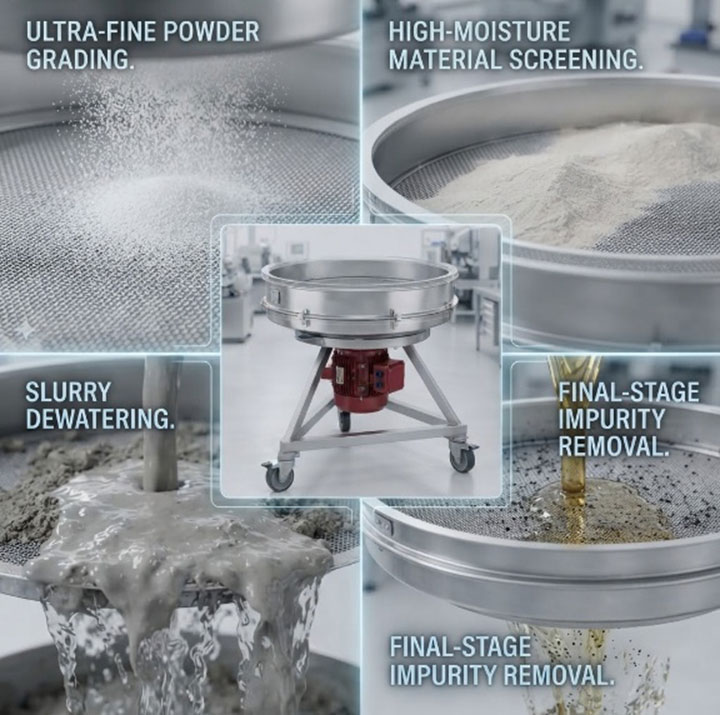
Selecting the ideal screening equipment requires a careful evaluation of material behavior, moisture levels, and production targets. When plant engineers encounter persistent operational challenges, choosing the right technology dictates overall line efficiency and product yield.
When dealing with semi-moist, damp, or naturally sticky powders prone to packing, a high-frequency vibrating screen becomes the essential option. Its swift micro-vibrations instantly shatter internal capillary bonds, whereas conventional rotary units rapidly drop in efficiency caused by severe moisture-driven agglomeration.
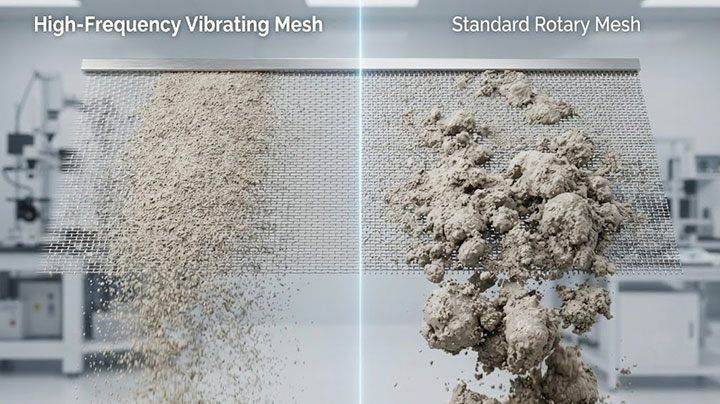
If the core goal involves attaining ultra-accurate cut points at micron scales for fine powders or slurries, high-frequency technology provides unmatched precision. In contrast, manufacturing lines demanding simultaneous multi-layer particle division of free-flowing dry substances find better utility in standard rotary screens.
For liquid-solid separation, tailing recovery, or high-viscosity slurry filtration, high-frequency systems stand out by quickly dismantling surface tension to speed up drainage. Standard rotary machinery manages basic liquid straining, yet misses the high-velocity kinetic energy demanded for heavy-duty slurry dewatering.
To help plant managers and engineers make informed purchasing and operational decisions, here are answers to the most common questions regarding high-frequency vibrating screens.
Routine maintenance is straightforward and focuses primarily on inspecting the high-frequency vibration motors and checking mesh tension. Because the system features fewer heavy structural wear points, upkeep is generally simpler than large linear screens.
While standard rotary screens usually struggle below 100 mesh to 200 mesh due to blinding, high-frequency units excel at ultra-fine classifications ranging from 300 mesh down to micron levels.
They are specifically engineered for high-efficiency, targeted separation rather than massive bulk volume. For best results, they are often integrated as high-precision finishing units downstream of primary coarse scalping screens.
High-frequency vibrating screens deliver unmatched precision in breaking surface tension, handling moisture-heavy powders, and achieving micro-fine grading where standard equipment falls short. Whether you are looking to upgrade your processing lines, resolve mesh blinding issues, or test challenging material samples, our engineering team is ready to assist you. Contact us to discuss your technical specifications and request a customized solution tailored to your plant.


Address:China,Yanjin county forest park gate to the west 1000 meters north road.


 Online Chat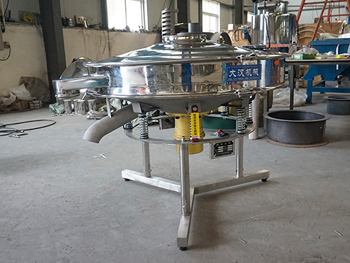
 Email
Email