


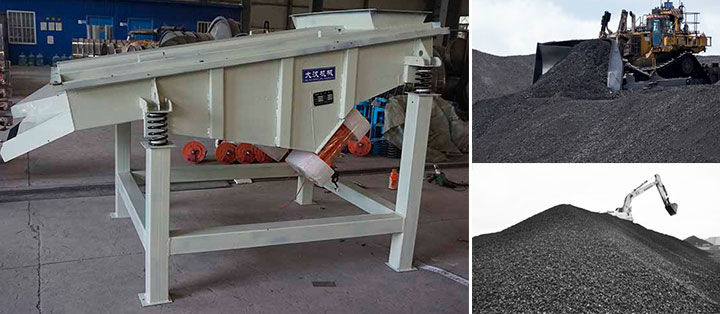
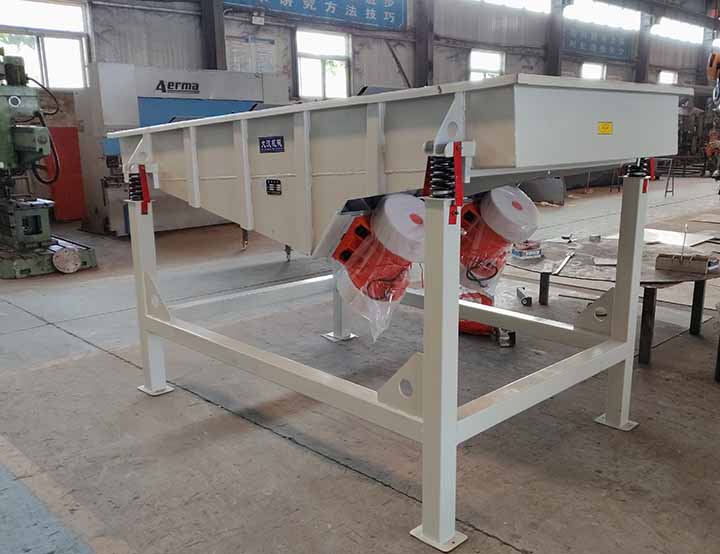
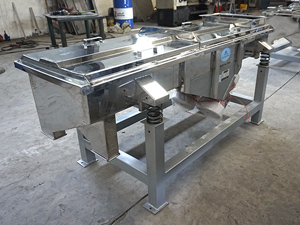
Linear Vibrating Screen for Coal Processing can grade and separate raw coal, screening out coal of different particle sizes according to requirements for subsequent washing or transportation. The machine uses two vibrating motors running in opposite directions to generate a linear vibration force, causing the material to jump forward on the screen surface, with small particles passing through the screen and large particles being discharged forward.
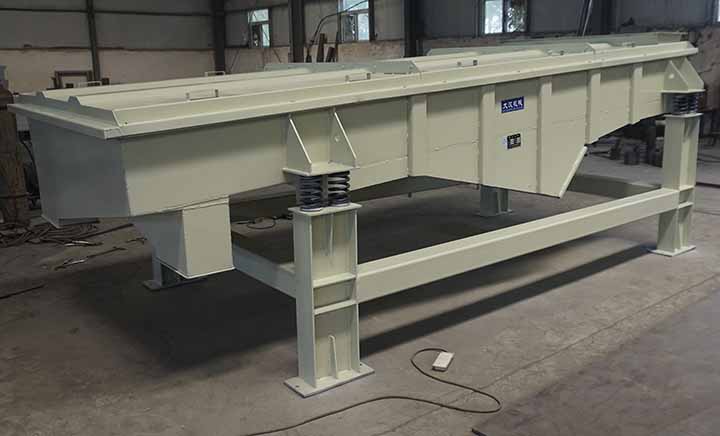
The machine's processing capacity varies from 1 to 10 tons of raw coal per hour, depending on the screen size and number of layers. Common materials include carbon steel structures with wear-resistant screen plates; stainless steel or polyurethane screens can also be selected depending on the operating conditions to handle coal with high moisture content or high abrasion.
In actual production, coal screening is not an optional step. Unscreened raw coal contains a mixture of particle sizes, with large pieces and pulverized coal mixed together, which can affect combustion and washing efficiency. Common on-site problems include uneven particle size distribution, with some particles being too large to enter subsequent equipment, and excessive powder causing blockages. Another issue is high moisture content, which causes coal to clump together and adhere to the screen, making it difficult to pass through. The Linear Vibrating Screen for Coal Processing uses continuous vibration to constantly agitate the material, giving smaller particles more opportunities to contact the screen openings and thus separate them. For coal with high moisture content, the amplitude and screen angle can be adjusted to create a loose state on the screen surface, reducing adhesion.
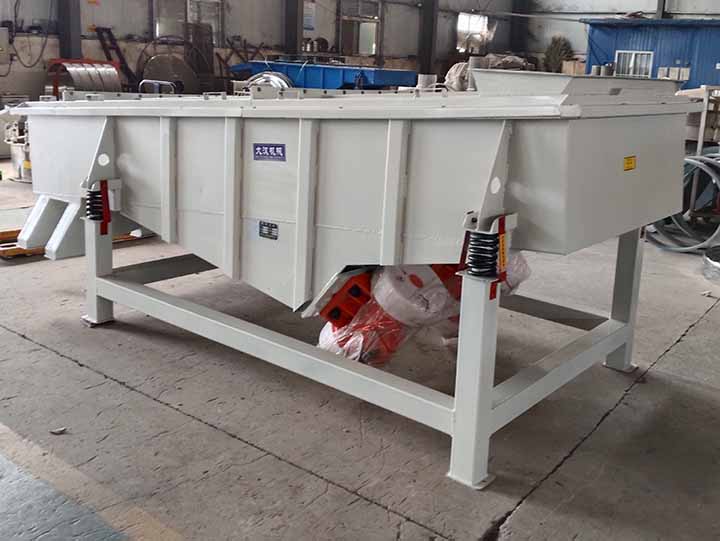
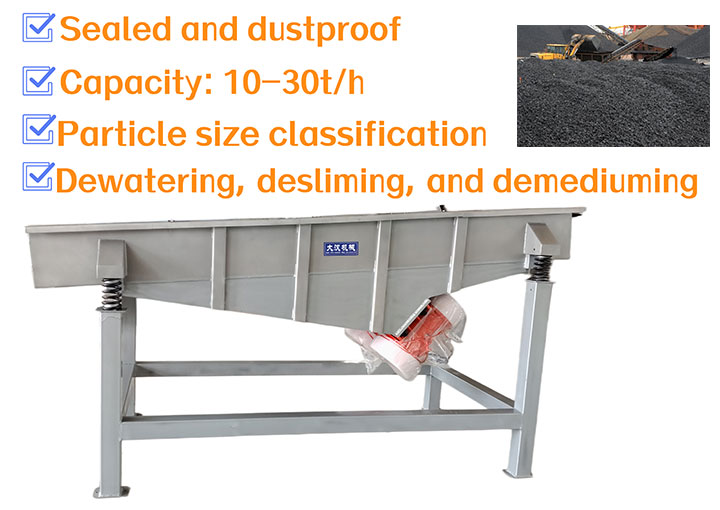
From a structural perspective, the Linear Vibrating Screen for Coal Processing is characterized by several details. The screen surface maintains a stable trajectory during vibration, ensuring uniform material distribution and reducing screening errors caused by localized accumulation. The 1-6 layer screen design allows for multi-stage grading in a single run, suitable for scenarios with specific particle size requirements. In terms of throughput, by lengthening the screen surface or increasing its width, continuous feeding can be supported without frequent shutdowns. Daily maintenance is also relatively simple; the external vibrating motor facilitates easy replacement when wear occurs. To address the issue of high dust levels at coal mine sites, the equipment can be equipped with a closed hood and a dust collection system connected to the discharge port to reduce dust spillage.
| Model | Layer |
Screening Area (mm) |
Mesh Size (mesh) |
Particle Size (mm) |
Capacity (t/h) |
Power (kw) |
Vibration Direction Angle (°) |
Screen Inclination (°) |
Dual Amplitude |
| DZSF-520 | 1-6 layers | 500*2000 | 2-400 | 0.074-10 | ≤3 | 0.37×2 | 45-60 | 0-7 | 3-4.5 |
| DZSF-525 | 500*2500 | ≤5 | 0.37×2 | ||||||
| DZSF-612 | 600*1200 | ≤8 | 0.37×2 | ||||||
| DZSF-1020 | 1000*2000 | ≤12 | 0.75×2 | ||||||
| DZSF-1025 | 1000*2500 | ≤16 | 0.75×2 | ||||||
| DZSF-1030 | 1000*3000 | ≤20 | 1.1×2 | ||||||
| DZSF-1224 | 1200*2400 | ≤23 | 1.5×2 | ||||||
| DZSF-1525 | 1500*2500 | ≤28 | 1.5×2 | ||||||
| DZSF-1530 | 1500*3000 | ≤32 | 2.2×2 |
In the coal industry, Linear Vibrating Screen for Coal Processing can be used in multiple stages. After raw coal enters the crushing system, it often needs to be classified by particle size. At this stage, the linear vibrating screen can separate materials of the appropriate particle size, reducing the burden on subsequent equipment. In coal washing plants, screening equipment is used in conjunction with jigs and flotation systems to process coal of different particle sizes, helping to improve the quality of the washed coal. In the dewatering stage, the screen surface can be combined with high-frequency vibration to allow moisture to be discharged from the screen holes, resulting in a product with lower moisture content.
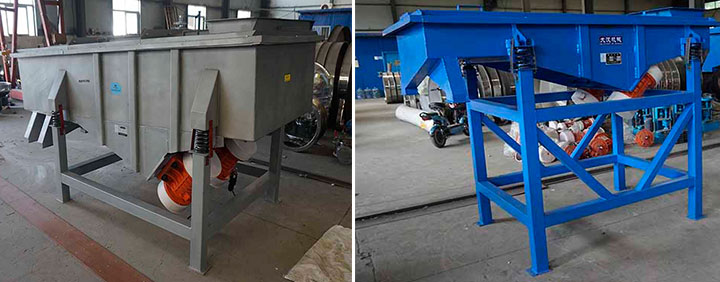
A coal mine encountered a screening bottleneck during its expansion process. The existing machines frequently experienced screen blockage when processing raw coal with high mud content, leading to frequent production line shutdowns. Later, a double-layer linear vibrating screen was installed, and the screen mesh was changed to polyurethane material. The angle of the vibrating motor was also adjusted to ensure a more uniform residence time of the material on the screen surface. After running for a period of time, the particle size of the undersize material became more stable, clogging decreased, and the continuous operating time of the entire production line improved.
Q:What is the capacity of a linear vibrating screen for coal processing?
A:Depending on the model and screen size, the processing capacity ranges from 1 to 32 tons per hour.
Q:Can a linear vibrating screen handle wet coal?
A:Yes. By adjusting the vibration amplitude and selecting polyurethane screen mesh, the machine can effectively process coal with high moisture content and reduce screen clogging.
Q:What screen materials are available for coal processing?
A:Common screen materials include carbon steel, stainless steel, and polyurethane. Polyurethane screens are especially suitable for abrasive and high-moisture coal.
Q:How many screening layers can be installed?
A:The linear vibrating screen supports 1 to 6 screening layers, allowing multiple particle size classifications in a single operation.
Q:Which industries use linear vibrating screens for coal processing?
A:These machines are widely used in coal mines, coal washing plants, coking plants, and thermal power plants.
The role of a linear vibrating screen in coal processing goes beyond simple grading; it directly affects the smoothness of subsequent processes. When selecting equipment, it's not enough to just look at the model; you also need to consider the particle size distribution, moisture content, and production requirements of the coal to determine the appropriate screen structure and material. If you are looking for a screening solution that can handle different coal qualities, you can learn about the equipment's operation and actual application scenarios.


Address:China,Yanjin county forest park gate to the west 1000 meters north road.


 Online Chat
 Email
Email