


Before finalizing the materials for a continuous bucket elevator, one must evaluate the material’s abrasiveness, temperature, moisture content, and friability to guide the selection of components. It is best to follow this sequence; selecting bucket materials before assessing the material’s characteristics often necessitates a subsequent revision of the equipment specifications.
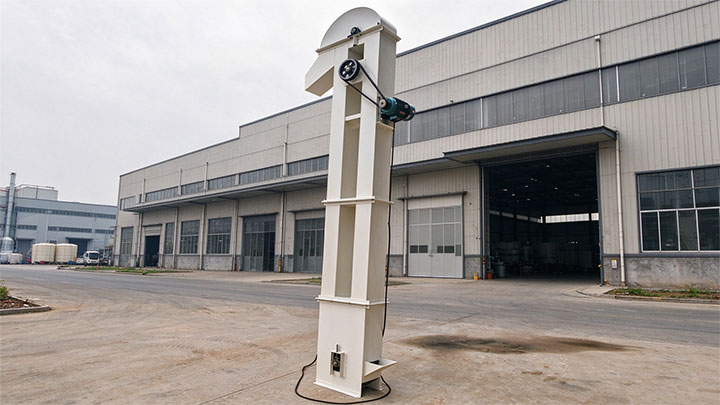
Abrasiveness: Fine, abrasive materials—such as sand—can infiltrate chain joints, causing internal wear. Consequently, in accordance with CEMA (Conveyor Equipment Manufacturers Association) guidelines, a belt-based system is generally better suited for such applications. Conversely, for coarse, abrasive, lump-form materials, a chain-based system is preferable, as chains can withstand impact better than belt splices.
Temperature: Belt-based designs are typically limited to operating environments below approximately 130°C, whereas chain-based systems can endure continuous temperatures of 250°C, with peak tolerances reaching as high as 350°C. When evaluating temperature, it is essential to consider the weakest component within the entire system rather than focusing solely on the chain itself; fasteners and bottom seals often reach their thermal limits well before the traction element (chain or belt) does.
Moisture and Stickiness: Moist or sticky materials can become compacted within deep buckets, making them difficult to discharge via gravity alone. In such cases, shallow buckets spaced closely together should be used, with surfaces designed to facilitate material discharge. Stainless steel should only be considered if the moisture is chemically corrosive; it is not required simply because the material is damp.
Friability: Friability locks the continuous configuration, and the configuration then limits the bucket material. A fragile, non-abrasive product may run in a moulded plastic bucket; the same product hot or abrasive needs fabricated steel with a reinforced lip.
| Variable | Constrains first | Selection shift |
|---|---|---|
| Abrasiveness | Traction element, bucket lip, liner | Fine abrasive → belt and lined casing; coarse abrasive → chain and wear-resistant bucket |
| Temperature | Belt/chain, bucket, seals | Above 130 °C → chain; above 70 °C → move off HDPE buckets |
| Moisture | Bucket depth and surface | Shallow close-pitched bucket; stainless only where moisture is corrosive |
| Friability | Configuration, then bucket | Continuous duty locked; bucket chosen by impact tolerance |
These variables interact. A hot fine abrasive accepts a chain but still punishes the bucket lip and boot liner. The sections below follow this order at component level.
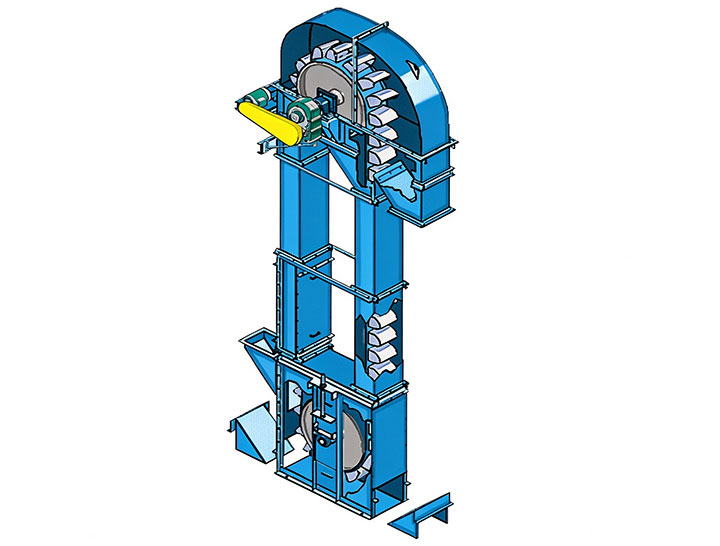
For continuous-duty applications, a chain is generally the preferred choice. Chains offer superior resistance to high temperatures, lumpy materials, and mechanical impact; they also ensure consistent bucket spacing during long-distance, low-speed operation. Conversely, a belt is a better option if the material consists of fine, abrasive dust—which could cause wear within the chain’s articulated joints—or if there are specific requirements for low noise levels and lower costs.
| Condition | Traction element |
|---|---|
| High temperature, heavy or lumpy feed | Chain |
| Fine abrasive dust, moderate temperature | Belt |
| Long centres, heavy bucket load | Chain |
| Wash-down or corrosive duty | Belt or stainless chain |
Chain and Belt Material Grades
Chains are typically manufactured from alloy steel, with their pins and bushings undergoing surface hardening. Stainless steel is primarily used for corrosion resistance rather than heat resistance. The selection of a conveyor belt involves both its carcass (core) and its cover rubber. If the carcass itself lacks sufficient rated heat resistance, the belt will fail to operate properly in high-temperature environments, even if a heat-resistant cover rubber is used.
Sprocket and Pulley Surface Materials
The tooth surfaces of sprockets are hardened. The choice of pulley lagging depends on the requirements for material grip and release. Diamond-patterned rubber is suitable for dry operating conditions, while oil-resistant rubber is used in environments where lubricants are present. Food-grade rubber or polyurethane is appropriate for production lines with strict hygienic requirements. Ceramic lagging is employed in scenarios where there is both a risk of slippage and exposure to wear.
Continuous elevators discharge by gravity across the back of the preceding bucket, so the bucket must be shallow, close-pitched and smooth inside. A deep bucket sized for centrifugal duty will compact sticky material and carry it back to the boot. Style comes first; material follows the wear and hygiene conditions.
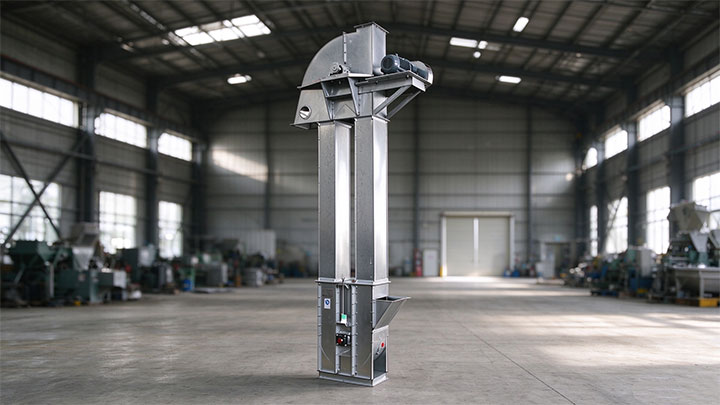
Bucket styles
Shallow close-pitched buckets suit free-flowing and slightly sticky products. V-bottom or bevelled-front buckets help wet, compacting material release cleanly. Fabricated steel buckets with a reinforced lip are used where the feed includes lumps or the bucket edge wears against residual material in the boot.
Bucket materials
Mild steel is the default for dry, non-corrosive, non-staining products. Stainless 304 or 316L is specified for food contact, wash-down and corrosive material; 316L only where chloride or cleaning chemicals are present. HDPE and food-grade plastics release sticky product better than steel and avoid metal contamination, but are limited on temperature and impact. Abrasion-resistant steel or a hardened lip is used where the product is coarse and abrasive, not where it is merely heavy.
| Material | Use when | Avoid when |
|---|---|---|
| Mild steel | Dry, non-staining, non-corrosive | Food contact, wash-down, corrosive product |
| 304 / 316L stainless | Hygiene, corrosion; 316L for chloride | Coarse abrasive where wear rate matters more than corrosion |
| HDPE / food-grade plastic | Sticky product, metal contamination risk | Hot product, heavy lumps, sharp edges |
| Abrasion-resistant steel | Coarse abrasive feed | Sticky product that needs a release-friendly surface |
Match the bucket to the discharge behaviour first, then to the wear and hygiene conditions. A correct material on the wrong bucket style still produces carry-back.
The casing is not one material decision. Wear concentrates in four places, and the straight runs see little.
Straight sections run mild steel, 3–6 mm, thickness there is set by stiffness, not abrasion. Boot and inlet take impact and sliding wear and should be thickened or lined first. The discharge throat is the highest sliding-wear point and should always carry a replaceable liner. The bucket-back drag zone is the one most often missed — residual material caught between bucket back and casing grinds slowly until the wall thins.
Stainless 304 or 316L is used where the casing interior stays wet between shifts. 316L only with chloride or cleaning chemicals. For liners, polyurethane suits fine abrasive and sticky material, rubber absorbs lump impact, ceramic gives the longest life under sliding abrasion, and abrasion-resistant plate is the fallback where a liner cannot be bolted.
Fit liners bolted, not welded — a welded liner turns a wear part into a casing repair.
Food-grade and corrosion-resistant are different requirements. Treating them as one usually leads to a specification that is either overpriced or under-protected.
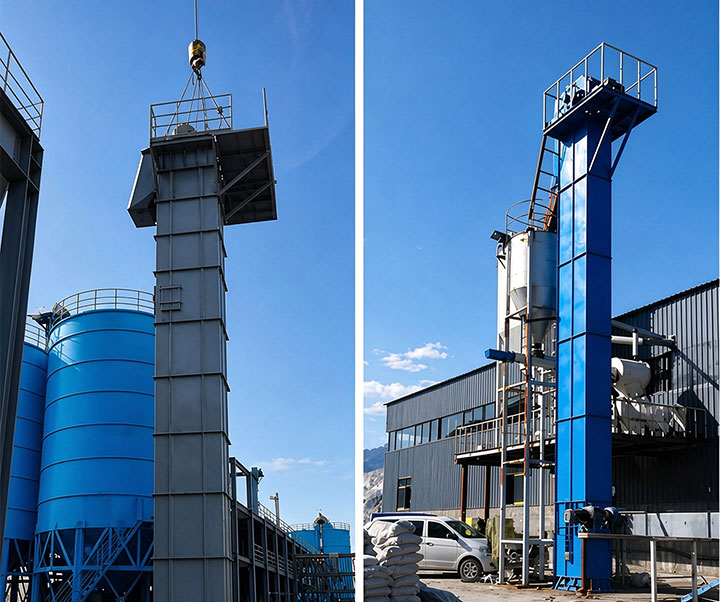
304 stainless covers food contact and routine wash-down. Where the product is neutral and cleaning is standard, 304 is the default. 316L is needed only where chloride is present. That means salt-bearing product, saline wash water, or cleaning chemicals that release chloride.
Non-metallic contact surfaces serve a different purpose. HDPE and other food-grade plastics help product release and keep metal away from the product. They are not a substitute for stainless in corrosive or hot duty.
Two details decide whether the grade performs. Welds in food contact zones must be ground flush with no crevices. A correct grade with an unground weld still traps product. Fasteners must also match the casing grade. Plated carbon fasteners on a stainless casing corrode at the fastener first.
Most material-related problems trace back to decisions made early. The bucket material gets fixed before the four key material variables are checked. The bucket is the visible part, so it is chosen first, and the material properties are verified afterwards.
These are ordering failures, not material failures. They are cheaper to fix on paper than in the boot.
The most suitable material combination is rarely the most expensive one. It is the one that best fits the actual operating conditions and balances the key variables. When the material specification is set correctly, the equipment runs without problems such as abnormal material carry-back or premature wear.
To confirm the materials and receive an accurate quote for your continuous bucket elevator, our engineering team needs five details:
Send these details through our contact page, and we will map the bucket, casing, liner and traction grades to your specific material.


Address:China,Yanjin county forest park gate to the west 1000 meters north road.


 Online Chat


 Email