


A fine mesh vibrating screen is a precision sieving and filtration equipment equipped with high-mesh wire cloth (typically 100 to 500 mesh, or 150 μm down to 25 μm). It is used for the fine classification, de-dusting, and filtering of ultra-fine dry powders or liquid slurries. Unlike standard heavy-duty vibratory screeners, fine mesh vibrating screens integrate anti-blinding technologies—such as ultrasonic transducers or high-frequency vibration systems—to overcome static electricity, surface tension, and mesh plugging during the screening process.
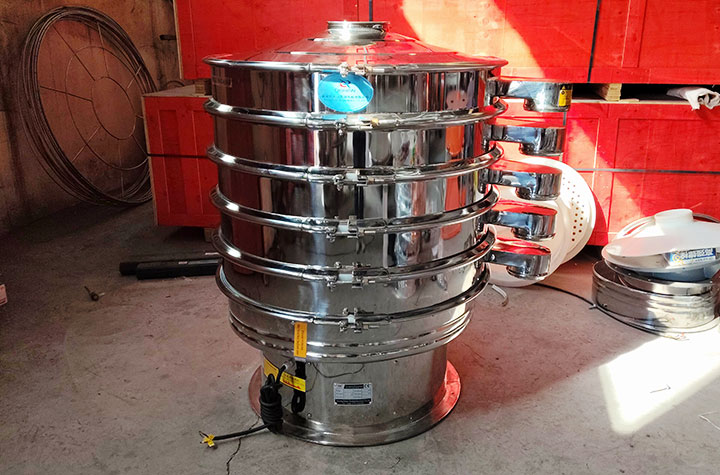
Sifting ultra-fine powders (100–500 mesh / 150-25 μm ) is challenged by dominant inter-particle forces. As gravity's effect decreases, static accumulation, material agglomeration, and mesh blinding frequently disrupt processing throughput.
Mesh to Micron Conversion Chart (100-500Mesh)
Before selecting a fine mesh vibrating screen, it is essential to clarify the actual particle size (microns, μm). As the mesh count increases, the aperture size decreases:
| Mesh Count | Aperture Size (Microns μm) | Aperture Size (Millimeters mm) | Typical Industrial Applications |
|---|---|---|---|
| 100 Mesh | 150 μm | 0.150 mm | Flour, coarse sugar, and plastic granule de-dusting |
| 200 Mesh | 75 μm | 0.075 mm | Metal powder, ceramic powder, and fine pharmaceuticals |
| 300 Mesh | 48 μm | 0.048 mm | Battery cathode/anode materials, coatings, and pigments |
| 400 Mesh | 38 μm | 0.038 mm | 3D printing metal powders and ultra-fine graphite powder |
| 500 Mesh | 25 μm | 0.025 mm | Ultra-fine micro-powders and high-purity cosmetic raw materials |
Key Engineering Note: When the particle size drops below 200 mesh (75 μm),physical characteristics shift significantly—gravity no longer dominates, causing standard screening equipment efficiency to drop sharply.
Key Obstacles: Blinding, Static, and Agglomeration
Sifting ultra-fine powders involves three main physical obstacles:
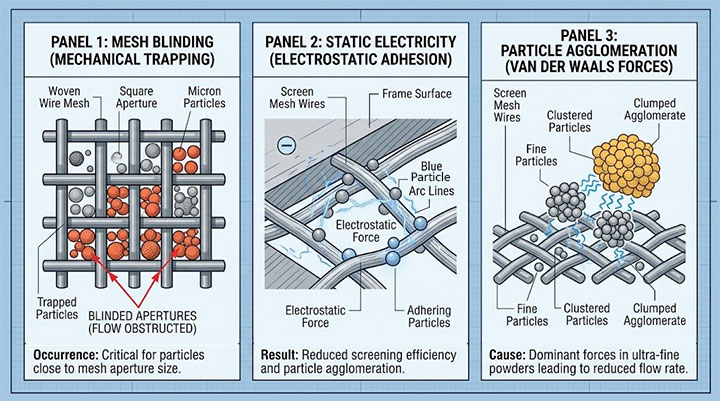
Mesh Blinding and Plugging: Ultra-fine particles close in size to the mesh apertures easily become trapped in the openings. Surface tension also causes fine particles to accumulate, resulting in mesh blinding.
Static Electricity and Friction: Fine powders generate static charges under high-speed friction and movement, causing particles to adhere tightly to the screen mesh and frame instead of passing through.
Particle Agglomeration: Influenced by van der Waals forces and ambient humidity, micron-sized powders tend to clump together. Without a strong dispersion mechanism, agglomerated particles are discharged as waste, leading to material loss.
Select the optimal vibrating screen for 100–500 mesh ultra-fine powders based on particle physical properties, bulk density, and electrostatic tendencies. The primary options include ultrasonic vibrating screens, rotary vibrating screens (vibro sifters), and airflow centrifugal sifters, each targeting distinct mesh ranges and powder processing challenges.
Ultrasonic Vibrating Screen (Best for 200–500 Mesh)
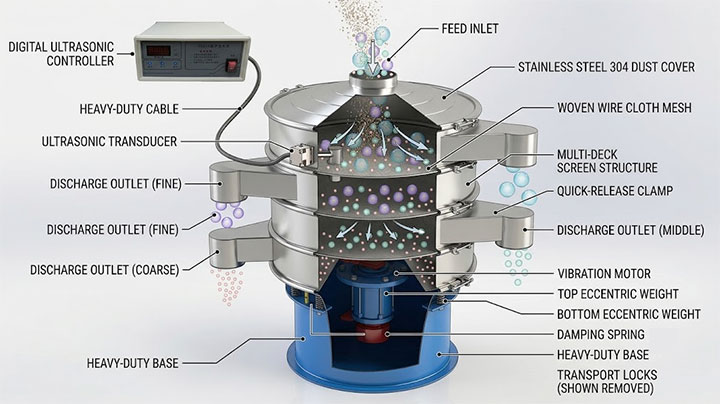
Working Principle: Integrates a high-frequency ultrasonic vibration system (20–40 kHz) onto a standard rotary vibratory separator.
Problem Solved: High-frequency ultrasonic energy transmits directly to the wire mesh, suspending powder particles above the mesh surface to dissipate static charges, break agglomerates, and prevent blinding.
Best Applications: High-value ultra-fine powders such as 3D printing metal powders, battery electrode materials, and fine pharmaceuticals.
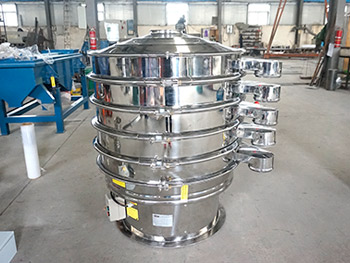
Rotary Vibrating Screen (Standard for 100–200 Mesh)
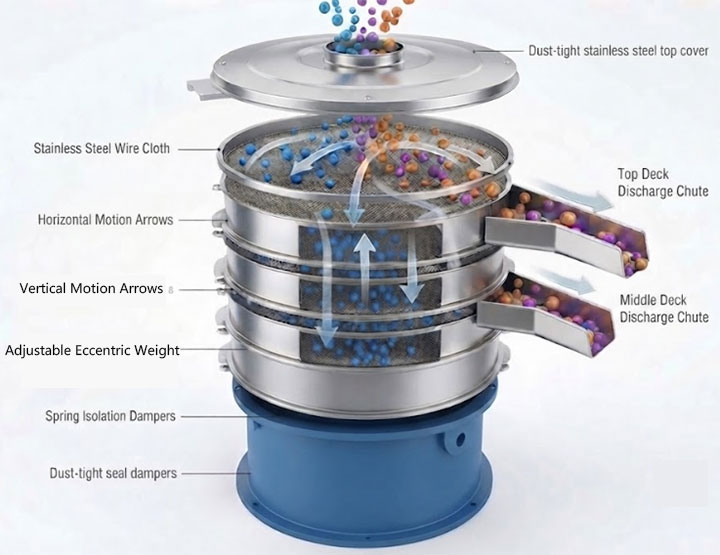
Working Principle: Utilizes a vertical vibration motor to generate a 3D motion (horizontal, vertical, and inclined), causing material to travel in a parabolic spiral across the screen mesh.
Anti-Blinding Method: Equipped with bouncing silicone/PU balls beneath the mesh frame to provide mechanical impact for mesh cleaning.
Best Applications: Conventional sieving and grading for medium-fine powders like flour, starch, resin powders, and coarse pigments.
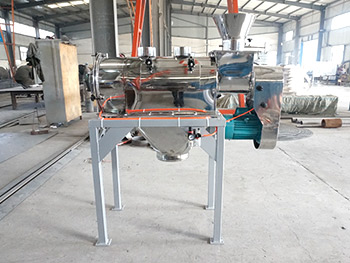
Airflow Centrifugal Sifter (For Light Bulk Density)
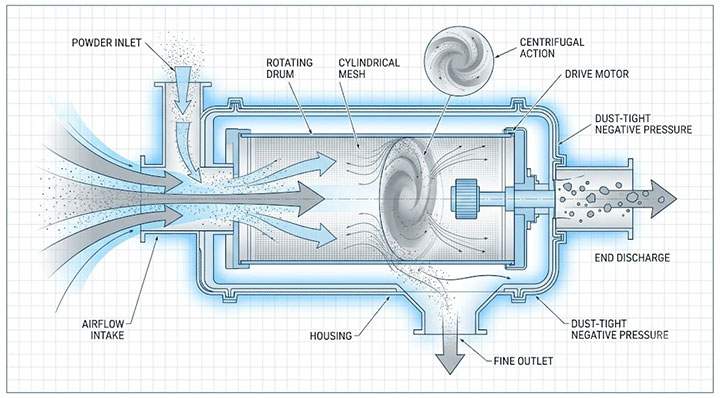
Working Principle: Replaces gravity-based feeding with a high-speed airflow system that feeds powder into a cylindrical screen, forcing fine particles through the mesh using centrifugal force.
Unique Advantage: Solves the issue of ultra-light bulk density powders (such as fumed silica or wood flour) that float in the air and fail to settle on horizontal screens, while providing dust-tight negative pressure operation.
Best Applications: High-capacity grading of lightweight powders and extremely fine materials prone to dusting.
Selecting the optimal fine mesh vibrating screen involves analyzing critical physical and mechanical engineering factors beyond just the machine type. Procurement and process engineers prioritize anti-blinding compatibility, mesh material specifications, and the trade-off between throughput capacity and screening accuracy before finalizing equipment sizing.
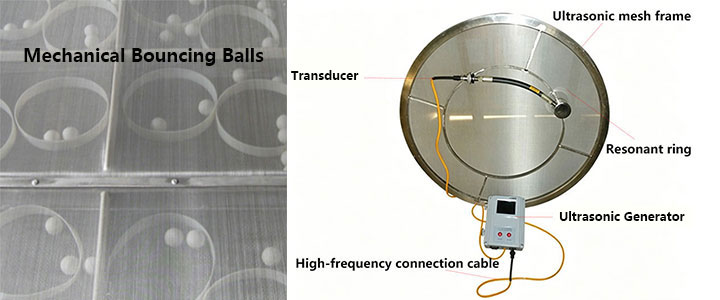
Anti-Blinding Systems(Ultrasonic vs. Mechanical)
Mesh Material & Weave (Stainless Steel 304/316L)
Throughput vs. Screening Efficiency
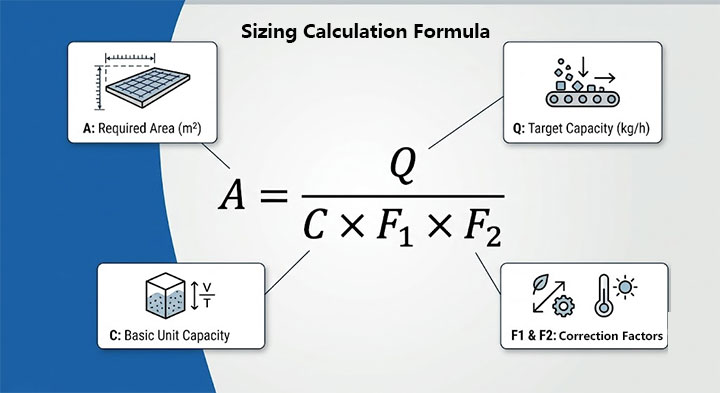
Accurately calculating the required screening area prevents equipment under-sizing or over-sizing . By combining target throughput, material bulk density, and key correction factors, engineers can determine the precise vibratory screener diameter for ultra-fine powders.
No. Ultra-fine powder (200–500 mesh) separation requires high frequency and low amplitude. Excessive motor amplitude causes lightweight particles to bounce violently off the mesh rather than pass through, reducing throughput.
Fine powders above 300 mesh carry strong static charges and physical adhesion that mechanical bouncing balls cannot break. Without an ultrasonic deblinding system to neutralize static via micro-vibrations, mesh blinding occurs almost instantly.
Stainless steel (SS304/SS316L) is recommended over nylon mesh for dry ultra-fine powders. Nylon generates friction static easily and suffers from tension distortion, leading to inconsistent mesh aperture sizes over time.
Selecting the ideal fine mesh vibrating screen requires matching equipment specifications with material behavior and processing goals. To streamline equipment sizing and request an accurate quotation, process engineers should prepare the following five critical engineering parameters.
When selecting ultra-fine powder screening equipment for your specific application, please consider the material characteristics, required processing capacity, and operating conditions. We invite you to explore our relevant product, ultrasonic vibrating screen, to learn more about the available configurations.


Address:China,Yanjin county forest park gate to the west 1000 meters north road.


 Online Chat
 Email
Email