


When processing lines face strict spatial limitations and high-volume separation demands, multi-deck vibrating screens provide a high-efficiency solution by sorting bulk feeds into 2 to 5 distinct particle size fractions within a single, vertically stacked footprint. Designed to remove secondary handling loops and reduce mechanical fatigue, these industrial sifters handle everything from coarse quarry aggregates down to fine powders.The following breakdown examines how these mechanical sifters operate, what structural features ensure their longevity, and how to select the right configuration for your specific material.
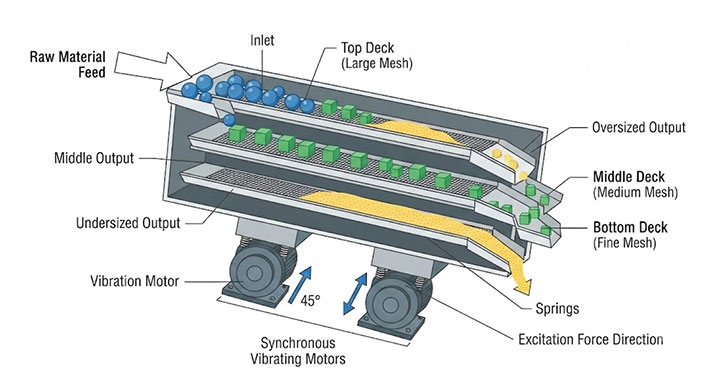
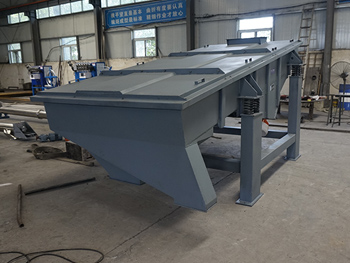
The fundamental purpose of a multi-deck vibrating screen is to separate bulk feed material into 2 to 5 distinct particle size fractions during a single operational pass. Driven by high-performance vibratory motors with adjustable eccentric blocks, the screen box undergoes continuous linear or elliptical throws.
Video: Seeing the multi-deck structure and linear motion of Dahan industrial vibrating screens in action.
Feed material enters the uppermost deck with the largest mesh aperture. Oversized particles are retained and discharged via side chutes, while finer fractions cascade downward through progressively finer mesh layers. By consolidating multiple separation stages into one compact footprint, processing facilities eliminate secondary screening loops and reduce equipment footprint.
Deck Range: 2–5 Decks
Material: SS304 / SS316L / Carbon Steel
Frequency: 1440 RPM (Adjustable)
Mesh Type: Woven, Punched, or PU
Max Throughput: Up to 50 TPH (Model Dependent)
Industry Grade: Industrial / Food / Pharma
Industrial screening environments subject machinery to intense, continuous G-forces and dynamic mechanical stress. Dahan multi-deck sifters incorporate advanced structural methodologies to guarantee long-term operational reliability:
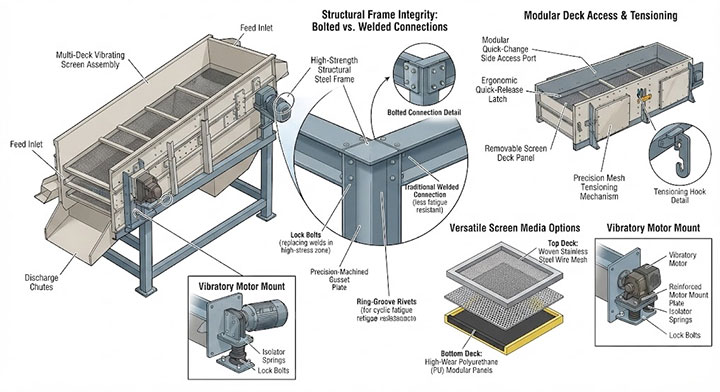
Mesh blinding and pegging are the primary causes of throughput degradation in industrial sizing. To maintain continuous operation, Dahan multi-deck systems utilize specialized anti-blinding countermeasures tailored to specific particle behaviors:
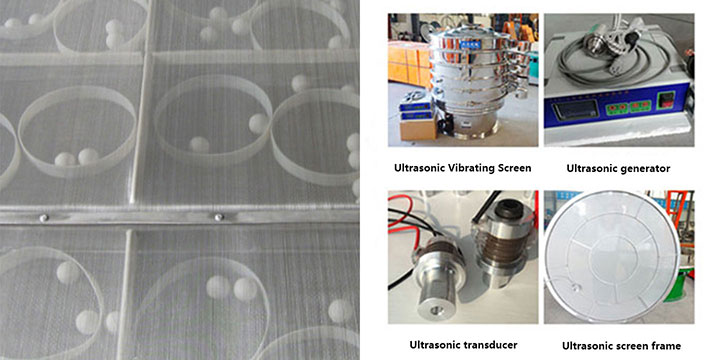
| Anti-Blinding System | Working Mechanism | Ideal Material Application | Key Benefit |
|---|---|---|---|
| Bounce Ball Trays | Resilient elastic rubber balls bounce against the underside of the mesh via vibration. | General dry granules, coarse powders, and abrasive aggregate particles. | Cost-effective, mechanical impact dislodges near-size wedged particles without wire damage. |
| Ultrasonic Kits | High-frequency, low-amplitude ultrasonic energy is transmitted uniformly across the screen. | Ultra-fine powders, cohesive materials, and moisture-prone powders (e.g., starch, metal powders). | Breaks surface tension and fluidizes fine particles, ensuring clean passage through fine mesh (up to 500 mesh). |
By selecting the correct anti-blinding mechanism, plant operators ensure stable continuous throughput and minimize manual intervention during multi-deck separation.
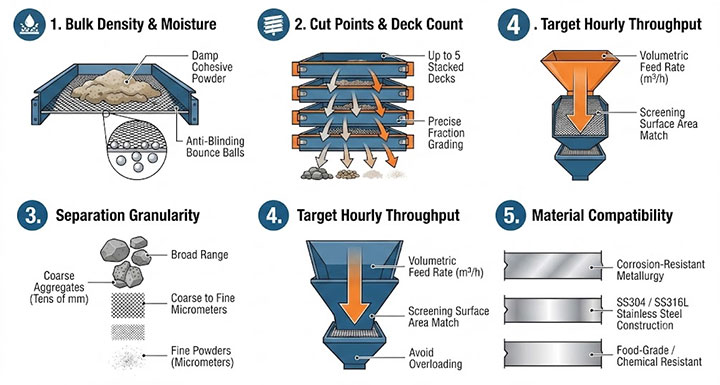
Choosing the correct multi-deck configuration requires a rigorous evaluation of your material characteristics and plant layout constraints. Key engineering variables include:
Share your material specifications, target capacity, and required mesh cuts with our engineering team. We provide customized screening solutions and material testing reports within 24 hours.
Get a Free Technical Proposal & QuoteDahan multi-deck screening machinery serves as a core backbone across diverse global supply chains, including mining and aggregates, chemical and fertilizer processing, food and pharmaceutical grading, and recycling metallurgy.
Standard industrial units typically support between 2 to 4 functional decks. Heavy-duty custom configurations can support up to 5 decks, depending on the material's physical profile and flow characteristics.
Material behavior under high-frequency G-forces cannot always be predicted purely through theory. Sending representative physical samples to our testing laboratory allows engineers to verify flow rates, test mesh sizes, and guarantee separation efficiency prior to capital expenditure.
Mesh replacement typically occurs every 3 to 6 months, depending on material abrasiveness and operating hours. Recommended spares include 1 to 2 sets of replacement mesh panels per deck, isolator springs, lock bolts, and anti-blinding bounce balls.
Yes. We provide comprehensive digital manuals, wiring diagrams, and high-definition installation videos, backed by direct online video technical support from our senior mechanical engineers.


Address:China,Yanjin county forest park gate to the west 1000 meters north road.


 Online Chat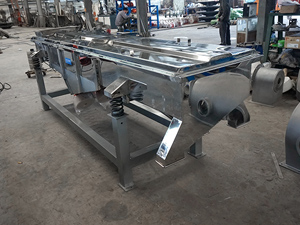
 Email
Email