


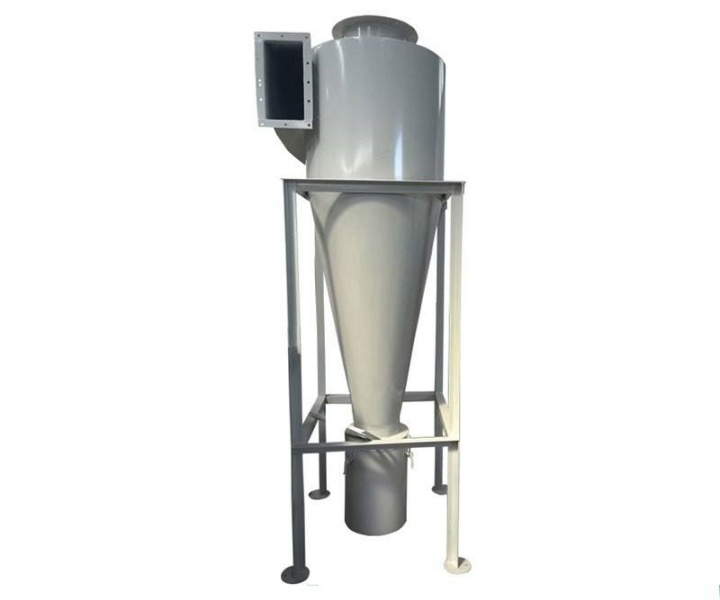
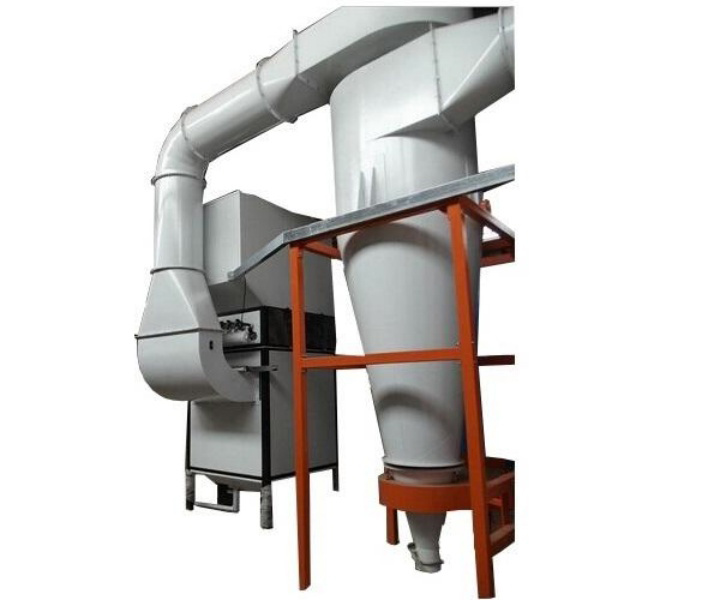
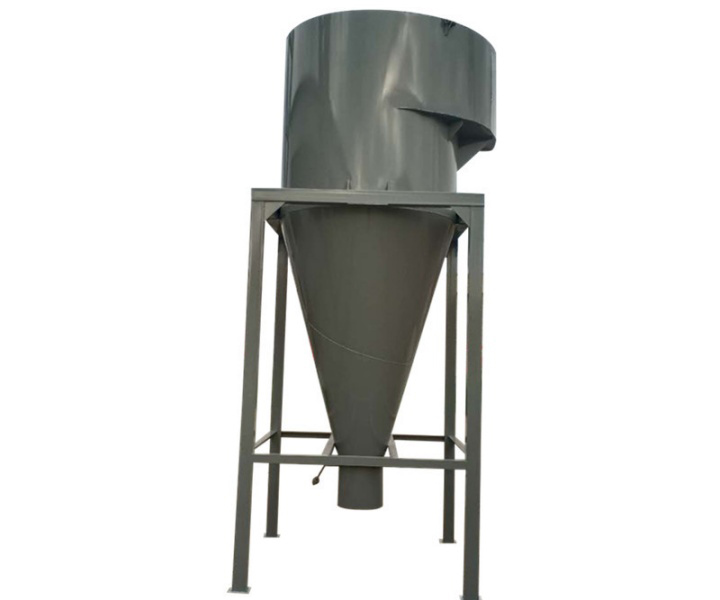
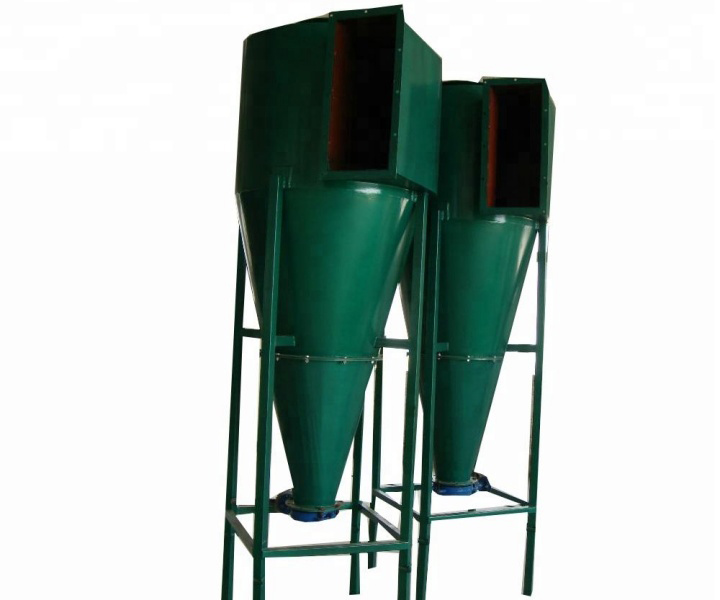
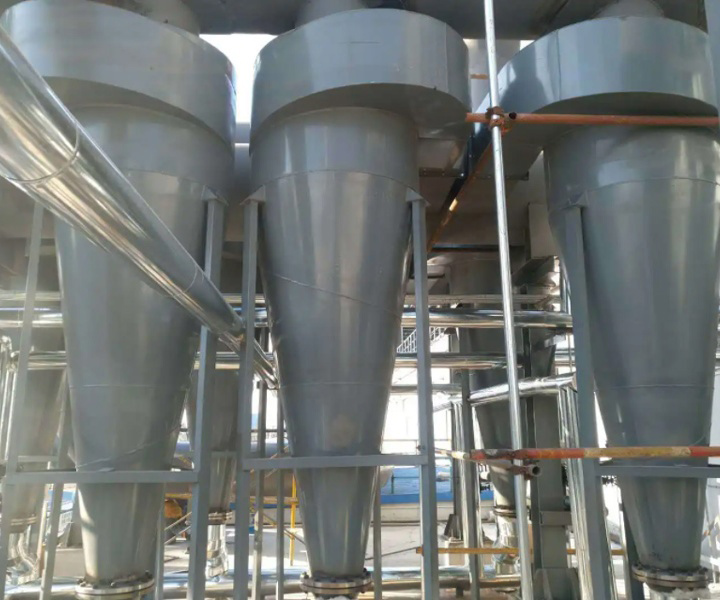
The dust in the gas is separated by centrifugal force and is often used for dust removal of coarse particle materials.


Price:$800.00-$2,509.00/Set
Consult now and enjoy a 10% discount
Exhaust volume:6900-66900m³/h
Filter wind speed:1.2-2.0m/min
Filter area:93-929m²
Filter bag:96-960PCS
Power:1470-1770kw
Insulation layer area:26.5-175m²
Application: Cyclone dust collectors are widely used in coal mines, cement industry, wood processing, mining, metallurgy, food processing and other fields.
Commitment:
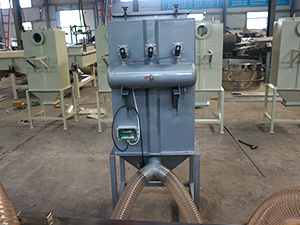
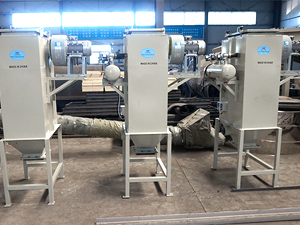
Cyclone dust collector, also called cyclone separator, is a commonly used dust collector. It is mainly used for dust recovery and collection of high-concentration waste gas. It is widely used in convection drying and drying systems. Under normal circumstances, theoretically The cyclone separator can capture powders of more than 5μmm, and the separation efficiency can reach more than 90%. It is the most economical solution to solve various dust problems. It can be used alone, or with bag filter components. Cleaner to use.
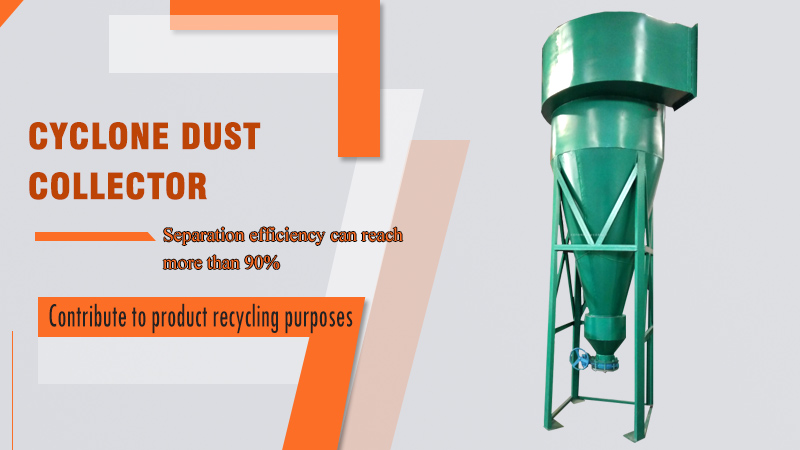
Cyclone dust collector is suitable for processing particles with larger particle sizes, such as dust, coal dust, wood chips, etc. It is one of the dust removal equipment commonly used in many industrial production processes. In the design of a cyclone dust collector, factors such as the gas flow rate, the size and shape of the cyclone tube, and the structural materials of the dust collector need to be considered to ensure its effective operation and efficient dust collection.
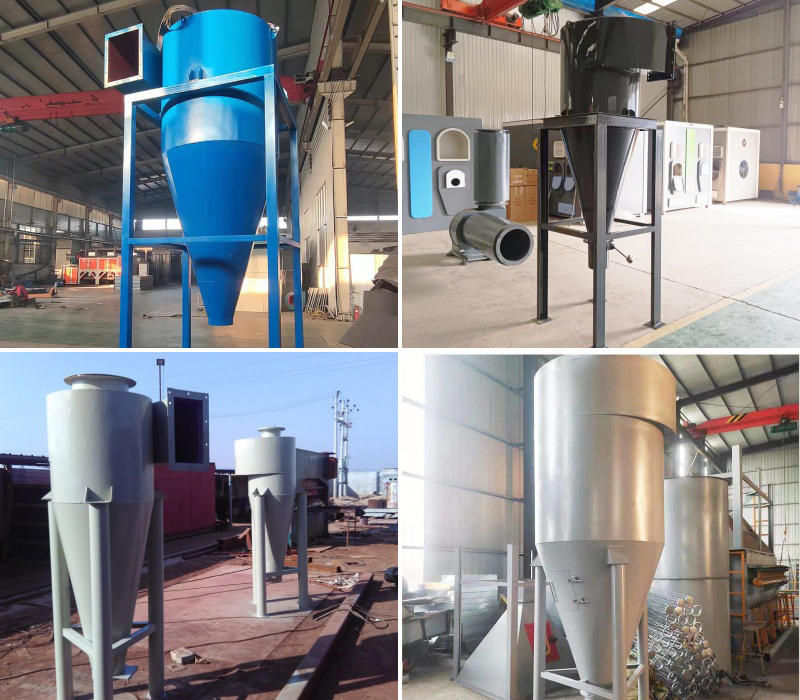
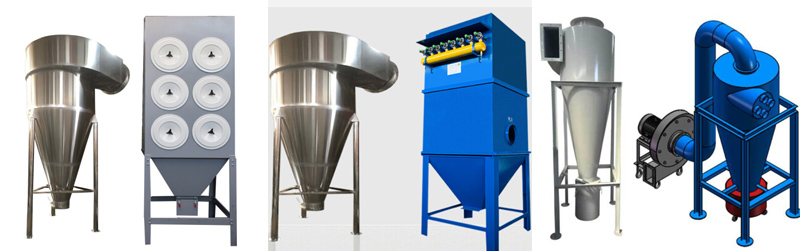
Works in a unique way by generating a high-speed rotating airflow, the air moves in a curved manner, starting from the very top of the cyclone and ending at the bottom, during this process, large particles of dust fall to the bottom of the cyclone, easily Cleared. The efficiency of the cyclone increases with decreasing gas density and decreasing outlet diameter. The main functions of the cyclone dust collector are as follows:
1. Very effective for high dust load and high temperature
2. Contribute to product recycling purposes
3. It is an economical solution to different dust removal problems
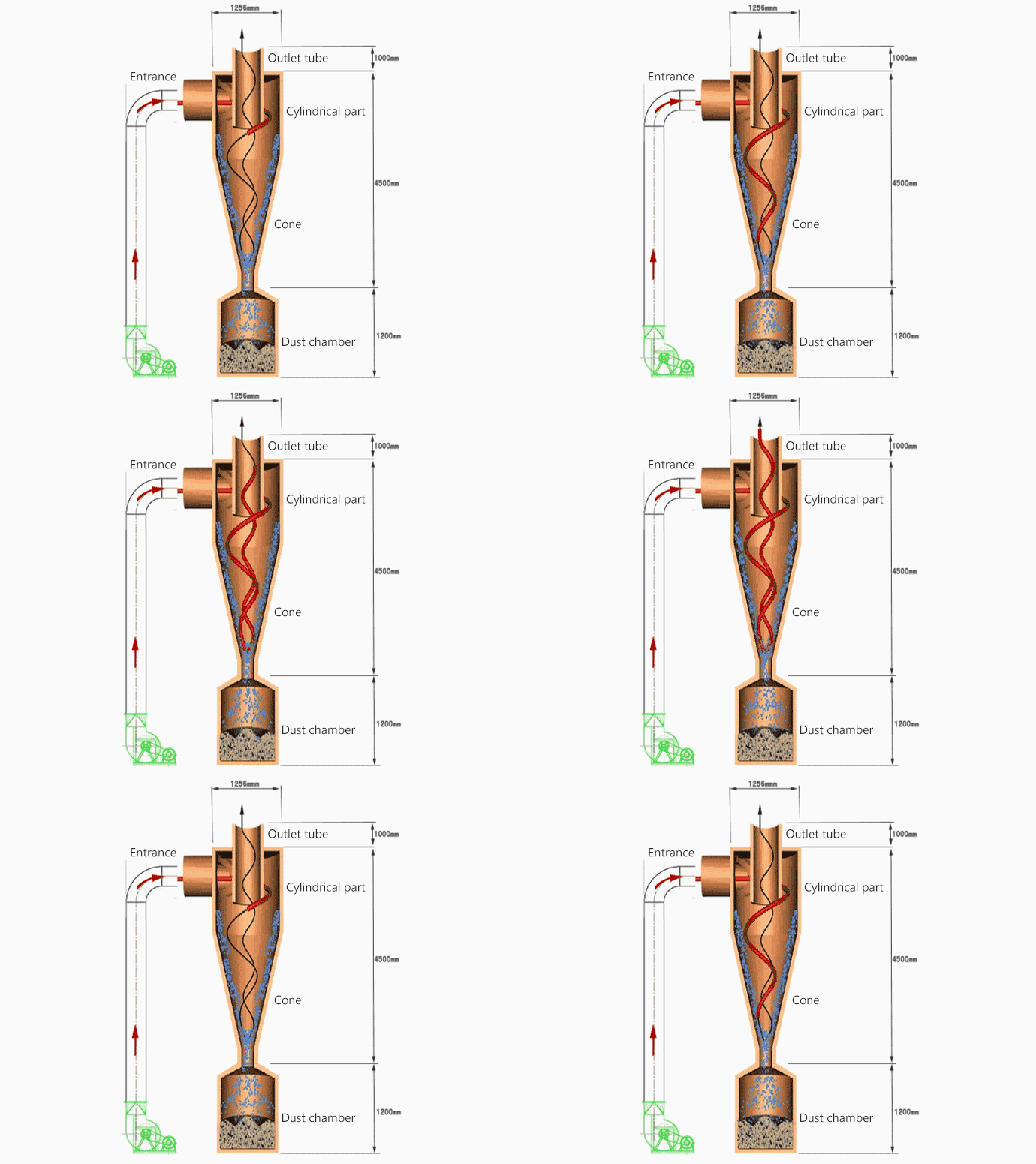
Cyclone dust collector is a process of separating particulate pollutants from the gas by using the centrifugal force generated by the rotating dust-laden airflow. The dust-laden gas enters the dust collector tangentially, and performs continuous rotating motion in the cyclone dust collector, so that the particles get larger The centrifugal force is thrown onto the wall of the container, collides and falls, and the dust particles slide along the wall of the container into the ash hopper at the bottom, and the outer cyclone flow turns into an upward reverse flow at the center of the bottom, and is then discharged through the exhaust pipe.
Good dust removal effect
It can capture powders above 5μmm, and the separation efficiency can reach more than 90%.
High temperature resistance
It can withstand high temperature of 600 ℃. If special high temperature resistant materials are used, it can also withstand higher temperatures.
Strong dust removal performance
After the dust collector is equipped with a wear-resistant lining, it can be used to purify the flue gas containing high abrasive dust.
Have recyclable
It can be dry cleaned, which is beneficial to the recovery of valuable dust.
Additional dust collection capacity
Connect the cyclone to the dust collector to form an extremely powerful two-step dust collection system, increasing the dust collection capacity to 99.99%.
Easy to use
The large-sized dust bucket can handle a large amount of dust, and the dust bucket is also equipped with casters to make dust removal easier.
| Model | Exhaust volume m3/h | Filter wind speed m/min | Filter area m2 |
Filter bag PCS |
Power kw | Insulation layer area m2 |
| DER32-3 | 6900 | 1.2-2.0 | 93 | 96 | 1470-1770 | 26.5 |
| DER32-4 | 8930 | 124 | 128 | 34 | ||
| DER32-5 | 11160 | 155 | 160 | 41 | ||
| DER32-6 | 13390 | 186 | 192 | 48.5 | ||
| DER64-4 | 17800 | 248 | 256 | 70 | ||
| DER64-5 | 22300 | 310 | 320 | 94 | ||
| DER64-6 | 26700 | 372 | 384 | 118 | ||
| DER64-7 | 31200 | 434 | 448 | 142 | ||
| DER64-8 | 35700 | 496 | 512 | 166 | ||
| DER96-4 | 26800 | 372 | 384 | 110 | ||
| DER96-5 | 33400 | 465 | 480 | 120 | ||
| DER96-6 | 40100 | 557 | 576 | 130 | ||
| DER96-7 | 46800 | 650 | 672 | 140 | ||
| DER96-8 | 53510 | 744 | 768 | 150 | ||
| DER96-9 | 60100 | 836 | 864 | 160 | ||
| DER96-2*5 | 66900 | 929 | 960 | 175 |
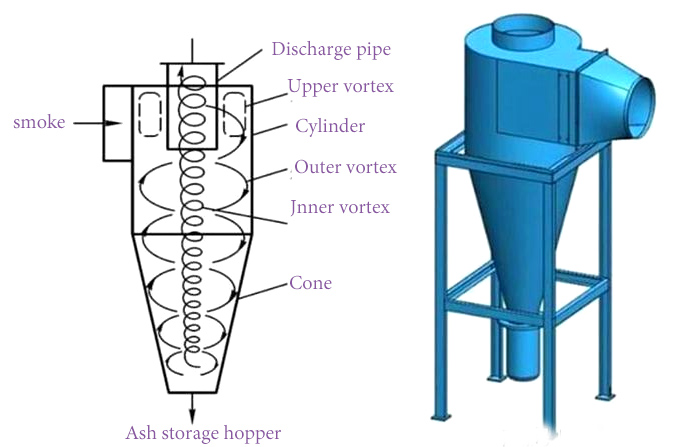
The cyclone dust collector is composed of four parts: exhaust pipe, intake pipe, cylinder and cone. The dust enters the dust collector from the inlet with the airflow, and rotates along the wall from top to bottom (this airflow is called the outer vortex), and the outer vortex reaches the bottom of the cone and then rotates up along the axis (this is called the inner vortex), and finally discharged from the discharge pipe. The inner and outer eddy currents rotate in the same direction. During the rotating motion, the dust particles move to the outer wall under the action of inertial centrifugal force, and finally the dust particles fall into the ash hopper along the wall surface under the combined action of airflow and gravity.
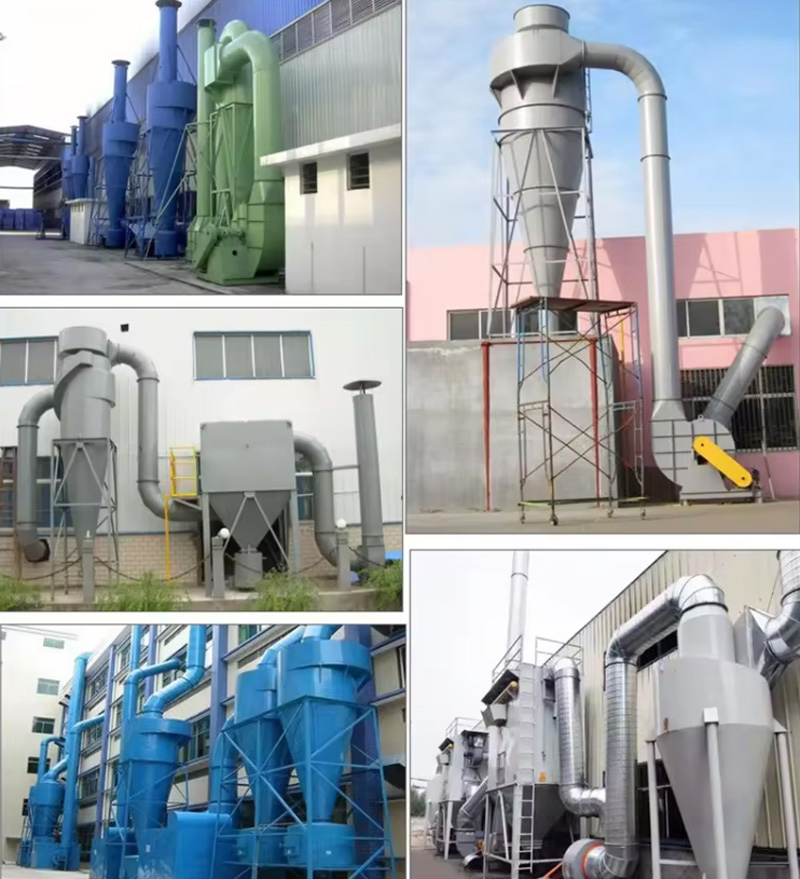
Cyclone dust collectors are suitable for capturing dry, non-fibrous granular dust. Because of its strong habit, it is widely used in coal mining, wood processing, mining and metallurgy, food, building materials, chemicals, cement and other industries.
The following are some specific applications of cyclone dust collectors:
Coal mining industry: In coal mine production, dust removal of coal dust and coal gangue is required to protect the health of workers.
Cement industry: Used for dust removal on coal mills, clinker mills and other equipment in the cement production process.
Wood processing: handle dust removal of solid particles such as wood chips and wood powder, keep the production workshop clean, and prevent safety issues such as dust explosions.
Mining and metallurgical industry: Used to treat dust generated during metal ore processing and reduce environmental pollution.
Food processing: In grain processing, flour production, etc., dust collectors can handle dust and impurities.
Chemical industry: Used to treat solid particles produced in chemical production, purify gas flows, and protect production equipment and the environment.
Building materials industry: In processes such as stone processing and ceramic production, dust collectors can handle solid particles such as stone powder and ceramic tile powder.
Screening Equipment: Includes linear vibrating screens, rotary vibrating screens, gyratory screens, and drum screens. Fine powder is easily dispersed during screening. Cyclone dust collectors are used to control dust generated at the inlet and outlet of the screening machine and on the screen surface, and are particularly suitable for gas phase collection after powder grading.
Conveying Equipment: Includes screw conveyors, belt conveyors, and bucket elevators. Materials easily generate large amounts of dust at transfer points, discharge ports, and elevator heads. Cyclone dust collectors can be placed at these dust-generating points, both recovering materials and purifying the air.
Crushing Equipment: Includes hammer crushers, jaw crushers, and various pulverizers. Crushing and grinding processes generate large amounts of dust consisting of a mixture of coarse and fine particles. As a primary dust collector, cyclone dust collectors can recover most of the coarse particles, effectively reducing the load on subsequent dust collection equipment.
Mixing and Feeding Systems: Includes belt mixers and powder mixers. During batching, dust easily escapes from gaps such as the feed inlet and observation port. Connecting a cyclone dust collector can effectively control dust emissions.
Improper selection can lead to low dust collection efficiency or excessive energy consumption. It is recommended to consider the following five factors:
Air Volume: Determine the specifications of the cyclone dust collector based on the required air volume of the system. Insufficient air volume results in inadequate dust collection efficiency; excessive air volume leads to a sharp increase in resistance and energy consumption. Generally, it should be selected at 1.1 to 1.2 times the air volume extracted from the dust-generating point hood.
Dust Particle Size Distribution: Cyclone dust collectors have a good separation effect on particles larger than 10 μm. If particles smaller than 10 μm account for more than 30% of the dust, it is difficult to meet the standards using a cyclone dust collector alone; it is recommended to use it only as a pre-dust removal device.
Dust Characteristics: Sticky, wet dust with a moisture content exceeding 5% easily causes scaling on the inner wall and is not suitable for ordinary cyclone dust collectors. Consider a liner or air cushion design. Sticky dust can cause bridging in the ash hopper and poor ash discharge, requiring the use of a vibrator. High-hardness dust requires wear-resistant linings.
Installation Location: The installation location determines the interface size, piping routing, and available space below the ash hopper of the cyclone dust collector. Typical installation locations include near the equipment inlet and outlet, material transfer points, and inside enclosed systems. Vertical installation should be ensured to avoid excessively long horizontal pipes that could cause dust settling.
System Configuration: In many cases, cyclone dust collectors are not used in isolation. They can be combined with bag filters to remove coarse particles, reducing filter bag wear and dust load. Combining with pulse-jet dust collectors is suitable for handling high-concentration or slightly sticky dust; pulse-jet backflushing ensures stable system operation.
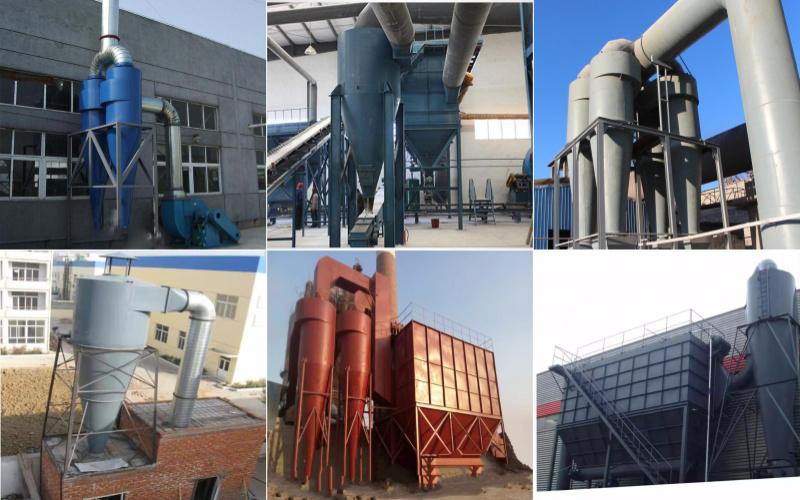
Cement Plants: Pre-dust removal for equipment such as raw material mills, cement mills, dryers, packaging machines, and crushers.
Grain Processing: Material recovery during grain cleaning, rice milling, flour processing, feed grinding, and pneumatic conveying processes.
Chemical Powders: Dust removal in processes such as plastic powder conveying, fertilizer crushing, and pigment packaging.
Mining and Aggregate: Primary dust removal and stone powder recovery in crushing and screening lines.
Food Processing: Dust treatment for starch drying exhaust gas, sugar powder grinding, and seasoning packaging.
Advantages and Limitations
Simple structure, no need for easily worn parts such as filter elements, minimal maintenance required.
Low operating and maintenance costs, only the fan incurs air pressure loss; routine cleaning and wear checks are sufficient.
Excellent high-temperature resistance, capable of handling flue gas up to 400℃, unaffected by filter material temperature limitations.
Capable of handling high-concentration dust-laden gas, with inlet dust concentrations reaching 100~1000 g/m³, often used as a pre-dust removal device.
Robust and durable overall structure; with proper material selection, the equipment's service life can reach 10~15 years or more.
Limitations:Weak purification capacity for fine particulate matter; separation efficiency for dust particles smaller than 10μm is only 50%~70%.
Not suitable for sticky, high-humidity dust, which easily adheres to the walls and clumps, causing duct blockage.
Single unit cannot achieve ultra-clean emissions; outlet dust concentrations are mostly 50~200 mg/m³, failing to meet ultra-low emission requirements.
| Comparison Items | Cyclone Dust Collector | Bag Filter | Pulse Jet Dust Collector |
|---|---|---|---|
| Filtration Method | Centrifugal Separation | Cloth Media Filtration | Pulse Jet Bag Filtration |
| Fine Dust Efficiency | Low | High | Extremely High |
| Maintenance Requirements | Extremely Low | Medium to High | Medium |
| Operating Costs | Low | High | Moderate |
| Applicable Dust | Coarse Particles | Fine Particles | Fine Dust, Ultrafine Dust |
| Temperature Resistance | Excellent | Limited | High-Temperature Refractory Filter Media Optional |
Q: Can a cyclone dust collector remove fine dust?
A: Cyclone dust collectors are effective at removing coarse dust particles, but their capacity for handling fine dust is limited. For fine dust particles smaller than 10μm, the separation efficiency is relatively low, and they generally need to be used in conjunction with downstream dust collection equipment.
Q: Does a cyclone dust collector need a filter?
A: No. Cyclone dust collectors rely on centrifugal force for dust removal. They have no filter bags, filter cartridges, or filter consumables, resulting in a simple structure, almost no vulnerable parts, and lower maintenance costs.
Q: Can a cyclone dust collector withstand high temperatures?
A: Yes. The equipment has no filter media limitations, strong high-temperature resistance, and can typically handle high-temperature flue gas up to 400℃, making it suitable for high-temperature industrial conditions.


Address:China,Yanjin county forest park gate to the west 1000 meters north road.


 Online Chat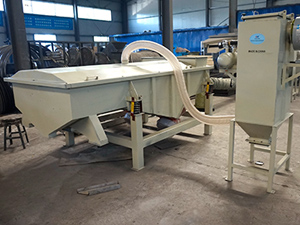
 Email
Email