


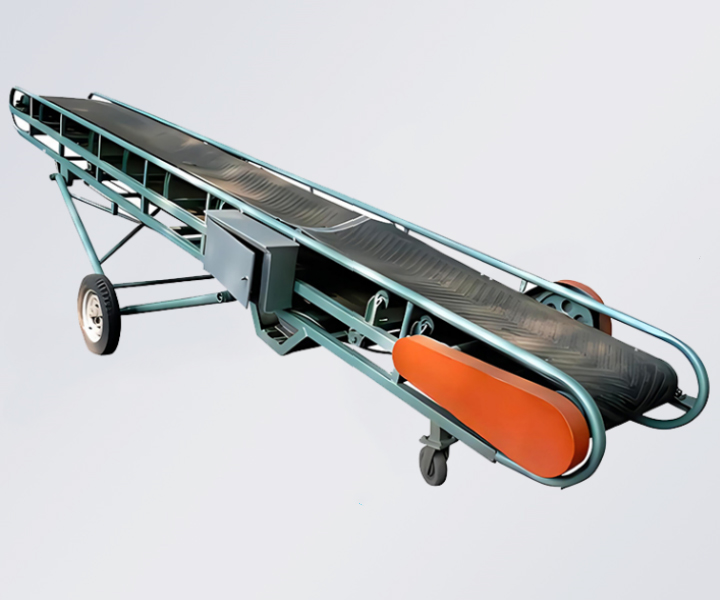
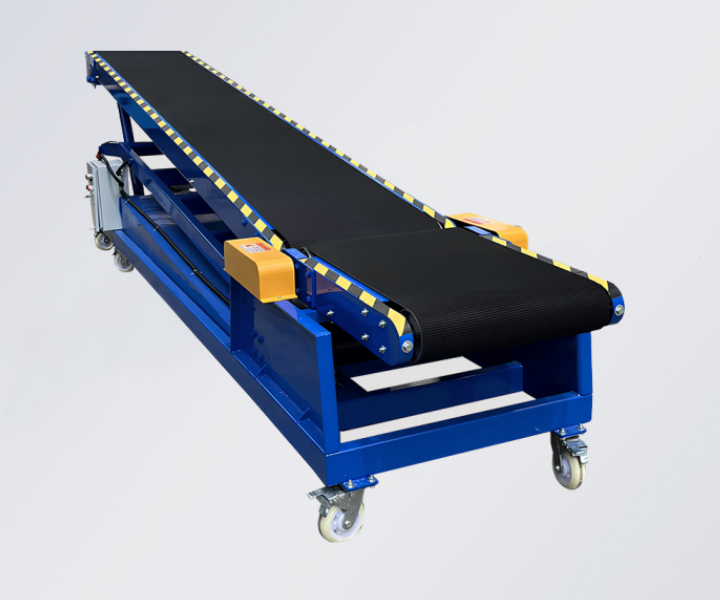
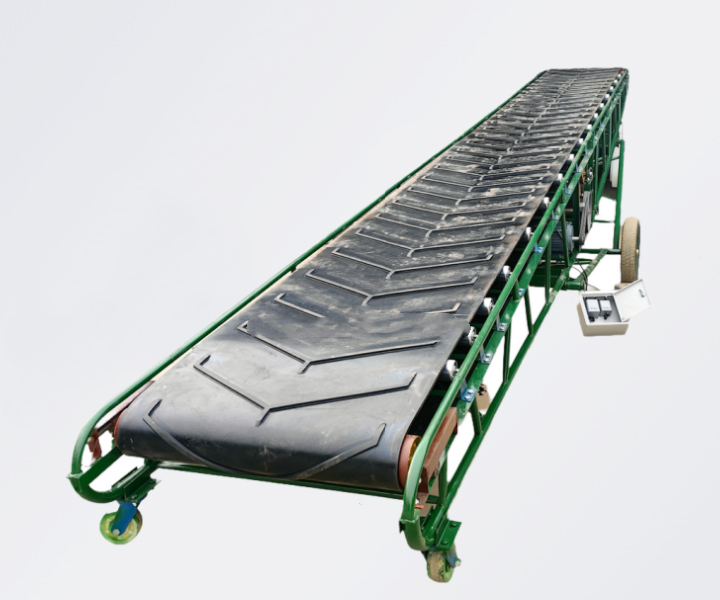
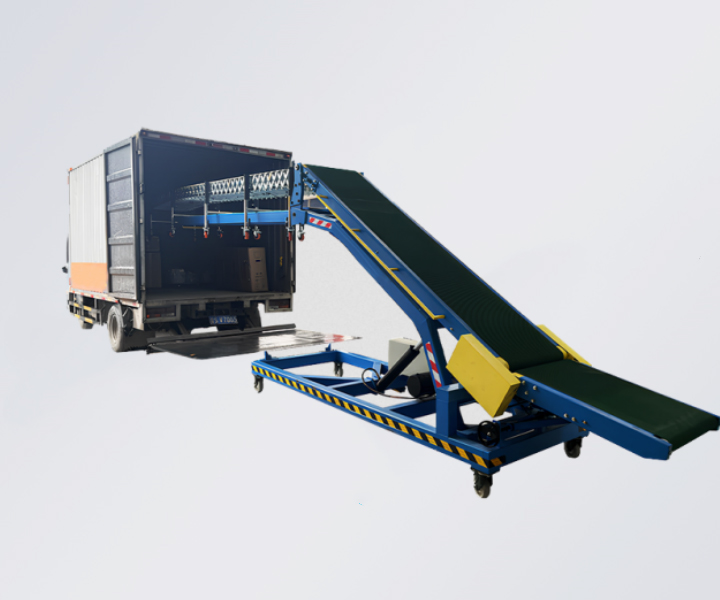
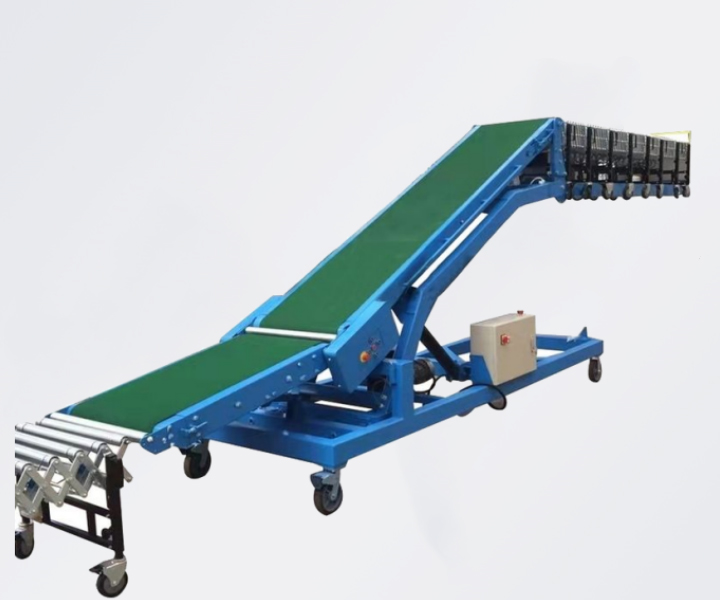
Mobile Conveyor utilizes a mobile roller design to flexibly transport different types of materials, enabling materials to be moved from the ground to higher places or into vehicles.
Conveying capacity: 70-278m³/h
Conveying length: 5-50 meters
Conveying speed: 1.25-2.0 m/s
Applications: Suitable for locations with frequent changes in loading and unloading points; can transport bulk materials and bagged materials; its mobile design allows it to easily adapt to different working scenarios.
A mobile conveyor is a portable material handling system designed to transport bulk materials or packaged materials from one location to another.
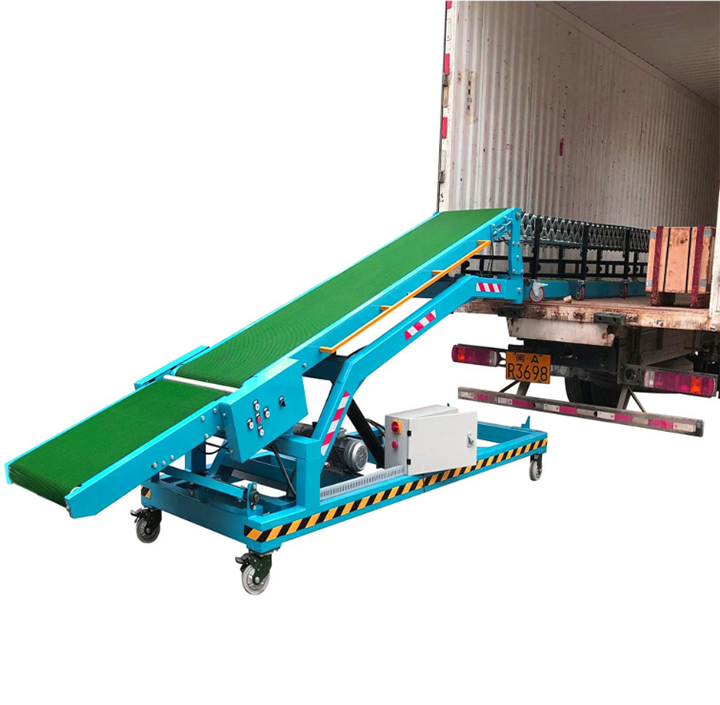
Mobile conveyors are commonly designed with adjustable conveying height and inclination angle. Operators can raise or lower the discharge height according to trucks, containers, warehouses, silos, or stockpile positions. Some models also use hydraulic lifting systems to improve adjustment efficiency and reduce manual operation.
Mobile conveyors are available in different structures such as wheel-mounted mobile conveyors, telescopic belt conveyors, inclined conveyors, tracked mobile conveyors and portable loading conveyors. Conveyor lengths typically range from 5 meters to over 50 meters, while conveying capacities can vary from small warehouse handling applications to large-scale mining and aggregate transportation systems handling thousands of tons per hour.
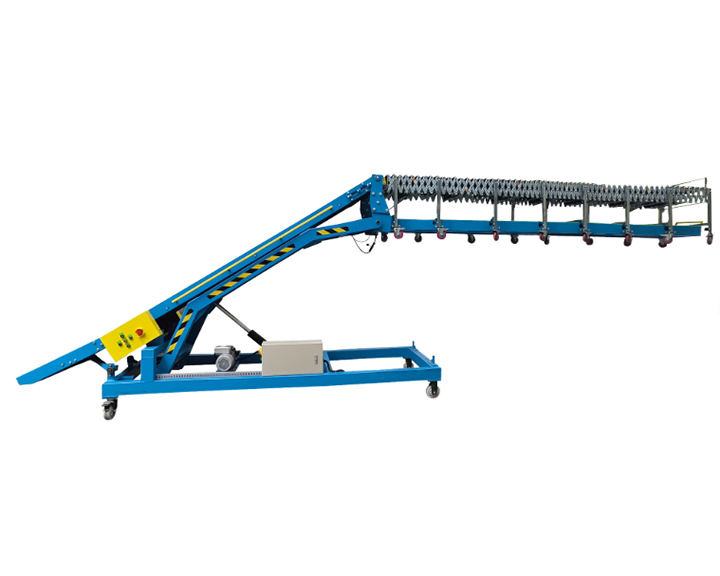
mobile conveyor, using tires or tracks mounted on its underside, moves to the designated work location. A motor or internal combustion engine then drives the conveyor belt or roller conveyor to continuously rotate. The friction between the conveyor belt and the material steadily transports the material from one end to the desired location. At the end of the conveyor, it can be combined with equipment such as crushers and screens to achieve continuous material transportation.
The value of mobile conveyors lies in their combination of conveying and moving functions. They offer flexible height and angle adjustments, allowing for easy transport of materials such as aggregates to another location, and can be used in tandem with other equipment.
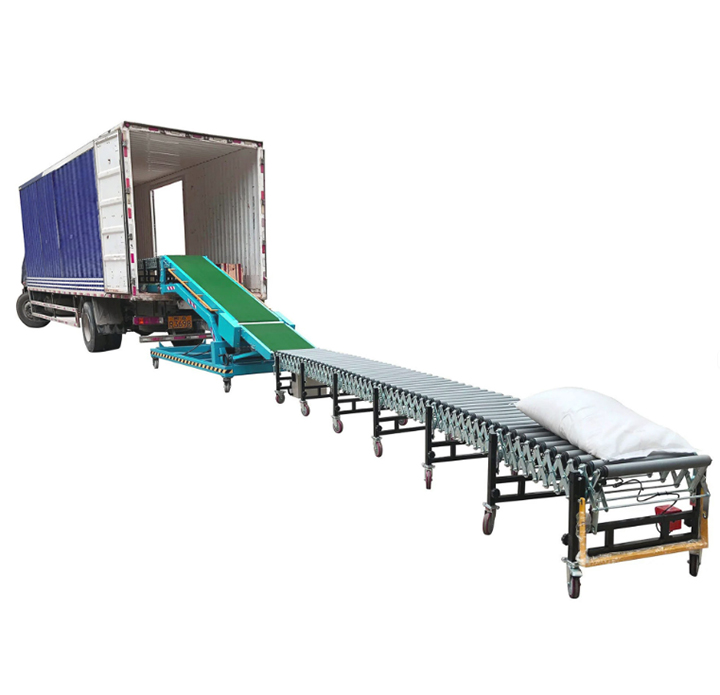
The Mobile Conveyor combines the dual benefits of conveying and mobility, offering flexible adjustment of conveyor height and angle for rapid transfer of bulk and bagged materials. It supports multi-device upstream and downstream connections, is equipped with pneumatic or solid tires, and can be towed or self-propelled. It utilizes diesel, electric, and hybrid power systems, requiring no complex installation or infrastructure, and allows for rapid relocation. Its hydraulic system enables lifting, tilting, and extension, making it suitable for loading and unloading trucks and ships. Multiple units can be connected in series to extend the conveyor line. It features various conveyor belt types, flexible steering, and safety devices such as emergency stop, anti-slip, anti-jamming, audible and visual alarms, and stabilizing outriggers.
| Model | Conveyor Length | Belt Width | Max. Capacity | Discharging Height | Piling Volume (120°) | Piling Volume (270°) |
| KYD1025 | 25m | 1000 | 850t/h | 10.7m | 5847m³ | 11747m³ |
| 82ft | 39” | 850t/h | 35ft | 5847m³ | 11747m³ | |
| KYD1032 | 32m | 1000 | 850t/h | 12.9m | 10591m³ | 21304m³ |
| 105ft | 39” | 850t/h | 42ft | 10591m³ | 21304m³ | |
| KYD1042 | 42m | 1000mm | 1000t/h | 16m | 21962m³ | 45041m³ |
| 137ft.8” | 39” | 1000t/h | 52ft.5” | 21962m³ | 45041m³ | |
| KYD1051 | 51m | 1000mm | 1000t/h | 18.8m | 36456m³ | 74031m³ |
| 167ft.3” | 39” | 1000t/h | 61.ft.7” | 36456m³ | 74031m³ | |
| KYD1058 | 58m | 1000mm | 1000t/h | 21m | 51777m³ | 106063m³ |
| 190ft.3” | 39” | 1000t/h | 68ft.9” | 51777m³ | 106063m³ | |
| KYD1062 | 62m | 1000mm | 1000t/h | 22.2m | 61583m³ | 126355m³ |
| 203ft.4” | 39” | 1000t/h | 72ft.8” | 61583m³ | 126355m³ | |
| KYD1225 | 25m | 1200 | 1250t/h | 10.7 | 5847m³ | 11747m³ |
| 82ft | 47” | 1250t/h | 35ft | 5847m³ | 11747m³ | |
| KYD1232 | 32m | 1200 | 1250t/h | 12.9 | 10591m³ | 21304m³ |
| 105ft | 47” | 1250t/h | 42ft | 10591m³ | 21304m³ | |
| KYD1242 | 42m | 1200mm | 1600t/h | 16m | 21962m³ | 45041m³ |
| 137ft.8” | 47” | 1600t/h | 52ft.5” | 21962m³ | 45041m³ | |
| KYD1251 | 51m | 1200mm | 1600t/h | 18.8m | 36456m³ | 74031m³ |
| 167ft.3” | 47” | 1600t/h | 61.ft.7” | 36456m³ | 74031m³ | |
| KYD1258 | 58m | 1200mm | 1600t/h | 21m | 51777m³ | 106063m³ |
| 190ft.3” | 47” | 1600t/h | 68ft.9” | 51777m³ | 106063m³ | |
| KYD1262 | 62m | 1200mm | 1600t/h | 22.2m | 61583m³ | 126355m³ |
| 203ft.4” | 47” | 1600t/h | 72ft.8” | 61583m³ | 126355m³ | |
| KYD1442 | 42m | 1400mm | 3200t/h | 16m | 21962m³ | 45041m³ |
| 137ft.8” | 55” | 3200t/h | 52ft.5” | 21962m³ | 45041m³ | |
| KYD1451 | 51m | 1400mm | 3200t/h | 18.8m | 36456m³ | 74031m³ |
| 167ft.3” | 55” | 3200t/h | 61.ft.7” | 36456m³ | 74031m³ | |
| KYD1458 | 58m | 1400mm | 3200t/h | 21m | 51777m³ | 106063m³ |
| 190ft.3” | 55” | 3200t/h | 68ft.9” | 51777m³ | 106063m³ | |
| KYD1462 | 62m | 1400mm | 3200t/h | 22.2m | 61583m³ | 126355m³ |
| 203ft.4” | 55” | 3200t/h | 72ft.8” | 61583m³ | 126355m³ | |
| KYD1642 | 42m | 1600mm | 4500t/h | 16m | 21962m³ | 45041m³ |
| 137ft.8” | 63” | 4500t/h | 52ft.5” | 21962m³ | 45041m³ | |
| KYD1651 | 51m | 1600mm | 4500t/h | 18.8m | 36456m³ | 74031m³ |
| 167ft.3” | 63” | 4500t/h | 61.ft.7” | 36456m³ | 74031m³ | |
| KYD1658 | 58m | 1600mm | 4500t/h | 21m | 51777m³ | 106063m³ |
| 190ft.3” | 63” | 4500t/h | 68ft.9” | 51777m³ | 106063m³ | |
| KYD1662 | 62m | 1600mm | 4500t/h | 22.2m | 61583m³ | 126355m³ |
| 203ft.4” | 63” | 4500t/h | 72ft.8” | 61583m³ | 126355m³ |
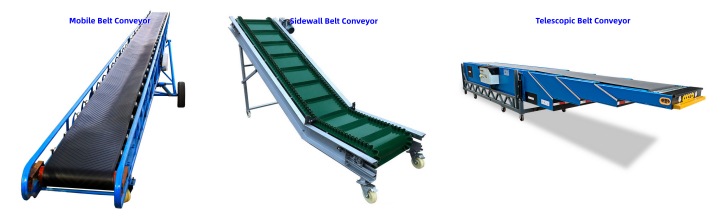
Our factory offers different types of mobile belt conveyors to meet customers' conveying scenarios and needs, allowing you to choose the appropriate mobile conveyor belt based on your specific requirements.
Mobile Belt Conveyor: Equipped with wheels, it can be moved freely and easily relocated. It allows for flexible adjustment of conveying height and angle, requires no fixed installation, and can be used simply by plugging in electricity. It is widely used in construction sites, farms, warehouses, logistics, and other scenarios.
Sidewall Belt Conveyor: With sidewalls on both sides of the belt, it effectively prevents materials from slipping and spilling during inclined conveying. Suitable for conveying materials at large angles and with high drops. It features a large conveying angle, good sealing, and high conveying efficiency, and can convey powders, granules, and small pieces of material.
Telescopic Belt Conveyor: Features a telescopic function and freely adjustable body length. It can directly extend into the interior of trucks and containers for loading and unloading, significantly reducing manual handling distances. It is used in logistics and express delivery, warehousing and sorting, and factory loading and unloading scenarios.
Choosing a suitable mobile conveyor depends on the type of material, conveying distance, loading environment, and production requirements. Different industries require different conveyor structures, belt types, discharge heights, and mobility systems. Understanding these factors can help users select a conveyor system that matches their actual working conditions.
Material type. Bulk materials such as grain, sand, gravel, coal, fertilizer, and aggregates require different conveyor belt structures depending on particle size, moisture content, abrasiveness, and flowability. For example, powders and lightweight materials may require sidewall belts or enclosed conveyors to reduce dust and spillage, while abrasive mining materials often require heavy-duty rubber belts with wear-resistant surfaces.
Conveying capacity. Users should determine how many tons or cubic meters of material need to be transported per hour. Conveyor capacity directly affects belt width, motor power, conveyor speed, and frame structure. Small warehouse applications may only require lightweight portable conveyors, while mining and aggregate operations often require large-capacity mobile belt conveyors capable of handling thousands of tons per hour.
Conveyor length and discharge height. Truck loading, warehouse stacking, silo feeding, and stockpile management all require different conveyor lengths and lifting heights. Hydraulic lifting systems are often preferred because they allow operators to adjust conveying angles more efficiently and improve operational flexibility.
Mobility structure. Wheel-mounted mobile conveyors are suitable for warehouses, farms, and temporary outdoor operations where equipment needs to be moved frequently on flat surfaces. Tracked mobile conveyors are more suitable for mining sites, quarry operations, and uneven terrain because crawler tracks provide better stability and traction.
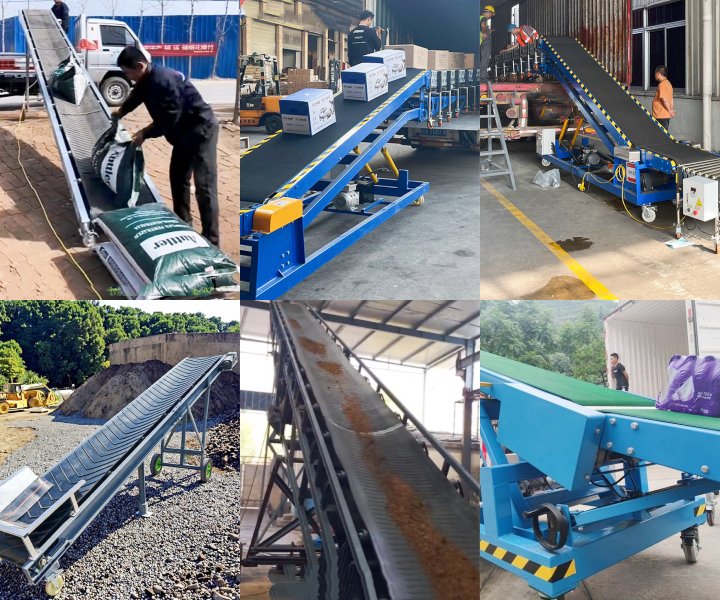
Mobile conveyor prices vary depending on factors such as length, width, suitable materials, and degree of automation. The following is a typical price range for reference. Lightweight mobile conveyors are priced between US$3,000 and US$8,000. They are 6-10 meters long, have a belt width of 400-500 mm, and are powered by a motorized system. Dahan Machinery's DY series mobile grain belt conveyors are priced between $450 and $4,600 and are suitable for transporting grain and bulk materials. Industrial-grade mobile belt conveyors, priced around $8,000, are foldable and support automated control. They are used in large mines, ports, and large-scale infrastructure projects, capable of continuously transporting heavy loads.
Agricultural applications.Mobile belt conveyors are commonly used for handling grain, corn, wheat, rice, soybean, barley, seeds, animal feed, and fertilizer.
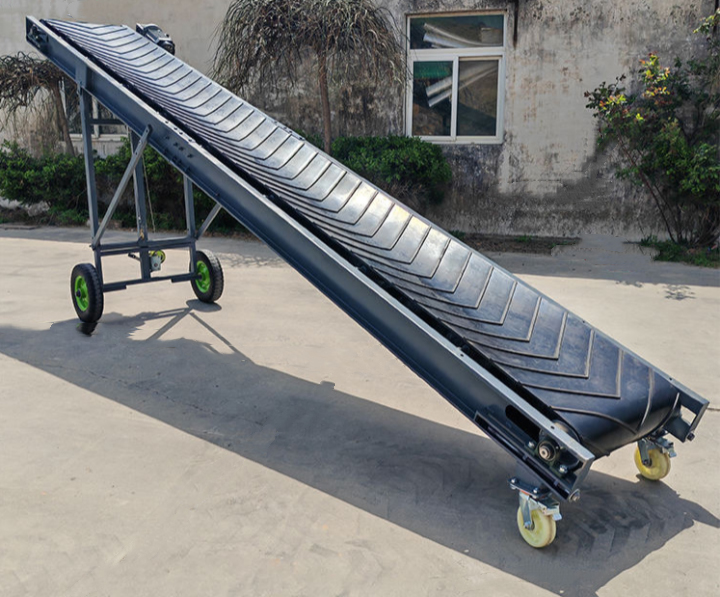
Construction and building materials industry.Mobile conveyors are widely used to transport sand, gravel, crushed stone, cement bags, aggregates, limestone, concrete waste, and bricks. Their mobility allows operators to move materials directly around construction sites or loading areas without requiring fixed conveying systems.
In logistics and warehousing industries, portable conveyors are used for loading and unloading cartons, bags, parcels, and packaged goods. Telescopic mobile conveyors can extend directly into containers or trucks, helping reduce manual carrying distances and improve loading speed in distribution centers and warehouses.
Mobile conveyors are also widely used in recycling plants and waste handling systems for transporting recyclable plastics, paper waste, wood chips, scrap materials, household waste, biomass fuel, and industrial waste materials. Sidewall belt conveyors can help prevent material spillage during inclined conveying, especially when handling lightweight or loose materials.
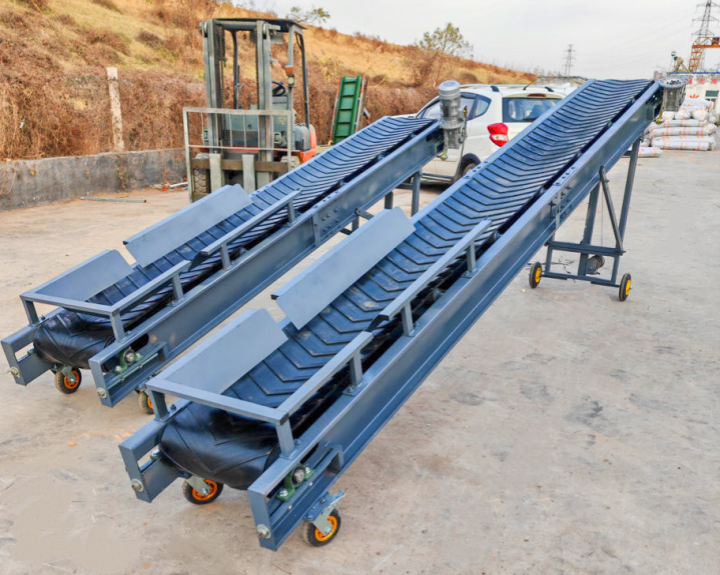
DaHan Machinery boasts mature manufacturing processes and a comprehensive quality inspection system, supporting non-standard customization. Length, height, bandwidth, and materials can be flexibly adjusted according to customer working conditions. A single Mobile Conveyor can reach a length of 50 meters, and multiple units can be connected in series to form long-distance conveyor lines, suitable for loading, unloading, and transfer needs in various scenarios such as mining, building materials, grain, and logistics. The products are flexible in movement, stable in operation, and easy to use. Directly supplied by the manufacturer, they offer high cost-effectiveness. We provide one-stop service including pre-sales selection, in-sales customization, and after-sales technical support to meet the conveying needs of various users.
Mobile conveyors are flexible and adaptable, meeting the material loading, unloading, and conveying needs of different industries and scenarios. The equipment is easy to operate and runs stably, supporting customization and multi-unit tandem operation, effectively improving work efficiency and reducing labor costs.
Q:What is the difference between a fixed conveyor and a mobile conveyor?
A:A fixed conveyor is permanently installed at a specific location and is mainly used for continuous production lines. A mobile conveyor is equipped with wheels or tracks, allowing it to be moved easily between different working locations. Mobile conveyors are more flexible and suitable for temporary or changing conveying environments.
Q:Can mobile conveyors be customized?
A:Yes. Mobile conveyors can usually be customized according to conveyor length, width, conveying capacity, discharge height, wheel type, material, power source, and working environment. Optional features such as hydraulic lifting, telescopic structures, sidewall design, and variable speed systems can also be added.
Q:What is the conveying capacity of a mobile conveyor?
A:The conveying capacity depends on factors such as conveyor width, speed, material density, and structure. Small portable conveyors may handle several tons per hour, while large mining mobile conveyors can transport thousands of tons per hour.
Q:Can mobile conveyors work outdoors?
A:Yes. Many mobile conveyors are designed for outdoor applications such as mining, construction, agriculture, and ports. Outdoor models often use heavy-duty steel frames, weather-resistant materials, pneumatic tires, or crawler tracks to improve durability in harsh working environments.


Address:China,Yanjin county forest park gate to the west 1000 meters north road.


 Online Chat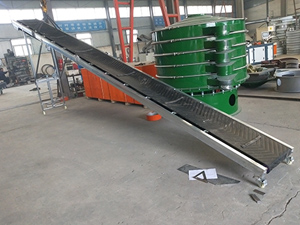
 Email
Email