


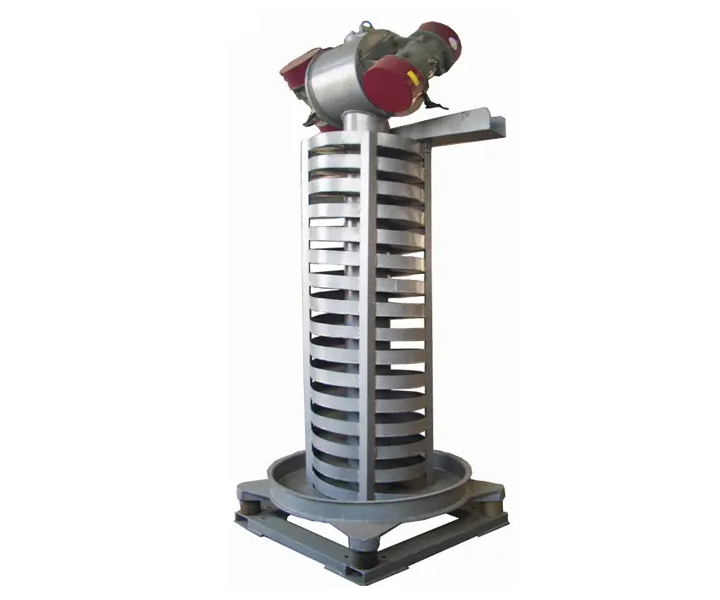
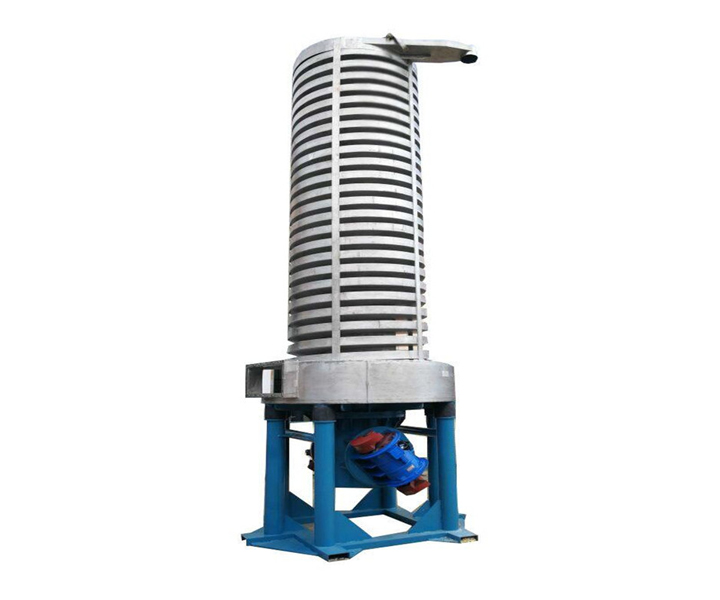
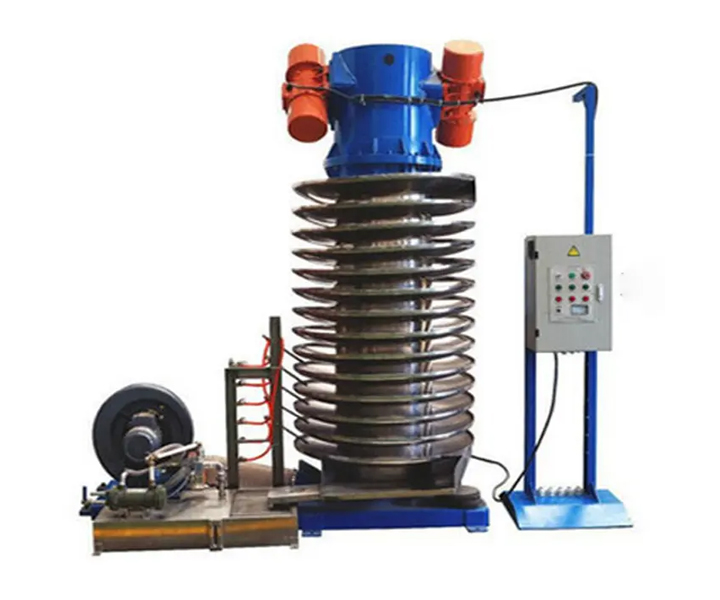
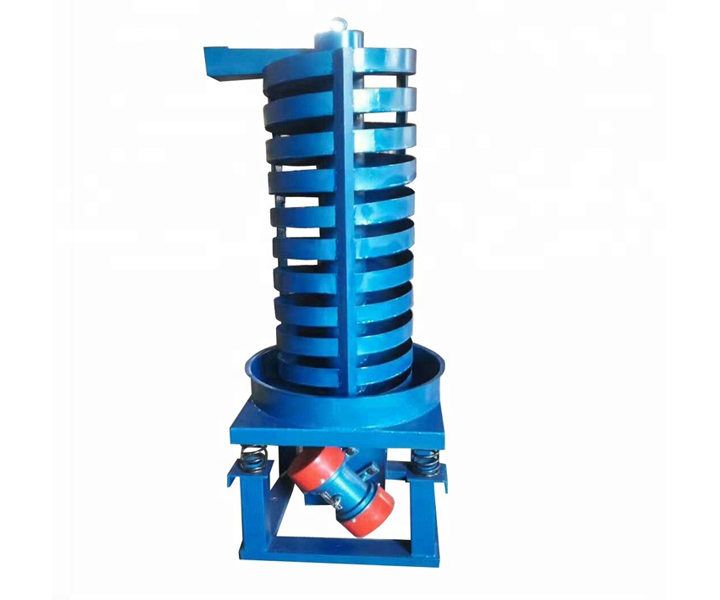
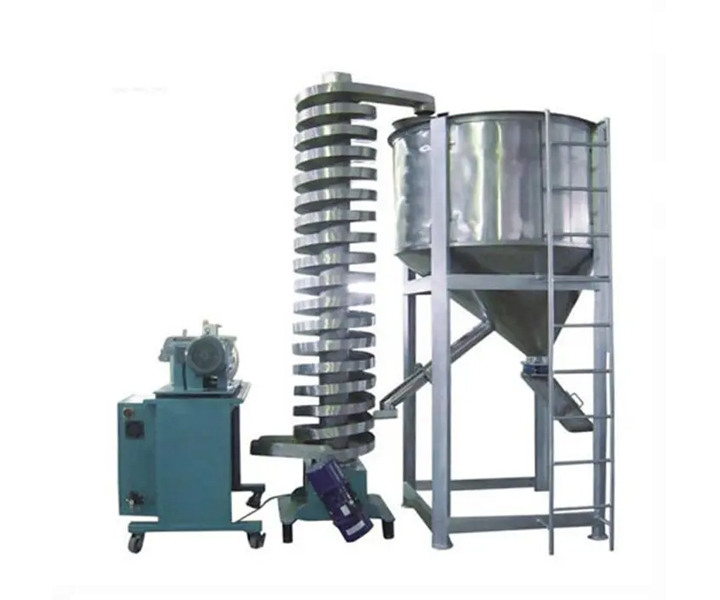
A conveying system that utilizes a continuous screw to transport material in a vertical or inclined direction. It is designed to move items between different floors or floors within a facility.


Price:$500.00 - $20,000.00/Set
Consult now and enjoy a 10% discount
Conveyor trough diameter: 300-900mm Height: ≤6 meters
Conveying capacity: 3.5 tons/hour
Power: 2* (0.4-3)kw
Frame material: SUS304/Carbon Steel
Speed: Adjsutable Speed
Customization: up-vibration, down-vibration, air-cooled, water-cooled, closed, open, 360-degree feeding, etc.
Application: For conveying and lifting powdery, lumpy and short-fiber materials.
Commitment:Free Shipping/5 Days Delivery/30-Day Returns/Support Customization
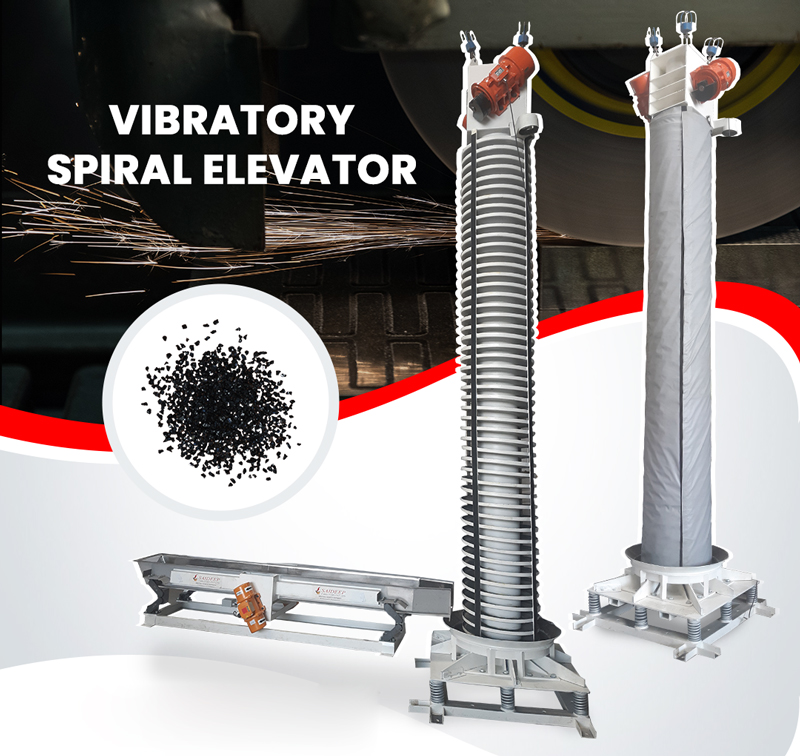
A spiral conveyor is a space-saving solution for vertical or inclined material transport. However, not all spiral conveyors are created equal.
Unlike ordinary screw conveyors that simply move materials from point A to point B, Dahan‘s vibratory spiral conveyors are engineered to do more — they cool, dry, or control temperature of your materials during the vertical conveying process. This dual-function capability eliminates the need for separate cooling equipment, saving floor space and reducing overall system costs.
Whether you’re handling high-temperature materials (up to 600°C) or moisture-sensitive products, our vibratory spiral elevators offer integrated cooling solutions — air-cooled, water-cooled, or a combination of both — ensuring your materials arrive at the next production stage at the right temperature, not just the right height.
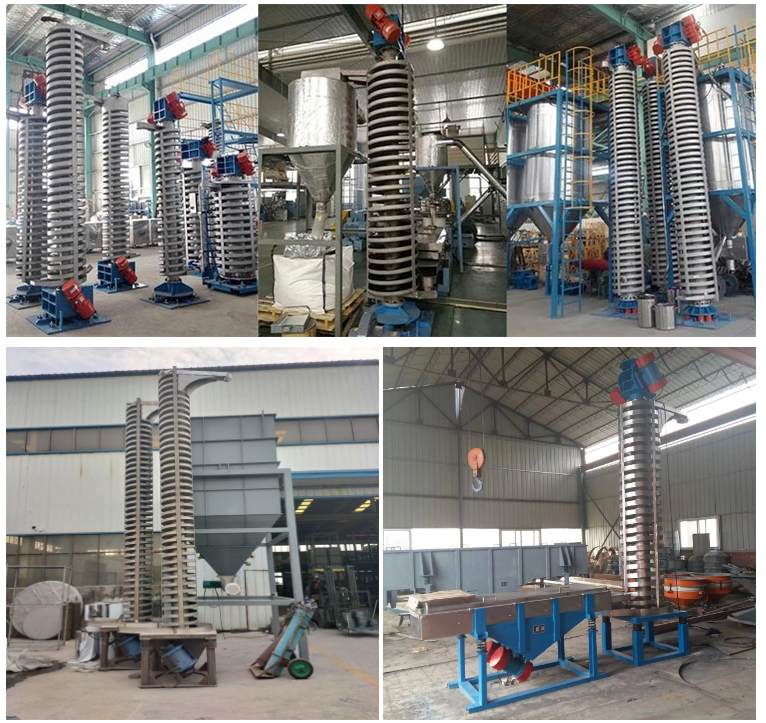
Built with food-grade SUS304 stainless steel or durable carbon steel, our conveyors are designed for hygiene, easy cleaning, and long-term reliability in demanding industrial environments.
Your 4-Step Quick Selection Guide to the Right Conveyor
Use this simple guide to narrow down your options in seconds:
Step 1: What is your material's maximum temperature?
Below 80°C → You can choose Common Type or Air Cooling (most economical).
80–200°C → Air Cooling or Water Cooling are both viable; it depends on your precision needs.
Above 200°C → You will need a Water Cooling or Air + Water Combined system.
Step 2: How precise must your final material temperature be?
Rough Cooling (within ±10°C) → Air Cooling is often sufficient and simpler.
Precise Control (within ±2°C) → You need the stable performance of a Water Cooling system.
Step 3: What is your daily production throughput?
Low to Medium → Common Type or Air Cooling meets most needs.
High & Continuous → Choose Water Cooling or Air + Water Combined for reliable long-term cooling performance.
Step 4: What are your site conditions?
No water supply on site → Your clear choice is Air Cooling.
Limited space → Consider models with an integrated cooling system.
Still have questions? [Contact our engineering team] for a personalized recommendation.
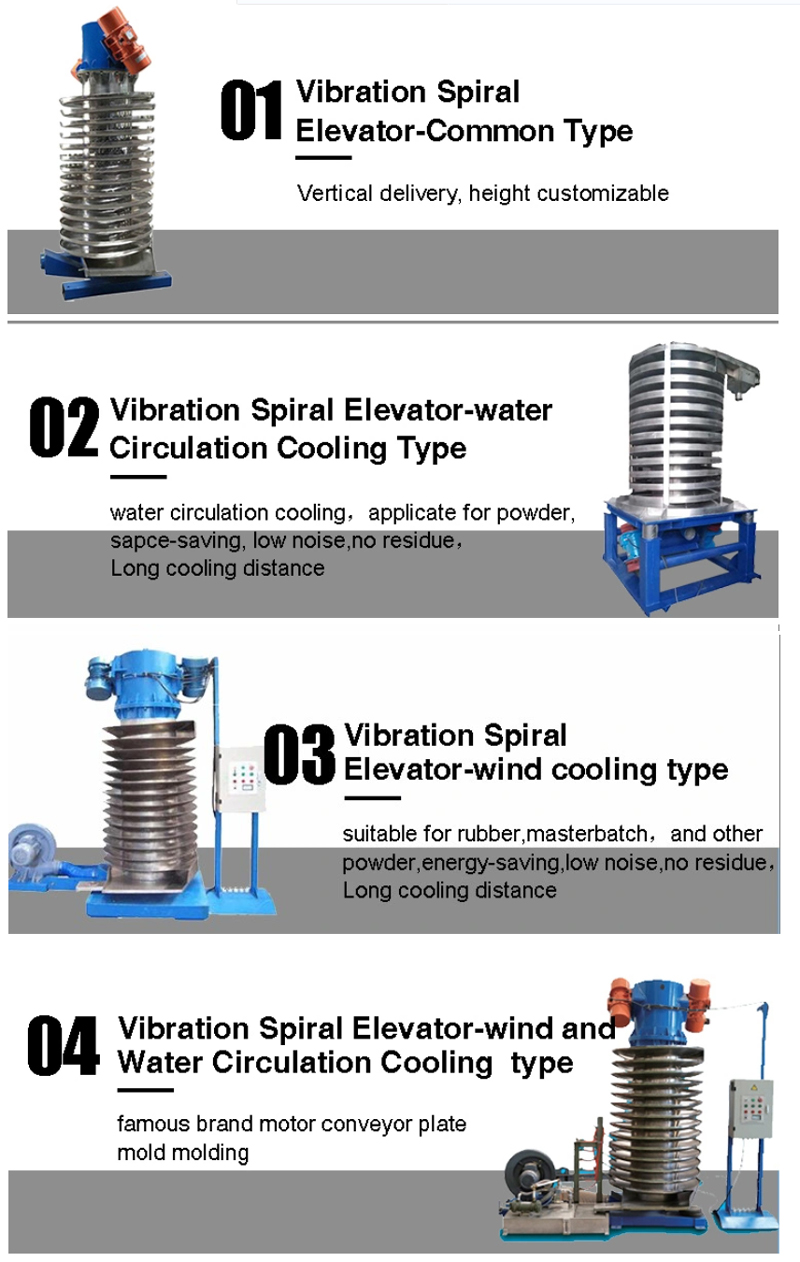
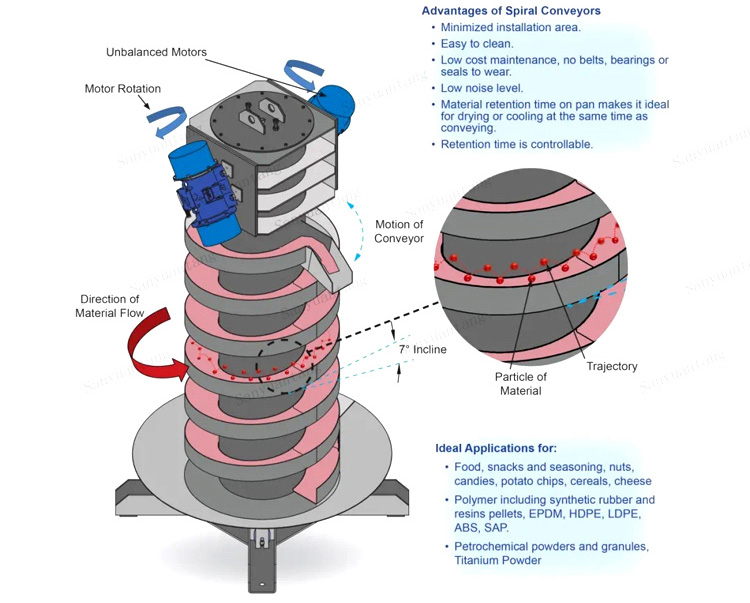
The working principle of a spiral conveyor involves the continuous movement of materials along a spiral-shaped path. Here's a breakdown of the working principle:
Loading: The materials to be transported are introduced onto the conveyor at the entry point, typically at ground level or a lower position. This can be done manually or by integrating the conveyor with other feeding mechanisms or upstream equipment.
Transport: As the spiral conveyor rotates, the materials are lifted or lowered along the spiral path. The shelves or platforms support the materials and move them in a controlled manner. The spiral design ensures a continuous flow of materials, eliminating the need for transfers or changes in direction.
Unloading: At the desired discharge point, usually at an elevated position or a higher level, the materials are unloaded from the conveyor.
Efficient vertical transport
Efficiently transport materials in vertical or inclined positions. They eliminate the need for separate lifts, hoists or inclined conveyors, simplifying material flow and reducing the overall complexity of the handling system.
Improve productivity
Helps increase productivity in material handling operations by providing a continuous flow of material, reducing product handling and transfers, and optimizing space utilization.
Space optimization
Its compact helical shape allows vertical or inclined transport while requiring a smaller footprint than conventional conveyors. This is especially beneficial for facilities with limited floor space or when using multi-story layouts.
Continuous flow
The helical design of these conveyors allows for a continuous flow of material without diversion or change of direction. This smooth, uninterrupted movement reduces the risk of product jams, jams or interruptions in the production process.
Gentle handling
The spiral motion minimizes the risk of product damage or spillage, ensuring safe transport of delicate or fragile items.
Easy to integrate
Can be easily integrated into existing conveyor systems or production layouts. They can be seamlessly connected to upstream or downstream equipment such as feeding mechanisms, sorting systems, packaging machines, etc.
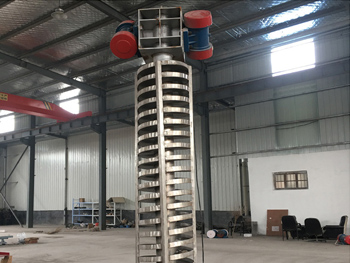
Vertical Spiral Conveyor
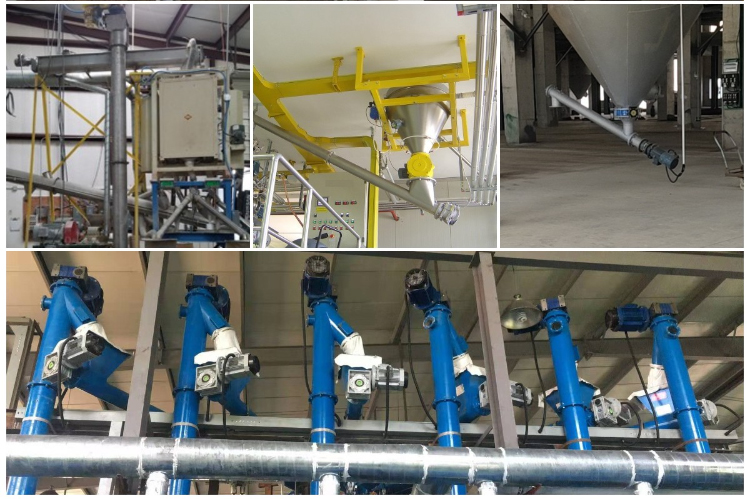
Spiral Conveyor for Fertilizer
Choosing the right vibrating screw conveyor mainly involves considering four aspects: material temperature, cooling requirements, production capacity, and installation conditions. Combining these with your specific needs will allow you to select the appropriate model. Specific details are as follows:
If the material temperature is below 80℃, strong cooling is not required; ordinary cooling or air cooling is sufficient, meeting the needs while saving money. If the temperature is between 80 and 200℃, cooling requirements are not high; air cooling or water cooling is suitable. If the temperature exceeds 200℃, strong cooling is needed; water cooling is preferred, or a combination of air and water cooling.
If only slight cooling is required and precise temperature control is not necessary, ordinary cooling or air cooling is sufficient, offering a simple structure and cost savings. If precise temperature control is required, choose water cooling for uniform cooling and stable maintenance of the required material temperature. If rapid cooling is desired to improve production efficiency, choose a combination of air and water cooling for both rapid cooling and effective temperature control.
For small-scale production lines with low material handling and low cooling pressure, ordinary cooling or air cooling is the most cost-effective option. For medium-scale production lines with moderate material handling, water cooling can meet the cooling needs of long-term production. For large continuous production lines with high material handling and high cooling pressure, a combination of air and water cooling can ensure stable operation of the equipment over a long period.
The choice depends on the installation conditions, taking into account the site environment, space size, and hygiene requirements. If there is no water supply on site and a water cooling system cannot be installed, air cooling is the preferred choice as it does not rely on a water source and is easier to install. If the site space is small and a separate cooling device cannot be installed, choose a hoist with an integrated cooling system; the integrated design saves considerable space.
| Model | Diameter of Spiral chute(mm) | Lifting height (m) |
Speed (rpm) |
Double amplitude (mm) |
Power (kw) |
| DZC-500 | 50 | ≤6m | 960 | 6-8 | 2*0.75 |
| DZC-600 | 600 | ≤7m | 2 X 1.5 | ||
| DZC-800 | 800 | 2 X 2.2 | |||
| DZC-1000 | 1000 | 2 X3.0 | |||
| DZC-1200 | 1200 | 2 X4.5 | |||
| DZC-1500 | 1500 | 2 X5.5 | |||
| DZC-1800 | 1800 | 2 X6.0 |
| Type | Cooling Efficiency | Cost | Complexity | Best for |
|---|---|---|---|---|
| Common Type | Low | Low | Simple | No strict cooling |
| Water Cooling | High | Medium–High | Medium | High-temp materials |
| Air Cooling | Medium–Low | Medium | Simple | Light cooling |
| Wind + Water | Very High | High | Complex | High-capacity cooling |
A spiral conveyor usually consists of base frame, spiral trough, inlet port, discharge outlet, vibration motors , support structure, springs, control cabinet and optional cooling system.
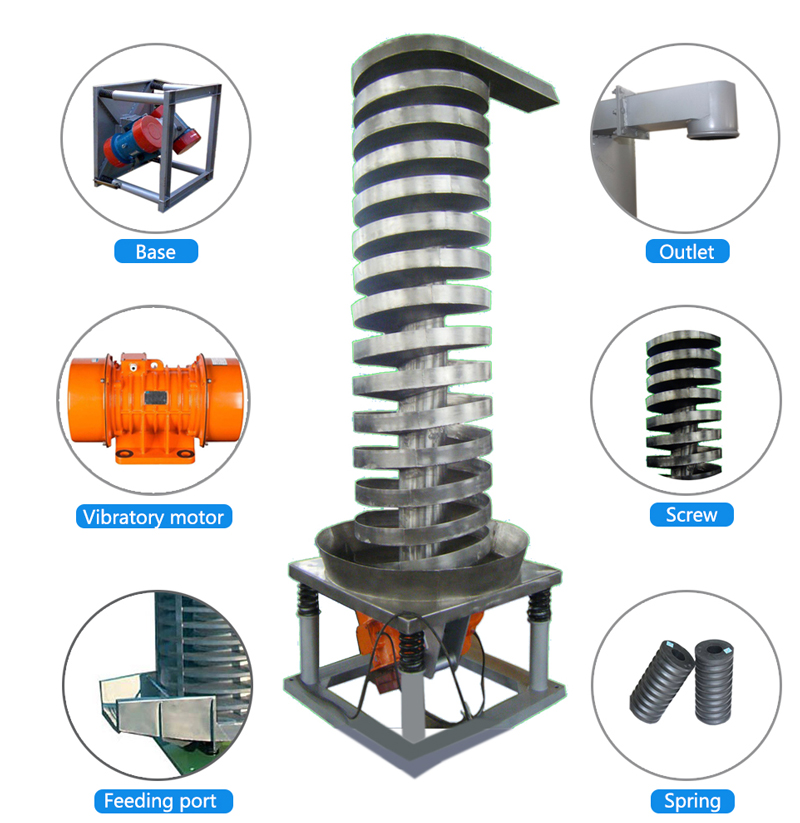
Different materials and industries may require additional components such as sealed covers, inspection doors, frequency converters, dust collection ports or explosion-proof motors.
Spiral conveyor price is influenced by diameter, lifting height, stainless steel material, motor power and cooling configuration.
Small standard vibration spiral conveyor models start from around USD 1,800, while large stainless‑steel or cooling‑equipped customized models can reach USD 20,000 or more based on technical specifications.
For an accurate quotation, customers need to provide material type, required capacity, lifting height and installation layout.
Food Processing
Challenge: Food products often require strict temperature control during handling to maintain quality and safety. Conventional conveyors can cause product degradation or contamination.
Dahan Solution: Our food-grade stainless steel spiral conveyors feature easy-to-clean designs and optional air or water cooling, ensuring hygienic, temperature-controlled transport for baked goods, snacks, frozen meals, and packaged foods — without compromising product integrity.
Pharmaceutical & Medical
Challenge: Pharmaceuticals demand contamination-free environments and gentle handling to prevent damage to vials, syringes, and blister packs. Static buildup or rough handling can compromise product quality.
Dahan Solution: Our vibratory spiral conveyors provide gentle, vibration-controlled lifting that minimizes product impact. With explosion-proof motor options and sealed designs, we meet the strict hygiene and safety standards of pharmaceutical production lines.
Warehousing & Distribution
Challenge: Limited floor space and the need to move goods between multiple mezzanines or floors often require complex lift systems that are costly and space-consuming.
Dahan Solution: Our compact spiral design maximizes vertical space utilization, enabling continuous, high-throughput movement of boxes, cartons, and totes between levels. This simplifies material flow, reduces manual handling, and boosts overall logistics efficiency.
Q1: What's the actual difference between air cooling and water cooling in operation?
A: Beyond the basic principle, the key difference lies in cooling rate and stability. Air cooling relies on ambient air, so its efficiency is affected by workshop temperature. It provides a gentle, gradual cooling, suitable for materials that don't require rapid temperature change. Water cooling, with its circulating water system, offers a faster and more uniform cooling effect, maintaining a stable material temperature even in hot environments. Choose water cooling if your process demands strict temperature control.
Q2: My material temperature is between 150–200°C. Which cooling type is most cost-effective?
A: For this range, air cooling is often the most economical choice if your facility has good ventilation and the material doesn't require rapid chilling. However, if the ambient temperature is high or you need precise output temperature, investing in a water-cooled system will provide more consistent results and can prevent overheating-related production issues in the long run.
Q3: Can the spiral conveyor handle sticky or abrasive materials?
A: Yes, but with specific design considerations. For sticky materials, we recommend a polished stainless steel trough and a variable speed drive to control the conveying speed and prevent build-up. For abrasive materials, a hardened carbon steel trough is advised to extend the equipment's service life. Our customization options can address these specific material challenges.
Q4: What's the maximum capacity I can achieve with this spiral conveyor?
A: The standard DZC-500 model can handle up to 3.5 tons/hour. However, capacity depends on material bulk density and trough diameter. Our larger models (like DZC-1800) can achieve higher throughputs. For a precise capacity estimate, it's best to provide your material type and target capacity so we can recommend the optimal model and configuration.
Spiral Conveyor for Food


Address:China,Yanjin county forest park gate to the west 1000 meters north road.


 Online Chat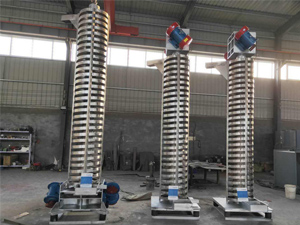
 Email
Email