Your location is: Home > News Center > 100-Ton Slag Cement Waste Transferred and Loaded Truck

100-Ton Slag Cement Waste Transferred and Loaded Truck

Transferring 100 tons of slag cement waste to loading trucks typically requires high-efficiency, durable conveying equipment to ensure fast and safe material handling. DaHan Machinery's belt conveyors are ideally suited for this task. Slag cement waste is characterized by uneven particle size, high density, and the presence of sharp impurities in some materials. DaHan Machinery's belt conveyors, with their robust structure, high conveying efficiency, and wear-resistant properties, offer advantages such as flexible core parameters that can be matched to the transfer standards of 100 tons of waste, ensuring stable conveying.

100-Ton Slag Cement Waste Transferred and Loaded Truck

How to use a belt conveyor to transfer 100 tons of slag cement waste to loading trucks?

The core principle of using a belt conveyor to transfer slag cement waste to trucks relies on its working principle. A drive unit rotates a drum, which, through friction, drives the conveyor belt in a cyclical motion, thus synchronously moving the slag cement waste on the conveyor belt, achieving continuous material transport. Considering the transfer requirements of 100 tons of waste, the conveyor's belt speed, drive power, and other parameters must be appropriately matched to ensure a balance between conveying efficiency and equipment load.

Main Types of Belt Conveyors

Dahan Machinery's belt conveyors can be classified into various types according to conveying direction and structural form. Different types are suitable for different transfer scenarios. Based on the need for transferring 100-ton slag and cement waste, the following classifications and suitable scenarios are highlighted:

Classification by Conveying Direction

Horizontal Belt Conveyor: Simple structure, high conveying efficiency, suitable for short-distance transfer of slag and cement waste on the same horizontal plane. It can be combined with other types of conveyors to achieve multi-directional transfer and reduce material loss during the conveying process. Its belt width can be selected from 300mm to 1000mm according to transfer requirements, and the belt speed can be controlled between 0.5 and 5 m/s.

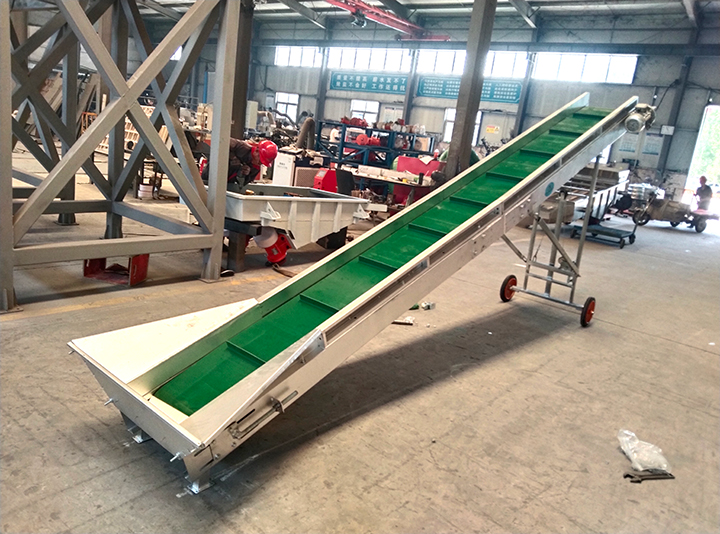
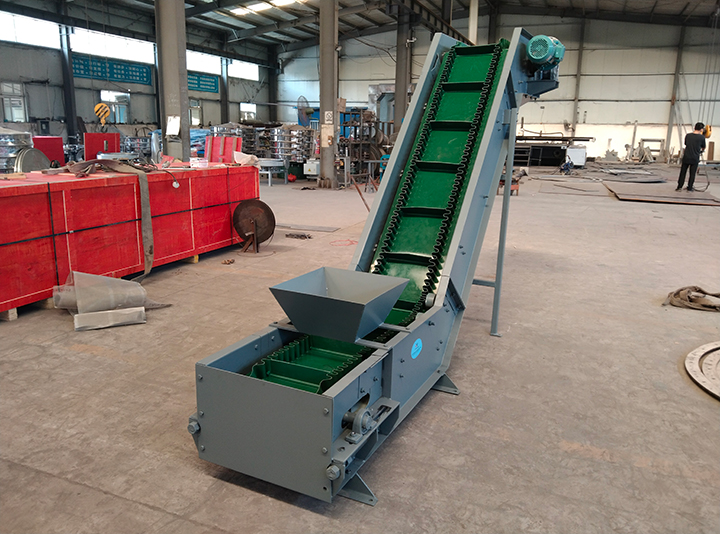
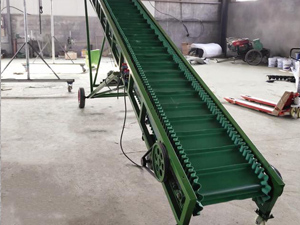
Inclined Belt Conveyor: The conveying direction is at a certain angle. Its core advantage is that it can achieve material transfer at different heights. Equipped with an anti-slip conveyor belt to prevent materials from slipping, while possessing strong load-bearing capacity. The inclination angle is typically between 15° and 30°, with a maximum of 60°, and can be flexibly adjusted according to truck height and site space. Wear-resistant belt thickness of 3mm to 15mm is used, suitable for slag and cement waste containing sharp impurities, preventing premature belt wear.

Vertical belt conveyor: Used for vertical material transport, suitable for scenarios with confined space requiring vertical material lifting. It can be used in conjunction with a horizontal belt conveyor to form a "horizontal + vertical" combined conveying mode, improving transfer flexibility. However, the conveying capacity is slightly lower than that of an inclined conveyor, and its conveying capacity can be adjusted according to needs.

Classification by structural form

Fixed belt conveyor: The machine body is fixed and cannot be moved. It is suitable for long-term transfer scenarios at fixed waste dumping sites and truck parking points. It has strong load-bearing capacity and high conveying efficiency. Length and width can be customized according to site requirements. Its drive power is configured according to conveying capacity and belt speed, typically between 2 kW and 50 kW, and the drum diameter is selected from 200mm to 500mm.

Mobile belt conveyor: Equipped with wheels at the bottom, it allows for flexible movement and is suitable for scenarios where waste dumps are scattered and truck parking locations are not fixed. It is particularly suitable for temporary or multi-location transfer needs. The conveying height and angle are adjustable to accommodate different sizes of loading trucks. Its belt width and speed are flexibly adjustable, and a thicker belt is selected to enhance wear resistance. The drive power is matched to the conveying requirements.

Detailed Parameters of Belt Conveyors

Parameter Item Parameter Details
Belt Speed Generally 0.5~5 m/s, determined according to material characteristics and conveying requirements
Conveying Capacity Calculated based on conveyor belt width, speed and material density, ranging from 10 to 1000 tons per hour
Belt Width Common specifications: 300mm, 400mm, 500mm, 600mm, 800mm, 1000mm. The selection of belt width affects conveying capacity and application scenarios
Belt Thickness The thickness of the belt is usually 3mm~15mm. Thicker belts are suitable for heavy materials or harsh working environments
Driving Power Determined according to the conveying capacity and belt speed, ranging from 2kW to 50kW
Drum Diameter The diameter of the drum is usually 200mm~500mm. Larger diameter helps improve the stability of the conveyor
Inclination Angle The inclination angle of inclined belt conveyors is usually 15°~30°, maximum up to 60°, used for material conveying at different heights

Which Type is Suitable for Transferring 100 Tons of Slag Cement Waste to Trucks?

Considering the characteristics and requirements of large batches of 100 tons of slag cement waste, the wear resistance of the material, the need for rapid transfer, and the requirement to lift the material to the height of the truck bed, we highly recommend using an inclined belt conveyor in combination with a mobile conveyor. The reasons are as follows: The core advantage of an inclined belt conveyor is its ability to transfer materials at different heights, solving the problem of horizontal conveyors' inability to lift materials. It also boasts high conveying efficiency and strong load-bearing capacity, adaptable to conveying capacities of 50-100 tons/hour. It can complete the transfer of 100 tons of slag cement waste in a short time, meeting the transfer requirements. Furthermore, the inclined belt conveyor allows for flexible adjustment of the tilt angle, and with wheels at the bottom, it can quickly adjust the conveying position and angle, adapting to different sizes of trucks. It can also be equipped with appropriate belt width, belt thickness, and drive power, perfectly suited to the transfer characteristics of slag cement waste.

Core Advantages of Belt Conveyors

Belt conveyors offer numerous practical advantages. They are robust with wear-resistant components, enabling them to operate in harsh environments and work continuously. Their conveying capacity can be adjusted to meet specific needs. Operation and maintenance are simple, equipped with safety features that allow operators to learn quickly. They can be customized to different site conditions and transfer requirements, and can be fitted with dust covers and spill-proof chutes to adapt to various transfer scenarios.

Working Precautions

When transferring slag and cement waste, it is crucial to manage the materials carefully. Large pieces of debris must not be mixed in. Clumps of waste must be broken up before transport to prevent belt blockage and wear. Special attention should be paid to protecting thicker, wear-resistant belts. Regular inspection and maintenance are essential. Severely worn parts should be replaced promptly. Pay particular attention to belt thickness and roller wear, ensuring adequate lubrication of all parts and thoroughly cleaning any residual material from the equipment. Strict safety measures must be implemented. Unauthorized personnel must not be allowed into the work area, and equipment must not be operated in violation of regulations. The belt speed must be controlled to prevent material spillage and potential safety hazards. If working outdoors, in low-temperature areas, or in dusty environments, appropriate protective devices must be installed to ensure safe and smooth transportation.

Belt Conveyor Frequently Asked Questions

Why choose a belt conveyor instead of other types of conveying equipment for transporting slag and cement waste?

Belt conveyors offer high operating efficiency, stable operation, and a wear-resistant body, making them suitable for the weight and characteristics of materials like slag and cement waste. Compared to screw conveyors and bucket elevators, they can continuously transport large quantities of materials for extended periods. The conveying angle and direction can be flexibly adjusted to meet various on-site transfer needs.

How to ensure no material loss or leakage occurs during transport using a belt conveyor?

Belt conveyors can be equipped with dust covers and guide chutes to effectively prevent material spillage and dust generation, ensuring intact material transport while maintaining a clean surrounding environment. Furthermore, the material and structural design of the conveyor belt also reduce material drop and leakage.

How can belt conveyors adapt to loading trucks of different heights?

Adjustable-angle belt conveyors can adjust the tilt angle according to on-site requirements, with a maximum tilt angle of 60 degrees, enabling the transport of slag and cement waste into truck beds of varying heights. Adjustable angle and easy-to-move body make it adaptable to trucks of different sizes and various on-site conditions.

How to prevent belt conveyor malfunctions in low-temperature or harsh environments?

When used in low-temperature and harsh outdoor environments, the equipment can be equipped with anti-freeze and dustproof protective accessories to ensure normal operation. Regular inspection of wiring and motor power components is also necessary to prevent equipment damage and malfunctions caused by weather conditions.

Which industries are suitable for belt conveyors?

Dahan Machinery belt conveyors are widely used in industries such as mining, chemical, building materials, steel, cement, grain, and waste treatment. They are well-suited for long-distance transportation of large quantities of highly abrasive materials. They can improve material handling speed, reduce manual handling costs, and operate stably even in harsh conditions.

Thursday April-23 2026  17:25:36
Resources
Contact Us

Whatsapp:+86 15236742901

Email:sale@xxdahan.com

Address:China,Yanjin county forest park gate to the west 1000 meters north road.