


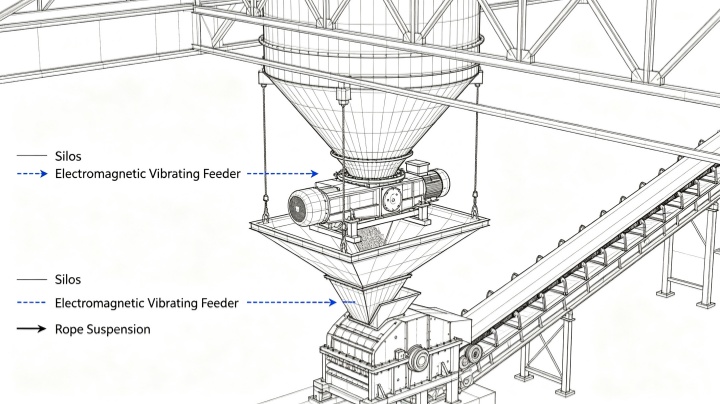
The Electromagnetic Vibrating Feeder (Suspension Type) is a high-performance feeding solution designed for the controlled, uniform, and continuous transfer of bulk materials from storage bins to downstream processing equipment. Widely utilized in mining, metallurgy, coal, chemical, building materials, ceramics, and food industries, this feeder ensures precise material flow with minimal maintenance requirements.
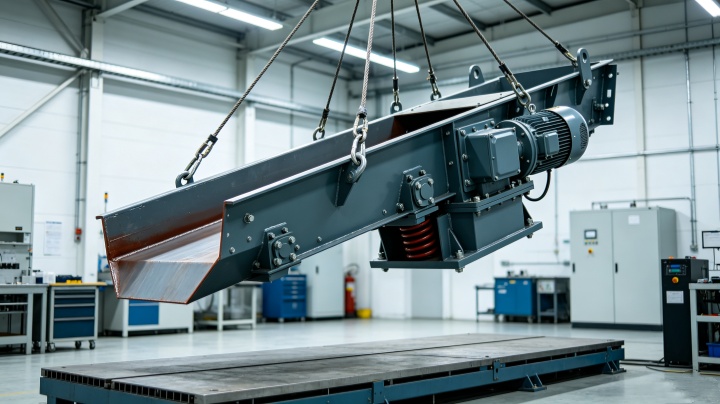
Unlike traditional mechanical feeders, our suspended electromagnetic vibrating feeder operates on a low-critical resonance principle, delivering exceptional energy efficiency and reliability. The suspension mounting design further enhances installation flexibility while reducing structural loading and vibration transmission to surrounding equipment.
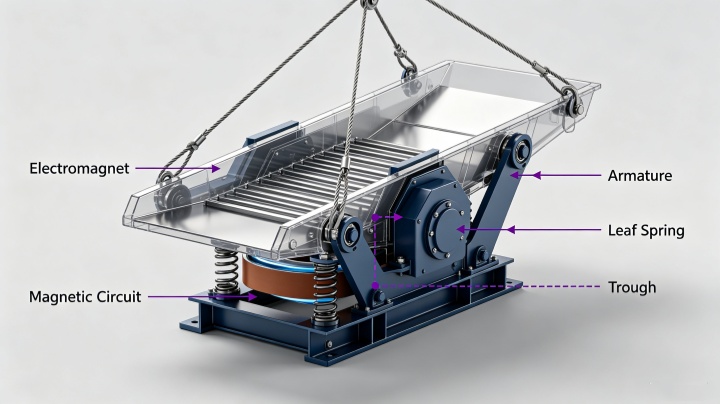
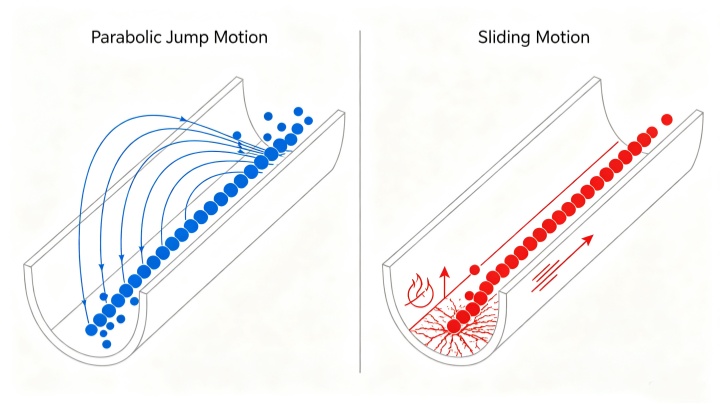
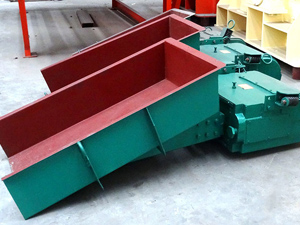
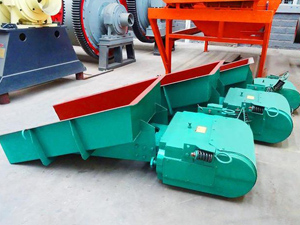
An electromagnetic vibrating feeder is a type of feeding equipment that uses electromagnetic force to generate controlled vibratory motion. The system consists of two primary components: the trough (chute) and the electromagnetic vibrator unit. When energized, the electromagnetic exciter drives the trough to perform reciprocating vibrations at a specific angle, causing materials to move forward along a parabolic trajectory.
Precise Feed Control – Infinitely variable adjustment via manual or automatic control systems
Energy Efficient – Operates in a low-critical resonance state, consuming minimal power
Maintenance-Free Operation – No lubrication required; simple mechanical design
Extended Service Life – Material jumps forward rather than sliding, minimizing trough wear
Quiet Operation – Low noise levels compared to mechanical vibratory feeders
Suspension Mounting: Design and Benefits
Our suspension-type electromagnetic vibrating feeder is engineered for overhead installation, offering distinct advantages over pedestal (floor) mounting configurations.
Structural Composition
The suspended feeder comprises four main assemblies:
Trough Body – Available in open or closed designs; fabricated from wear-resistant steel
Vibrating Frame – Supports the trough and transmits vibratory force
Electromagnetic Vibrator – The drive unit generating reciprocating motion
Damping Device – Includes suspension cables, springs, and safety cables to isolate vibration
| Installation Method | Advantages |
| Suspension (Standard) | Saves floor space; reduces vibration transmission; ideal for restricted access areas |
| Pedestal (Optional) | Simpler installation; suitable for ground-level operation |
| Combined | Hybrid approach for special application requirements |
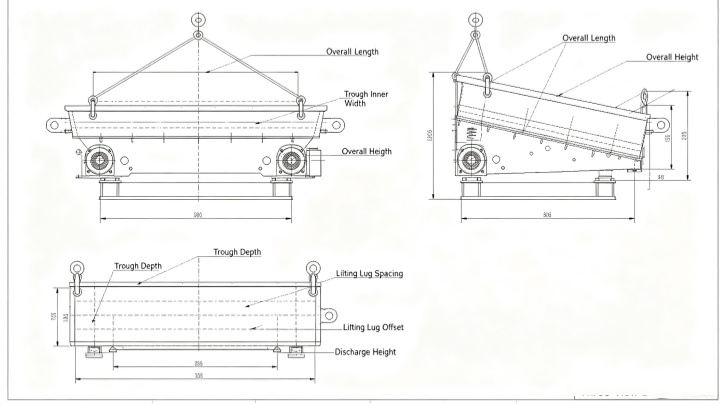
For optimal performance and safety observe these installation guidelines:
Suspension Angle – Install support booms at approximately 10° outward angle to reduce lateral oscillation
Structural Rigidity – Support booms must be mounted on sufficiently rigid structures
Safety Cables – Always install safety cables (rated for 1.0 ton for rear, 5/16" cable for front) to prevent equipment fall in case of primary suspension failure
Clearance Requirements – Maintain minimum clearances: 50 mm longitudinally, 25 mm laterally to prevent collision with adjacent equipment
Horizontal Leveling – Ensure the feeder is level horizontally to prevent material bias to one side
| Model | Feeding Size (mm) | Capacity (t/h) | Power (kW) | Frequency (Hz) | Amplitude (mm) | Exciting Force (kN) |
| ZG(F)-35-90 | 0-60 | 25 | 2×0.25 | 25 | 2-4 | 2×2.5 |
| ZG(F)-40-90 | 0-60 | 30 | 2×0.25 | 25 | 2-4 | 2×2.5 |
| ZG(F)-45-90 | 0-100 | 50 | 2×0.4 | 25 | 2-4 | 2×5 |
| ZG(F)-70-100 | 0-150 | 100 | 2×0.75 | 25 | 2-4 | 2×8 |
| ZG(F)-80-120 | 0-150 | 200 | 2×1.5 | 25 | 2-4 | 2×17 |
| ZG(F)-90-150 | 0-150 | 300 | 2×2.0 | 25 | 2-4 | 2×20 |
| ZG(F)-95-150 | 0-150 | 400 | 2×2.0 | 25 | 4-6 | 2×20 |
| ZG(F)-140-180 | 0-150 | 750 | 2×2.5 | 25 | 4-6 | 2×30 |
| ZG(F)-160-180 | 0-150 | 1000 | 2×3.7 | 25 | 4-6 | 2×50 |
Specifications sourced from industry data
Material Compatibility
Our suspended electromagnetic vibrating feeders handle a wide range of materials:
Ores and minerals (iron ore, copper ore, gold ore, manganese ore)
Aggregates (gravel, granite, basalt, limestone, river stone)
Coal and coke
Chemical powders and granules
Food products (grains, cereals, processed foods)
Cement and building materials
Working Principle
The electromagnetic vibrating feeder operates as a double-mass, forced-vibration elastic system under low-critical resonance conditions.
Electromagnetic Excitation – AC current energizes the electromagnetic coil, creating an alternating magnetic field
Reciprocating Motion – The magnetic field alternately attracts and releases the armature, producing rapid reciprocating vibration
Directional Vibration – The vibration is directed at a specific angle (typically 20°–45° to the horizontal)
Material Propulsion – When the vertical acceleration component exceeds gravitational acceleration, materials are momentarily thrown into the air and propelled forward along a parabolic path
Continuous Flow – This throw-and-catch cycle repeats at the line frequency (50/60 Hz), generating continuous material flow
Unlike sliding motion, the material "jumps" forward, significantly reducing friction between the trough and material, thereby extending trough service life.
1. Precision Feeding Control
Feed rate is infinitely adjustable by regulating the input voltage or current to the electromagnetic coil. This enables:
Manual adjustment via control knob for immediate flow changes
Automatic control integration with upstream/downstream equipment for synchronized production lines
Variable frequency drive (VFD) compatibility for enhanced control precision
2. Superior Energy Efficiency
Operating in a low-critical resonance state, the electromagnetic feeder consumes significantly less power than mechanically driven alternatives. The system requires only enough energy to maintain resonance, not to generate the entire vibratory force.
3. Minimal Maintenance Requirements
No lubrication needed – The electromagnetic drive has no rotating bearings requiring oil or grease
Simple construction – Fewer moving parts means reduced failure points
Easy access – Quick-disconnect covers facilitate inspection and spring replacement
4. Long Service Life
The "jumping" material movement pattern minimizes trough abrasion, extending wear life significantly compared to sliding motion designs. Trough liners can be replaced or added for particularly abrasive materials.
5. Installation Versatility
| Installation Method | Advantages |
| Suspension (Standard) | Saves floor space; reduces vibration transmission; ideal for restricted access areas |
| Pedestal (Optional) | Simpler installation; suitable for ground-level operation |
| Combined | Hybrid approach for special application requirements |
Pre-Installation Checklist
Verify structural supports are adequate for feeder weight and dynamic loads
Confirm power supply matches nameplate specifications (voltage, frequency, phase)
Inspect suspension cables and hardware for damage
Ensure adequate clearance around equipment
Step-by-Step Installation
Suspension System – Install suspension booms at 10° outward angle; attach cables to eyebolts
Safety Cables – Install secondary safety cables to prevent free fall in case of primary suspension failure
Leveling – Ensure the trough is horizontally level to prevent material migration
Electrical Connections – Hard-wire feeder to control; ensure proper grounding
Air Gap Adjustment – Set the core-to-armature air gap to specified dimension (typically 0.062"–0.085")
Commissioning Procedure
With trough empty and control at minimum, start feeder
Gradually increase feed rate, observing for abnormal noise or vibration
Verify no "striking" (metal-to-metal contact) at startup
If striking occurs, adjust soft-start ramp-up time in the controller
Routine Maintenance
| Task | Frequency |
| Check suspension cables and hardware | Monthly |
| Inspect springs for damage or fatigue | Quarterly |
| Clean trough and remove debris | As needed |
| Check air gap dimension | Annually |
| Verify fastening bolt torque | After 8 hours of operation; then quarterly |
CAUTION: Never oil or lubricate the spring assembly—this can attract dust and cause spring failure.
Common Troubleshooting Guide
| Problem | Possible Cause | Solution |
| Unable to start | Power failure; short circuit | Check wiring, fuses, and power supply |
| Unstable current | Loose or broken spring fasteners | Tighten or replace spring bolts |
| High current draw | Excessive air gap | Readjust core-to-armature gap |
| Weak vibration | Rectifier failure; incorrect coil polarity; debris in air gap | Replace rectifier; correct wiring; clean air gap |
| Intermittent operation | Circuit damage | Repair or replace damaged electrical components |
| Excessive noise | Spring damage; loose bolts | Replace springs; tighten all fasteners |
| Discharge blockage | Excessive bin pressure; poor chute design | Reduce bin pressure; modify chute size |
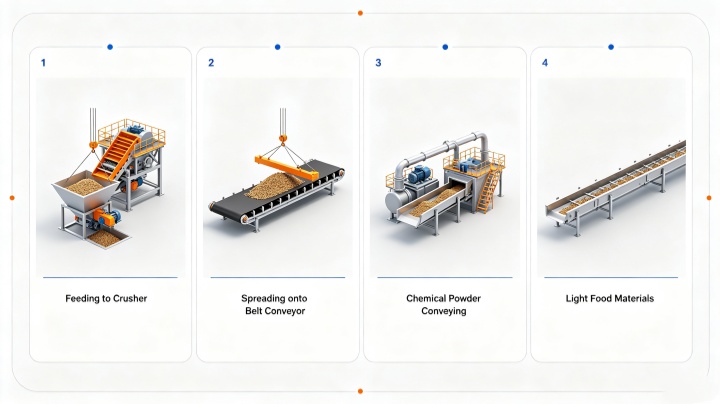
Mining and Aggregates
Primary crusher feed (jaw crushers, gyratory crushers)
Belt conveyor loading from stockpiles
Pre-screening and scalping
Metallurgy and Steel
Furnace charge feeding
Scrap and alloy addition
Flux and additive dosing
Chemical and Fertilizer
Powder and granule metering
Reactor feed systems
Bagging and packaging lines
Building Materials
Cement kiln feed
Aggregate blending
Batching systems
Food Processing
Grain handling and milling
Ingredient metering
Sanitary processing (closed designs)
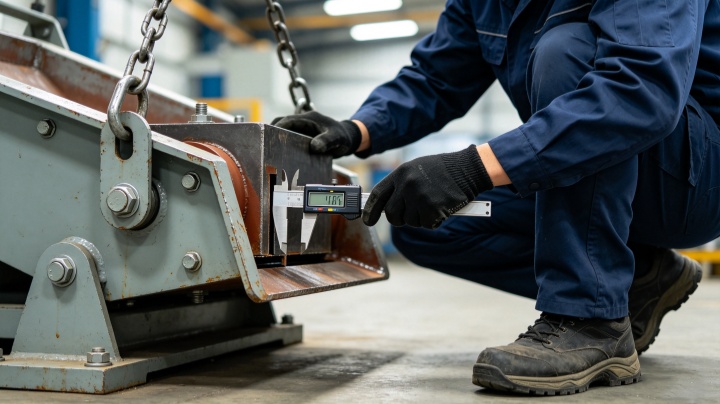
When placing your order, please specify:
Model and size of the desired feeder
Material to be handled – name, bulk density, particle size, moisture content
Required capacity – in tons per hour (t/h)
Installation type – suspension, pedestal, or combined
Trough configuration – open or closed type
Special requirements – liners, dust enclosures, coatings, custom dimensions
| Feature | Our Advantage |
| Quality | Manufactured to international standards with rigorous quality control |
| Experience | Proven performance in demanding applications worldwide |
| Customization | Available in open/closed configurations; custom trough dimensions |
| Support | Complete technical documentation and after-sales support |
| Value | Competitive pricing without compromising quality or reliability |
Ready to improve your material handling efficiency? Contact our engineering team today for expert selection and quotation.


Address:China,Yanjin county forest park gate to the west 1000 meters north road.


 Online Chat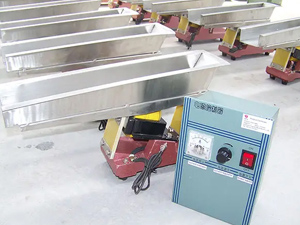
 Email
Email