


Selecting the right circular vibrating screen is rarely just about capacity; it is a critical operational pivot that dictates your production line's long-term throughput and product consistency. As heavy-duty screening equipment manufacturers, our engineering team frequently encounters plant managers facing persistent downtime—often because their equipment selection fails to account for real-world variables like bulk density, moisture content, and actual feed variance.
True operational optimization requires moving beyond generic manufacturer datasheets toward a rigorous assessment of your specific site requirements. This guide outlines six professional engineering criteria to help you bridge the gap between technical specifications and your real-world production needs, ensuring lasting output stability.
Need immediate sizing assistance for your specific material?
Our engineers can help you evaluate feed rates and mesh configurations. Request a Free Screening Solution & Parameters Consultation >>
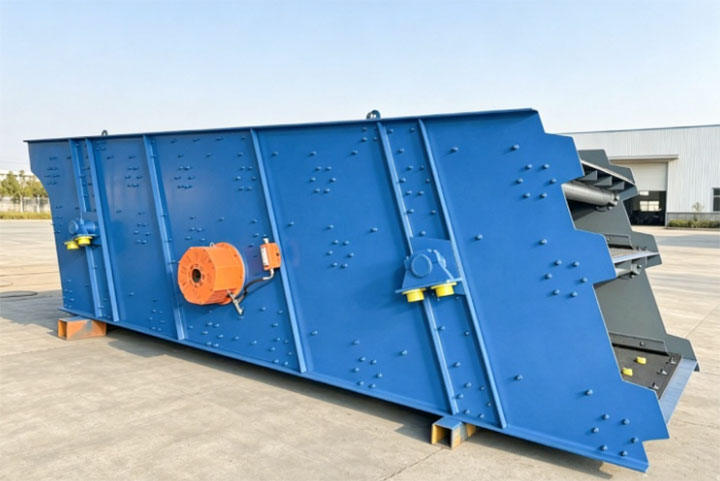
The industrial circular vibrating screen handles heavy-duty processing through a robust eccentric shaft or block exciter. This mechanism drives the entire screen box in a continuous, high-frequency orbital trajectory. Unlike lighter equipment—or linear vibrating screens designed primarily for horizontal dewatering and initial bulk sizing—this intense circular motion forces heavy ores or materials to tumble and stratify rapidly. It creates a three-dimensional agitation effect that effectively prevents the blinding (clogging) of the screen mesh while maintaining high-volume throughput in continuous operation.
Watch: See Dahan heavy-duty circular vibrating screen in action, demonstrating continuous orbital trajectory and high-volume material stratification.
To ensure your heavy-duty screening operation maintains peak efficiency, evaluate prospective equipment against these six operational benchmarks:
Focus on bulk density, moisture levels, and particle shape. Dense, abrasive ores demand high-intensity orbital force and heavy-duty deck plates; conversely, high-moisture feeds require optimized deck angles and anti-blinding media to combat adhesion.
Nominal capacity ratings often fail to reflect operational reality during peak feed surges. Sizing equipment based on maximum surge load is essential to ensure proper material stratification across the entire screen width.
Achieving the balance between throughput and structural rigidity centers on the open area ratio. Excessive mesh flex under high loads leads to inconsistent aperture sizes, directly degrading cut-point precision.
The exciter delivers enough force to maintain bed movement regardless of feed rate. Adjustable amplitude settings provide the necessary control to adapt to seasonal material changes or varying feed compositions.
High-load mining and aggregate environments punish equipment with constant stress. Prioritize screens with stress-relieved side plates and modular wear liners in high-impact zones to prevent fatigue-related structural failure.
Evaluate the TCO beyond the initial invoice. Consider motor efficiency, the ease of screen media access, and the global availability of standard bearings to keep your cost-per-ton metrics competitive.
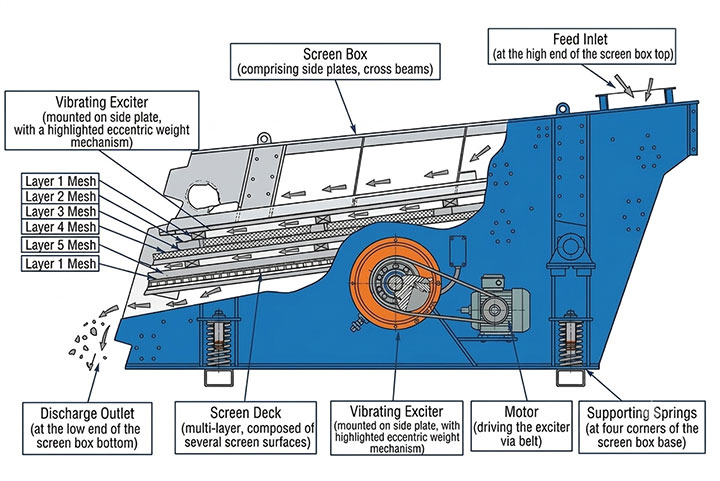
The continuous orbital motion and internal material flow illustrated below act as the mechanical foundation satisfying the six operational benchmarks discussed above. Maintaining this consistent trajectory mitigates material blinding and locks in the throughput capacity required for heavy-duty sites.
Common missteps in equipment selection frequently translate into immediate production losses. By recognizing these technical gaps, you can shift from a reactive maintenance posture to a high-output operational mode using robust industrial equipment like a heavy-duty vibrating screen.
Matching Excitation to Material Flow: Tuning the orbital intensity to match your specific feed characteristics forces material to move actively across the deck, minimizing stagnant zones and consistently driving higher throughput.
Optimizing Bed Depth for Stratification: Optimization requires fine-tuning the amplitude to "open up" the material bed, allowing fines to migrate to the deck surface efficiently.
Correcting Media-Material Mismatch: Aligning the open area ratio with the material’s specific particle morphology breaks the cycle of constant, unplanned shutdowns.
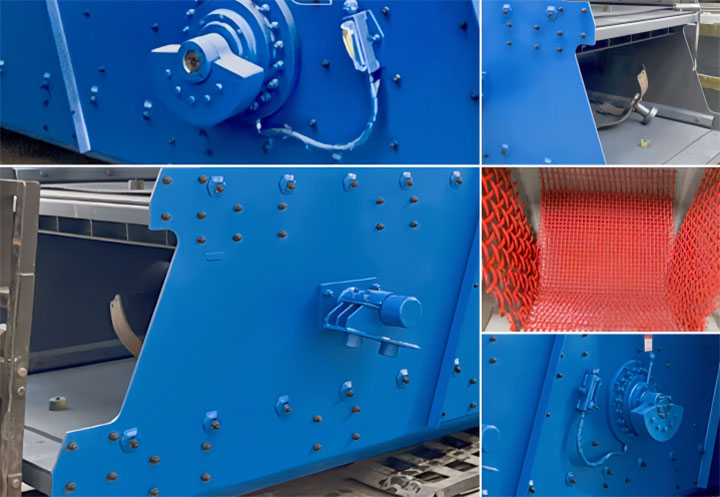
Standard equipment specifications often provide only a baseline. Our engineering team is available to assist you in developing a Customized Material Screening Solution. By reviewing your feed characteristics and site constraints, we can help define an equipment configuration designed to maximize your vibratory screening efficiency, reduce reactive maintenance cycles, and optimize your overall cost per ton.
The primary difference lies in their motion trajectory and application. A circular vibrating screen uses an eccentric exciter to create a continuous orbital trajectory, providing high-intensity, three-dimensional agitation ideal for heavy-duty material tumbling, sizing, and preventing mesh blinding. A linear vibrating screen utilizes dual-vibration motors for a linear motion, which is typically optimized for horizontal dewatering, grading, and fine sizing.
Mesh selection depends directly on your target particle cut-point, material bulk density, and moisture content. Generally, high-abrasion ores require heavy-duty woven or polyurethane mesh with an optimized open area ratio to prevent blinding while maintaining structural durability under high surge loads.
Yes. As a direct manufacturing factory, Dahan Machinery provides fully customized solutions. We can tailor the deck count, screen material (such as stainless steel or carbon steel), motor power, and special anti-corrosion or dust-proof enclosures to match your specific plant layout and material characteristics.
Share your material specs (bulk density, size, moisture, and capacity), and our senior engineers will calculate the exact machine model and mesh configuration for your plant.
Consult Our Screening Engineers >>


Address:China,Yanjin county forest park gate to the west 1000 meters north road.


 Online Chat
 Email
Email