


In fine powder processing, selecting the wrong screen mesh or failing to control mesh blinding leads directly to plummeting throughput and spiraling energy waste. Achieving precise particle separation requires balancing mesh geometry against powder rheology, supported by high-frequency ultrasonic energy when mechanical vibration hits its limit.
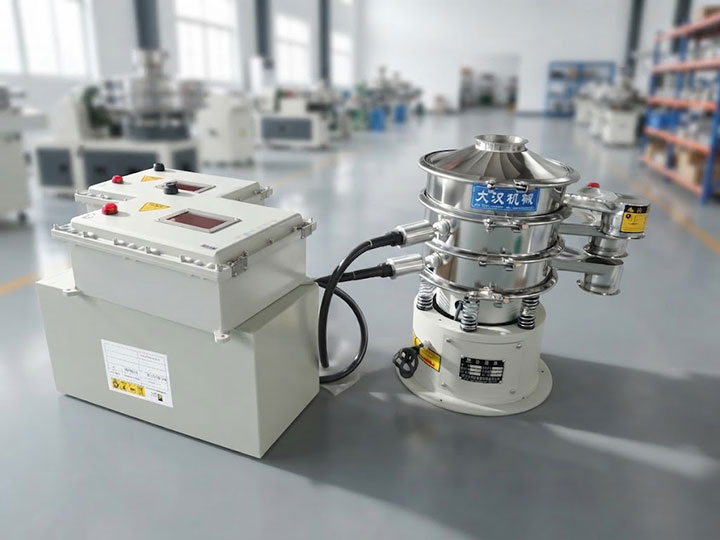
Choosing an industrial screen mesh is not merely a matter of matching aperture size to a target particle dimension. Real-world powder behavior—such as agglomeration tendencies, bulk density, and electrostatic charge—dictates how material interacts with the screening surface.
| Target Particle Size / Mesh | Primary Powder Behavior | Recommended Screening Solution |
|---|---|---|
| Coarse (> 40 Mesh / > 400µm) | High flowability, minimal surface tension | Standard linear or rotary vibrating screen |
| Medium (40 - 200 Mesh / 74µm - 400µm) | Moderate friction, minor bridging risk | Standard mesh with mechanical bouncing balls |
| Fine & Ultra-Fine (< 200 Mesh / < 74µm) | High agglomeration, static cling, severe blinding | Rotary sieve / Vibrating screen + Ultrasonic De-blinding System |
When processing powders below 200 mesh, standard mechanical throw forces fail to overcome inter-particle cohesion. Mapping your material's rheological profile first prevents costly trial-and-error changes on the production line.
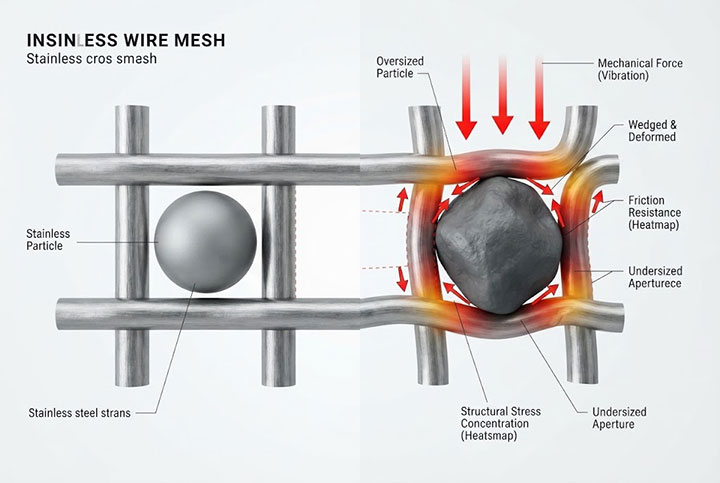
A common engineering misconception is that selecting the finest available mesh guarantees superior product quality. In practice, over-specifying mesh density often triggers a severe trade-off: skyrocketing rejection rates and catastrophic drops in overall plant throughput.
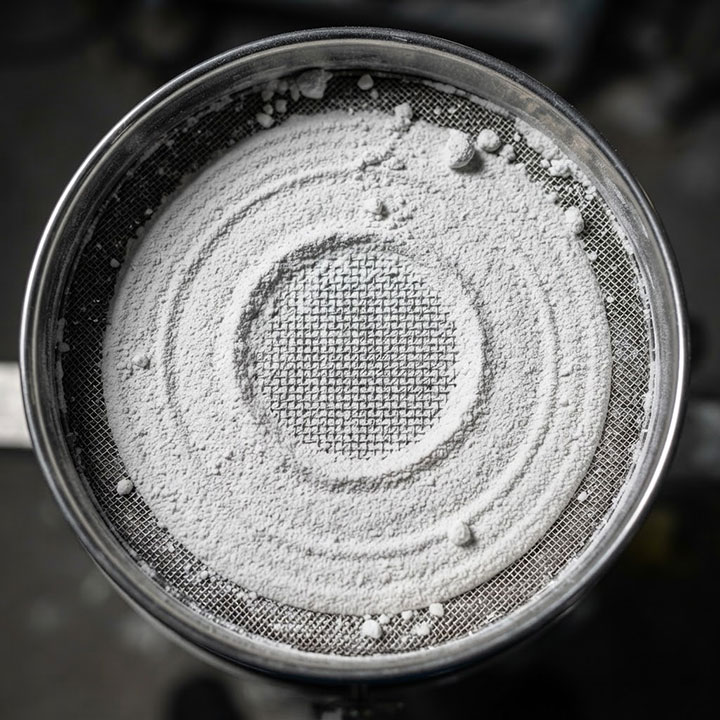
When screen apertures approach the particle size limit without accounting for material surface energy, three major issues occur:
Before locking in a high-density specification, evaluate your true downstream purity requirements rather than defaulting to the absolute minimum micron size.
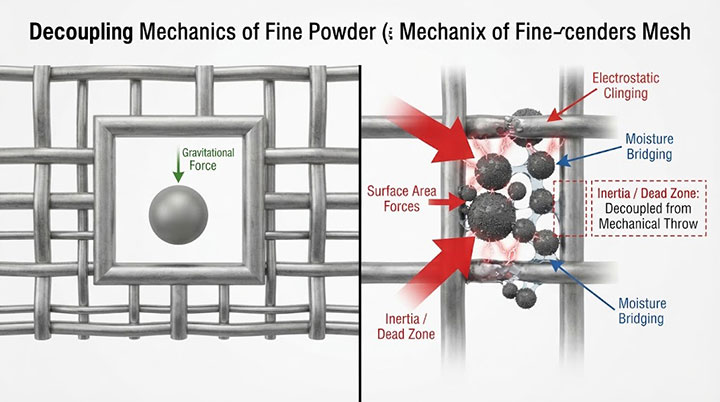
Every industrial vibrating screen operates on mechanical throw—launching particles upward and outward to encourage passage through the mesh. However, for powders finer than 200 mesh, standard gravity and mechanical vibration encounter a distinct physical barrier.
As particle size decreases, surface-area-to-mass ratios shift dramatically. Inter-particle forces, moisture bridges, and electrostatic charges begin to outweigh gravitational pull. When this happens, standard screens hit a wall:
Recognizing the exact threshold where mechanical throw loses efficacy is the critical turning point for introducing secondary energy assistance.
When standard mechanical vibration fails against fine-powder blinding, integrating a high-frequency ultrasonic system provides the necessary physical breakthrough. The core mechanism involves superimposing a low-amplitude, high-frequency ultrasonic wave directly onto the screen mesh.
Successful ultrasonic integration relies on specific engineering protocols:
By pairing ultrasonic excitation with your screening deck, fine powders pass through the mesh cleanly, drastically increasing effective screening area and overall output.
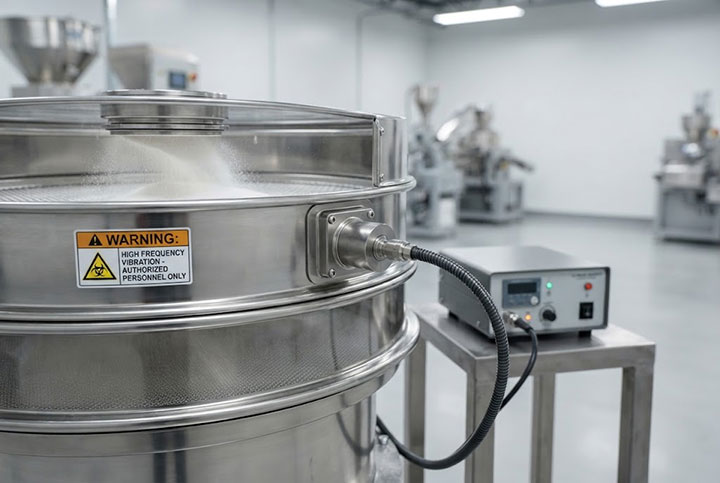
In our industrial testing laboratory at Dahan Machinery, electrostatic adhesion is among the most frequent obstacles reported during ultra-fine powder classification. When handling materials such as fine metal powders, toner, or pharmaceutical chemicals, static charge causes particles to cluster into larger pseudo-particles that flatly refuse to pass through standard apertures.
Applying these lab-tested calibration protocols allows processing lines to handle high-static fine powders continuously without manual intervention or frequent shutdowns.
Watch: Laboratory demonstration comparing standard screening vs. ultrasonic-assisted screening for highly adhesive graphite powders.
Our testing data reveals several critical insights for overcoming static cling:
Applying these lab-tested calibration protocols allows processing lines to handle high-static fine powders continuously without manual intervention or frequent shutdowns.
Theoretical screening efficiency must ultimately be proven on the production floor. To evaluate the true performance impact of adding an ultrasonic de-blinding system, our engineering team tracked operational metrics across continuous processing lines handling fine abrasive and chemical powders.
Demonstration of ultrasonic de-blinding on a 120-mesh screen handling fine soybean meal.
| Performance Metric | Standard Mechanical Screening | Ultrasonic-Assisted Screening |
|---|---|---|
| Effective Throughput (325 Mesh) | Baseline (Moderate output, rapid blinding) | Up to 2.5x increase in continuous output |
| Mesh Lifespan / Maintenance Interval | Frequent manual cleaning required every 2–4 hours | Continuous operation over extended multi-shift cycles |
| Product Purity & Pass Rate | Inconsistent due to blinding and particle agglomeration | Stable, high-precision grading with zero oversize contamination |
These field metrics confirm that integrating ultrasonic technology eliminates production bottlenecks, transforming high-maintenance fine screening into a reliable, high-yield operation.
Even the most advanced ultrasonic screening system requires disciplined maintenance to sustain peak performance over years of industrial operation. Neglecting basic mechanical and acoustic upkeep leads to premature mesh fatigue and declining separation accuracy.
Key maintenance practices to protect your screening investment include:
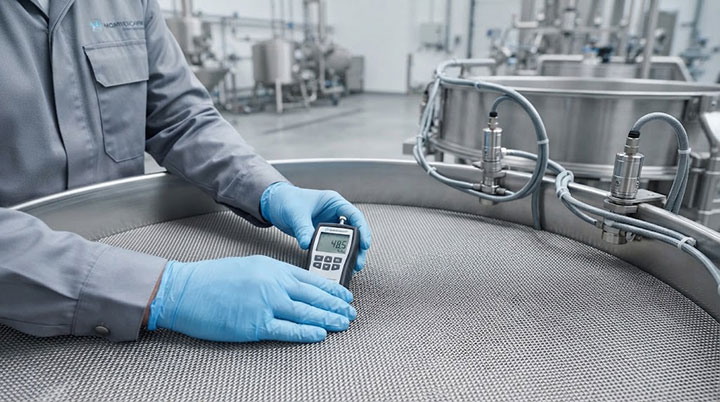
Implementing a structured preventive maintenance routine maximizes equipment uptime, preserves screening precision, and significantly extends the operational lifespan of both your mesh and ultrasonic assemblies.
No. When properly tuned, the high-frequency, low-amplitude vibration operates at a microscopic scale that neutralizes surface tension without inducing fatigue stress on the wire strands. In fact, by eliminating manual scraping and abrasive cleaning tools, ultrasonic systems often extend the functional lifespan of fine wire mesh.
Generator power must be matched to the specific surface area and mesh density of each individual deck rather than total machine throughput. Fine particle decks requiring ultrasonic assistance typically demand dedicated transducer distribution to ensure uniform resonance across the entire screening surface.
Ultrasonic systems excel at breaking electrostatic charges and fine powder agglomeration, but they have physical boundaries with high-moisture (sticky) materials. If moisture content exceeds normal atmospheric thresholds, pre-drying or thermal-assisted screening solutions should be evaluated alongside ultrasonic integration.
As a general industrial benchmark, powders finer than 200 mesh (74 microns) experience a sharp decline in gravity-fed pass rates due to inter-particle cohesion. If your current mechanical screen experiences rapid blinding within hours of processing sub-200 mesh material, it is the critical threshold to introduce ultrasonic assistance.
Selecting the right mesh size and ultrasonic configuration depends heavily on your specific material rheology, particle distribution, and throughput goals. Our engineering team at Dahan Machinery can run material tests and provide a custom technical proposal.
Request a Free Technical Consultation & Quote


Address:China,Yanjin county forest park gate to the west 1000 meters north road.


 Online Chat
 Email
Email