


Most processing lines run smoothly until they meet fine, moisture-rich, or electrostatic powders and high-viscosity slurries. When materials get sticky, standard vibratory separators often struggle, leaving operators with a costly dilemma: slow down the feed rate or shut down the line to clean blinded screens.
If your production depends on high-throughput separation of difficult materials, a standard vibratory screening machine might not cut it. You need a setup designed to handle high surface tension and micro-particles without constant maintenance. That is where high-frequency vibrating screens come into play.
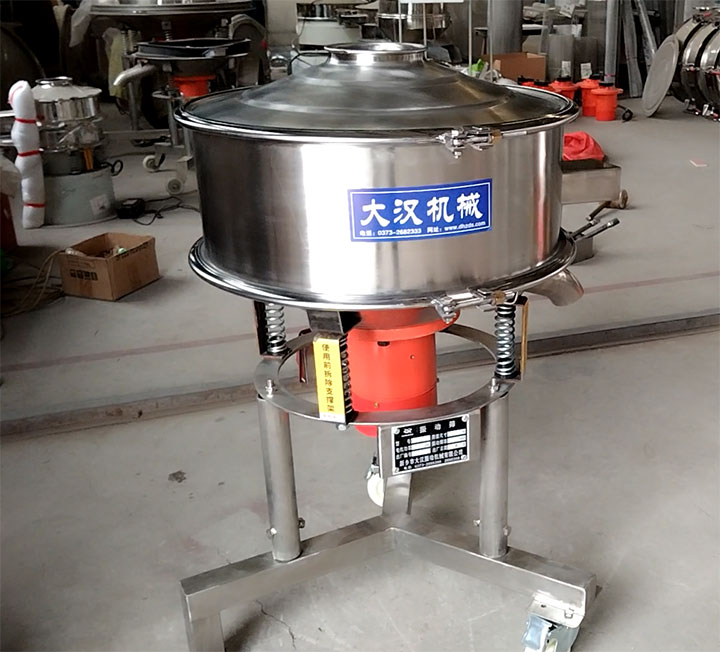
When handling dry, coarse aggregates, gravity and basic mechanical shaking are usually enough to keep material moving. But everything changes when particles shrink below 2 mm or carry moisture, making them behave more like a cohesive paste than free-flowing solids.
Instead of passing through the mesh, these fine particles or thick viscous liquids cling to the wire cloth. This phenomenon, known as screen blinding, quickly snowballs. As more material accumulates, the open area of your screen drops to zero, bringing immediate consequences:
Using brute force or larger screen openings is rarely the answer, as it directly compromises your final product quality. To keep the line running, the solution lies not in shaking harder, but in changing how the vibration is applied.
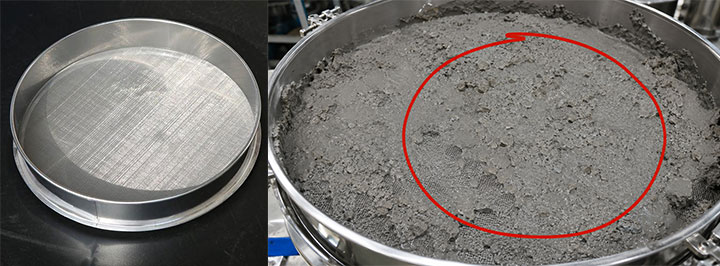
A standard rotary vibratory sifter operates at speeds between 900 and 1500 RPM. While this movement is great for general grading, it is incredibly inefficient for sticky slurries or ultra-fine powders. The large, slow movements actually allow sticky particles to settle and bind together on the screen mesh.
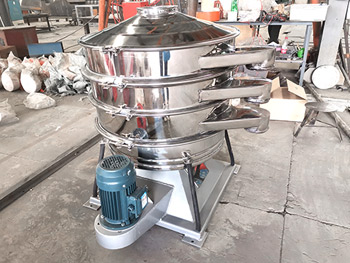
High-frequency screens throw out that old playbook. By using specialized high-speed vibrators operating at 3000 RPM, they generate intense, micro-vibrations with a small amplitude of under 2 mm directly on the screen surface.
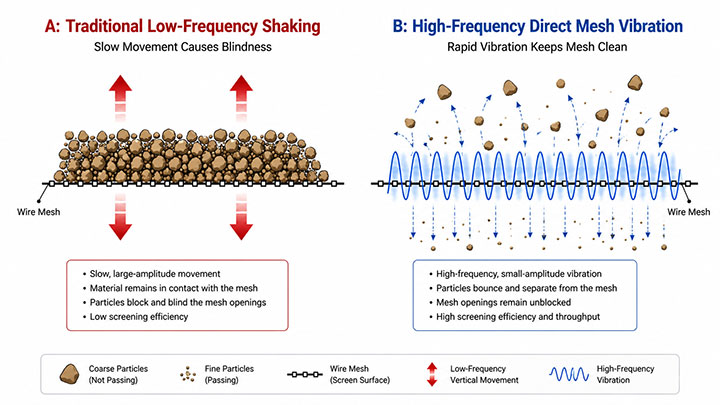
This localized high-frequency energy produces two massive mechanical benefits:
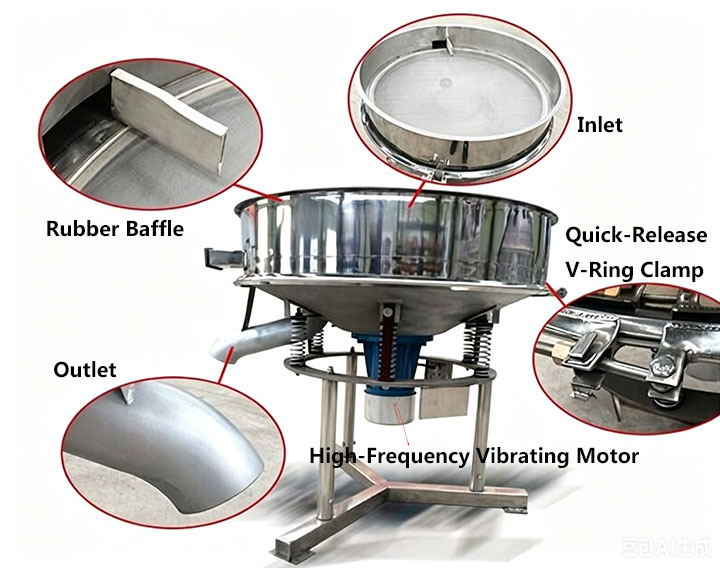
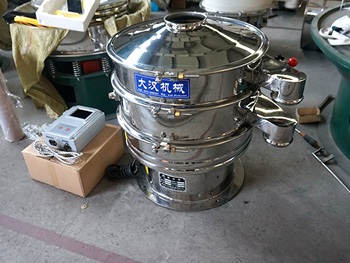
This disk-shaped, compact design is not just about vibrating faster; it is about applying energy precisely to maximize throughput without splashing or losing fluid efficiency.
Share your material parameters (particle size, moisture, capacity) with our senior engineers. We provide a free custom screening evaluation and test report within 24 hours.
Chat on WhatsApp for Quick Solution Send Inquiry via EmailTo understand why high-frequency screening works, you have to look at how moisture and viscosity behave at the microscopic level. When fine materials contain water or run as a liquid slurry, they form liquid bridges between individual particles and the metal wire of the screen. This surface tension acts like a microscopic glue.
Standard separators simply do not have the speed to break these liquid bonds. The sticky paste or liquid just rides along the screen, blocking the holes within minutes.
High-frequency vibration alters this dynamic by shifting the energy balance. The intense 3000 RPM micro-strokes deliver massive acceleration directly to the material. This continuous energy creates a force that counteracts the sticky bond of surface tension. Instead of clinging to the wire, the moisture films are disrupted, allowing the fine particles to separate from each other, drop through the clear mesh, and keep your production flowing.
Investing in a high-frequency vibrating screen involves more than just picking a motor size. To ensure the equipment matches your production goals, evaluate these four critical performance metrics:
| Material Challenge | Optimal Concentration / Size | Recommended Screen Configuration |
|---|---|---|
| Ceramic Slurry & Clay Glaze | 30% – 40% Slurry Concentration | 3000 RPM Motor, Disk-shaped Design, Fine Mesh |
| Electrostatic Chemical Powders | Under 0.2 mm Particle Size | Stainless Steel 304/316L, Under 2 mm Amplitude |
| Sticky Limestone & Mineral Dust | 1.0 mm – 3.0 mm Particle Size | High G-force Configuration, Mobile Support Frame |
No two sticky materials behave exactly the same way. A screening frequency that works perfectly for liquid ceramic glaze might cause dry limestone dust to agglomerate or static powder to blind the mesh entirely. Relying on an off-the-shelf, standard machine setup without analyzing your specific material characteristics is usually a recipe for lost efficiency.
If high-frequency direct vibration is not the exact fit for your plant layout, or if you are handling ultra-fine, dry electrostatic powders under 200 mesh, we offer other high-performance separators to keep your line running smoothly:
Getting the highest possible yield from a difficult production feed requires a targeted approach. This means choosing a high-frequency vibrating screen designed with the right motor power, stroke amplitude, and cloth material that matches your daily plant realities. When these variables align, you get a clean separation process, zero unexpected downtime, and a final product that meets your exact grade specifications.
If fine, sticky materials are currently capping your plant’s daily throughput or forcing your crew into frequent maintenance shutdowns, you do not have to guess at the right solution. Our engineering team can help you analyze your material behavior and configure a custom vibratory screening system tailored for your specific footprint. Get in touch with us today to discuss your application parameters and get a reliable equipment recommendation.
Speak directly with our industrial screening experts to get a tailored configuration and competitive factory pricing.
Request a Quote & Technical SupportA high-frequency vibrating screen operates at around 3000 RPM with a small amplitude of under 2 mm. This generates high G-force acceleration directly on the mesh surface, instantly disrupting moisture surface tension and liquid bridges to prevent sticky particles from clogging the wire cloth.
For high-viscosity liquids and slurries (such as ceramic glazes and clay slurries), maintaining an inlet concentration between 30% and 40% ensures smooth passage and allows the high-speed waves to rapidly disperse agglomerated clumps.
It depends on your material type. High-frequency screens are best for high-throughput separation of moisture-rich, sticky materials and slurries. Ultrasonic vibrating screens are ideal for ultra-fine, dry electrostatic powders (under 200 mesh) where ultrasonic waves are needed to break static charges.


Address:China,Yanjin county forest park gate to the west 1000 meters north road.


 Online Chat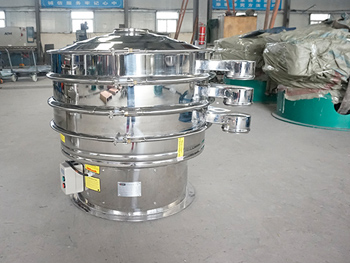
 Email
Email