How to Prevent Vibrating Screen Blinding: Troubleshooting Causes & Solutions
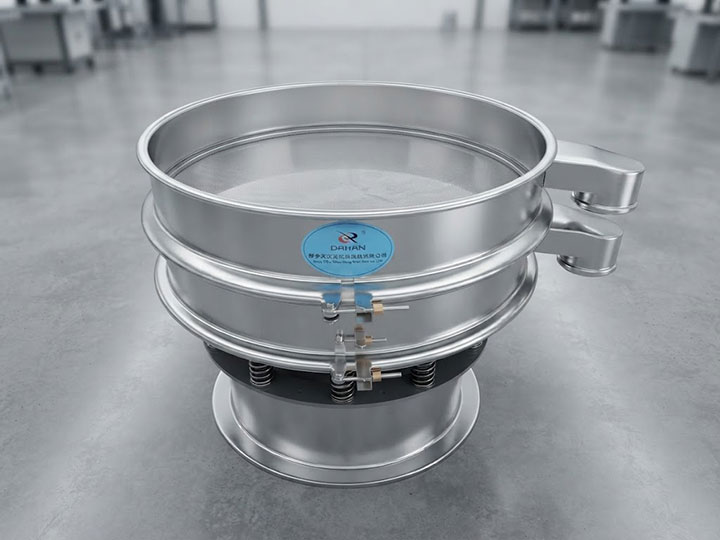
Mesh blinding is one of the most persistent bottlenecks in continuous industrial screening. When separation efficiency drops, plant throughput halts, and operating costs escalate rapidly. Addressing this failure requires looking beyond temporary cleanups and diagnosing the mechanical and material triggers at play.
Why Standard Screening Lines Fall Victim to Blinding
The Ripple Effect of Mesh Clogging on Downstream Processing Capacity
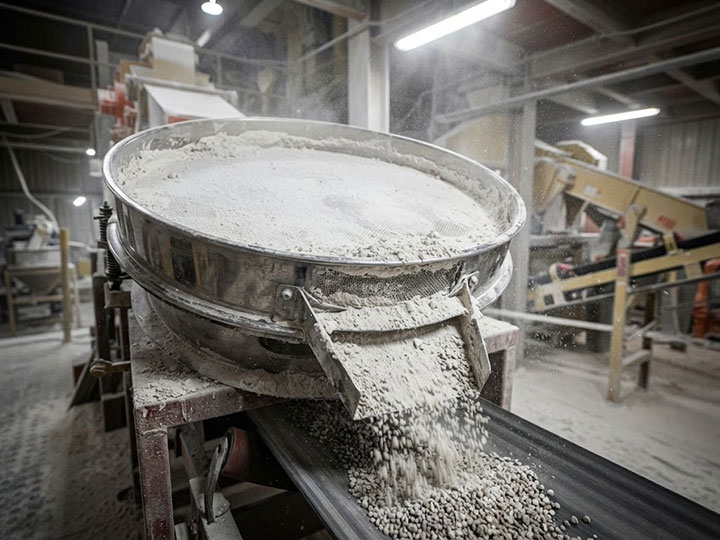
When screen apertures begin to blind or peg, the mass balance of the entire processing circuit breaks down. Oversized particles bleed into fine fractions, while near-size material recirculates needlessly, overloading feed conveyors and starving downstream mills or classifiers. This invisible choke point compresses profit margins through unscheduled downtime, elevated energy consumption per ton, and premature wear on upstream and downstream machinery alike.
Blinding vs. Pegging: The Two Distinct Mechanical Failures Operators Misdiagnose
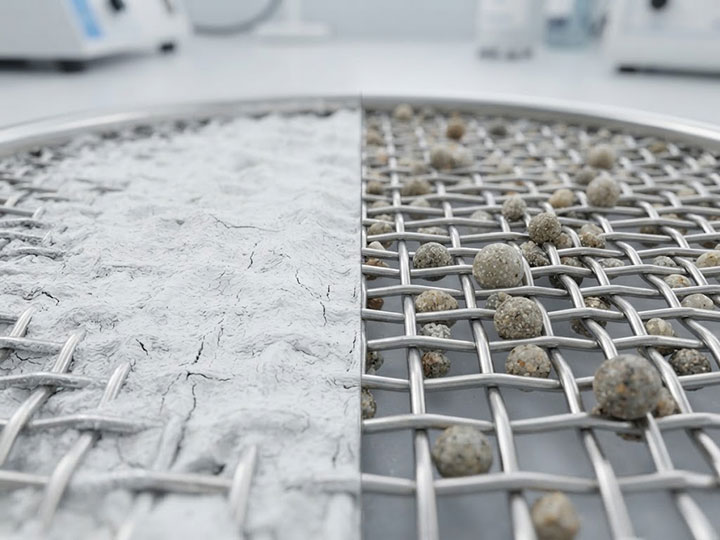
Plant operators frequently conflate two fundamentally different physical mechanisms: blinding and pegging. Blinding occurs when moisture-laden, fine cohesive particles adhere directly to the wire filaments or form a continuous superficial film across the open area of the mesh. Pegging, by contrast, happens when individual near-size particles wedge mechanically into the aperture geometry under sustained dynamic pressure. Accurately distinguishing between the two dictates whether the correct remedy is surface modification or kinetic parameter adjustment.
The Root Triggers: Material Behavior vs. Mechanical Parameters
Moisture Thresholds and Cohesive Fine Aggregates in Continuous Feeds
Surface moisture acts as a primary catalyst for mesh blinding. When feed moisture crosses a specific alloy or polymer threshold, capillary forces and surface tension bind fine particles into cohesive agglomerates. These clusters rapidly coat the screen wire, bridging open apertures and choking the effective screening area long before the bed depth reaches discharge.
The Physics of Near-Size Particles Trapped in Aperture Geometries
Pegging is fundamentally a geometrical conflict. Particles dimensionally close to the nominal mesh opening—known as near-size fractions—encounter aperture boundaries at suboptimal angles under continuous vibrational thrust. Instead of bouncing clear, these particles wedge tightly into the weave or punched plate profile, wedging so firmly that standard gravity discharge fails.
Energy Starvation: When Vibration Amplitude Fails to Overcome Inter-Particle Friction
Screening efficiency relies on continuous particle fluidization across the deck. When stroke amplitude drops or eccentric weight distribution creates dead zones, the kinetic energy transferred to the material bed becomes insufficient to overcome inter-particle friction. Without adequate vertical acceleration, the material compacts rather than stratifies, sealing the mesh surface prematurely.
Engineering Countermeasures: Moving Beyond Reactive Maintenance
Upgrading Screen Media: Polyurethane Elastomers vs. Traditional Woven Wire
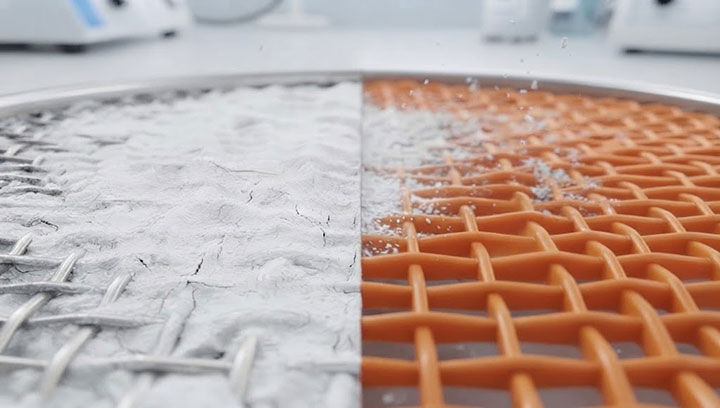
Replacing traditional high-carbon steel wire cloth with modular polyurethane or rubber panels offers a direct mechanical advantage against sticky blinding. Polyurethane’s high elasticity and anti-stick surface properties allow the mesh apertures to flex dynamically under vibration, shedding cohesive fines before a stagnant cake can form.
Mechanical Self-Cleaning Integration: Harnessing Bounce and Kinetic Energy
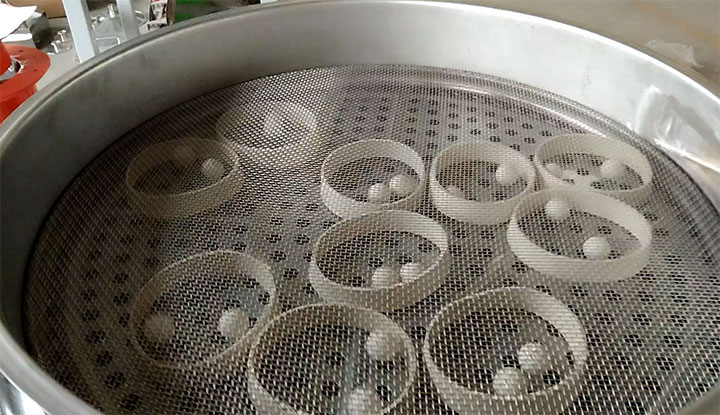
For fine dry powders prone to static and blinding, integrating mechanical accessories beneath the screen deck is essential. Sub-screen ball trays or slider rings utilize the continuous, chaotic impacts of bouncing elastomer spheres to strike the underside of the mesh, dislodging wedged particles and clearing blocked apertures without interrupting production.
Optimizing Throw Angles and Stroke Kinetics for Sticky Materials
Overcoming high-moisture cohesion requires tuning the machine's throwing characteristics. Adjusting the dynamic throw angle and increasing stroke intensity forces a more aggressive forward trajectory, breaking up cohesive surface mats and ensuring that near-size particles are repeatedly lifted and re-oriented rather than left to pack down.
Real-World Case Insights: Tackling Blinding in High-Moisture and Fine Powder Processing
Resolving Screen Clogging in Fine Chemical Powder Screening
A chemical processing plant struggling with electrostatic fine powders experienced severe mesh blinding on traditional wire screens, cutting throughput by nearly 40%. By retrofitting the multi-deck setup with self-cleaning bouncing ball trays and transitioning to precision aperture stainless steel assemblies, the facility eliminated aperture bridging and restored full continuous design capacity.
Overcoming Blinding Challenges in High-Humidity Mineral Grading
Processing clay-bearing minerals under high ambient humidity frequently causes rapid near-size pegging. A mid-sized aggregate operation solved this by adjusting eccentric block phase angles to increase vertical throw acceleration, combined with high-elasticity polyurethane panels that actively flexed to break up cohesive moisture mats.
Built-In Mitigation: How Modern Equipment Design Prevents Blinding at the Source
Precision Mesh Tensioning Systems to Stop Dead Zones
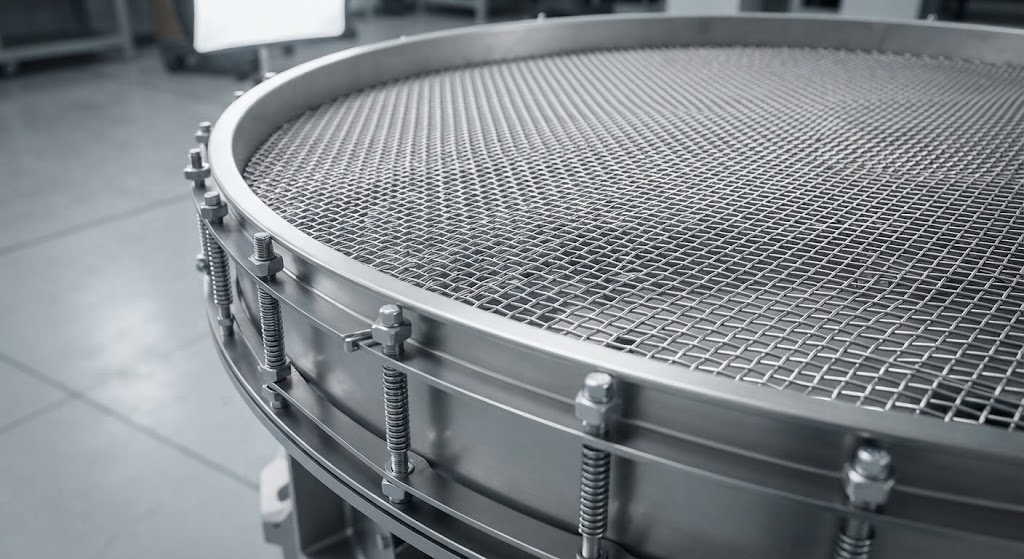
Even the highest-grade screen media will blind prematurely if poorly tensioned. Side-tensioned and end-tensioned crown bars must maintain uniform, high-tensile surface tautness across the entire screening deck. Removing loose spots prevents localized sagging where near-size particles collect and dead zones form.
Tailored Vibrating Parameters for Specific Industrial Minerals and Chemicals
Effective blinding mitigation is never a one-size-fits-all metric. Modern vibratory screening equipment requires custom-engineered motor power, adjustable eccentric block configurations, and optimized centrifugal force ratings tailored directly to the specific bulk density, moisture content, and particle size distribution of the material being processed.
Diagnostic Checklist: A Plant Manager’s Framework for Instant Resolution
Step-by-Step Troubleshooting Workflow for Plant Maintenance Teams
When sudden mesh blinding halts your production line, execute this systematic diagnostic checklist to restore efficiency quickly:
-
Step 1: Feed Rate Audit – Verify that the feed rate matches the machine's designed volumetric capacity to prevent excessive bed depth.
-
Step 2: Tension Inspection – Check all side and end tensioning bars for loose spots or localized sagging across the mesh deck.
-
Step 3: Moisture & Particle Analysis – Test incoming material for moisture spikes or shifts in near-size particle distribution.
-
Step 4: Kinetic Tuning – Inspect motor eccentric block settings and stroke amplitude to ensure adequate vertical acceleration.
-
Step 5: Media & Accessory Check – Evaluate whether screen media requires an upgrade to polyurethane or the addition of anti-blinding ball trays.
Frequently Asked Questions (FAQs) on Vibrating Screen Blinding
Can ultrasonic systems entirely prevent mesh blinding for ultra-fine powders?
Ultrasonic screening systems drastically reduce blinding for dry, ultra-fine powders (typically 300 mesh and finer) by imparting high-frequency, low-amplitude secondary vibrations directly to the mesh. However, they are not a universal fix for extreme moisture or sticky cohesive clays, where mechanical ball trays or wet screening remain necessary.
How does ambient humidity change the critical moisture threshold for screen blinding?
High ambient humidity increases surface moisture absorption in hydroscopic powders and fine minerals, lowering the critical moisture threshold at which blinding occurs. Operators must adjust feed pre-drying protocols or increase screen stroke intensity during humid operating conditions.
When should a plant manager choose polyurethane panels over stainless steel mesh?
Polyurethane panels are ideal for sticky, abrasive, or high-moisture materials where traditional wire mesh rapidly blinds or wears out. If your application involves severe blinding with abrasive slurries or fine aggregates, switching to modular polyurethane usually delivers superior longevity and self-cleaning flex. If you are unsure which screen media suits your specific material, Dahan Machinery’s engineering team offers free technical consultation and material testing.





 Email
Email