Your location is: Home > News Center > Heavy-Duty Circular Vibrating Screen Bearing Failures: Common Causes and Troubleshooting Guide

Heavy-Duty Circular Vibrating Screen Bearing Failures: Common Causes and Troubleshooting Guide

The Harsh Operational Realities of Heavy-Duty Circular Screens

Unlike standard conveyors or closed-loop motors, heavy-duty circular vibrating screens operate under exceptionally punishing conditions. Driven by high centrifugal forces from eccentric block assemblies, these machines endure continuous multi-directional shock loads, abrasive mineral dust, and rapid cyclic stress.

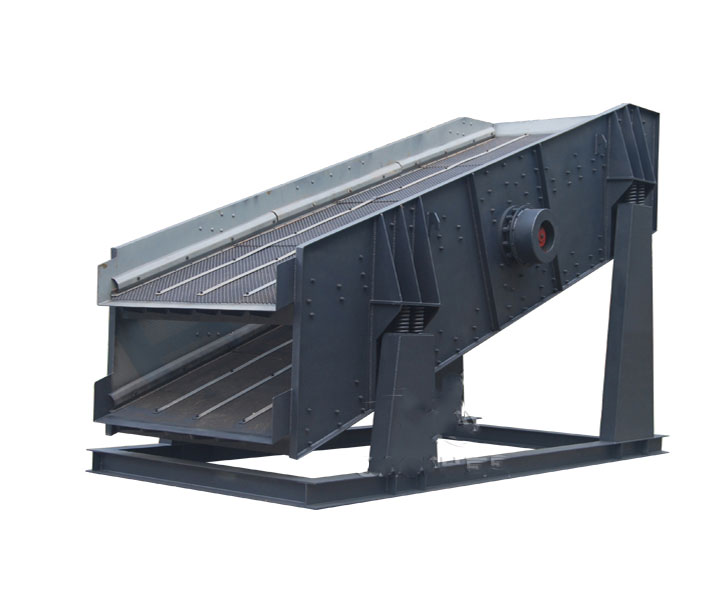
Visual Reference: Heavy-duty circular vibrating screen structure in operation.

In this high-vibration environment, the support bearings act as the critical load-transfer hubs. Every rotation subjects the rolling elements to immense radial forces, making the bearing zone the most vulnerable failure point in the entire screening assembly if operating margins are pushed too far.

Distinctive Failure Signatures: How High G-Force Damages Bearings

The intense centrifugal acceleration generated by heavy-duty circular screens creates specific bearing failure patterns that differ significantly from standard industrial rotating equipment. Recognizing these signatures is the first step toward accurate diagnosis:

Technical infographic triptych comparing three distinct bearing failure modes in heavy-duty circular vibrating screens: 1. Rolling Contact Fatigue (Spalling), 2. False Brinelling wear marks, 3. Thermal Runaway seizure and discoloration.

  • Rolling Contact Fatigue (Spalling): Under relentless high-frequency cyclic loading, subsurface micro-cracks form and propagate upward, resulting in flaking or pitting on the raceways and rolling elements.
  • False Brinelling: When the screen is idle during transport or extended shutdowns, external ambient vibrations from nearby plant machinery cause micro-movements between the rollers and raceways, wearing shallow indentations into the steel.
  • Thermal Runaway: High G-forces cause severe grease churning within the housing. If the operating temperature spikes unchecked, the lubricant breaks down rapidly, leading to metal-on-metal friction and catastrophic seizure.

Root Causes Behind Bearing Breakdowns in Continuous Operation

While failure signatures reveal how a bearing breaks, identifying the root cause prevents recurring breakdowns. In continuous heavy-screening operations, premature bearing failure typically traces back to four primary operational triggers:
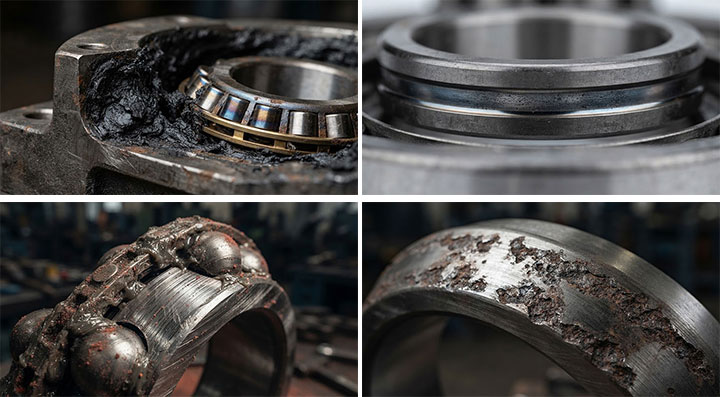
Technical infographic showing a quad-chart comparison of four distinct bearing failure modes in heavy-duty circular vibrating screens: 1. Severe Grease Contamination, 2. Incorrect Internal Clearance / Preload, 3. Abrasive Wear from Contaminants, 4. Severe Rolling Contact Fatigue (Spalling).

  • Improper Grease Viscosity or Over-Lubrication: Excessive grease volume causes internal churning and high heat, while incorrect grease grades fail to form a stable hydrodynamic film under heavy shock loads.
  • Incorrect Internal Clearance Selection: Using standard motor clearances instead of specialized vibrating screen clearances (such as C3/C4) restricts thermal expansion space, leading to internal binding.
  • Contaminant Ingress: Fine abrasive mineral dust bypassing worn labyrinth seals or damaged contact seals, rapidly turning the grease into an abrasive lapping compound.
  • Housing Misalignment or Fit Tolerances: Worn bearing housing seats or improper shaft machining tolerances create uneven localized stress, accelerating fatigue failure.

Field Diagnostic Methods: Spotting Failure Before Catastrophic Breakdown

Catching bearing distress early prevents costly emergency production halts. Plant engineers and maintenance teams rely on three primary field diagnostics to detect problems before breakdown occurs:

Impact of Improper Loading

Operational Note: Running heavy-duty screens without proper product load leads to erratic structural jumping, which imposes severe, uncontrollable fatigue stress on eccentric bearings.

  • Vibration Trend Monitoring: Sudden spikes in high-frequency acceleration spectra or unusual shifts in orbital motion indicate initial raceway micro-pitting or cage wear.
  • Surface Temperature Checks: Monitoring bearing housing temperatures with an infrared thermometer; a rapid temperature climb exceeding normal operating thresholds signals impending lubrication or clearance failure.
  • Acoustic and Sonic Inspection: Using electronic stethoscopes to detect high-pitched metallic scraping or grinding sounds, which clearly distinguish mechanical distress from normal rhythmic screening noise.

Engineering Matrix: Troubleshooting Symptoms vs. Corrective Actions

Use the troubleshooting matrix below to quickly match observable bearing symptoms on heavy-duty circular screens with their direct mechanical causes and immediate corrective actions:

Observable Symptom Root Cause Corrective Action
Abnormal Housing Overheating (>75°C) Over-greasing or incorrect grease viscosity Purge old grease, check fill levels, and switch to high-load high-temp grease.
High-Pitched Metallic Squeal Insufficient radial internal clearance (binding) Replace with designated C3 or C4 clearance vibrating screen bearings.
Severe Structural Vibration & Noise Contaminant ingress or severe raceway spalling Inspect/replace labyrinth seals and change the bearing assembly immediately.

The Critical Role of C3/C4 Internal Clearance and Original Component Integrity

Selecting replacement parts for heavy-duty circular screens requires strict adherence to engineering standards. Standard commercial bearings and generic aftermarket alternatives frequently fail in high-G-force environments due to two non-negotiable factors:
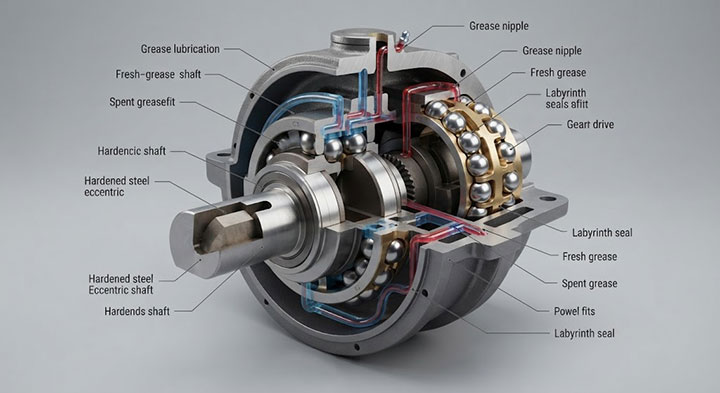
Technical cutaway illustration of a heavy-duty circular vibrating screen exciter gearbox, detailing the hardened steel eccentric shaft, spherical roller bearings, labyrinth seals, and the internal grease lubrication path (blue for fresh grease, red for spent grease).

  • The Necessity of C3/C4 Clearances: Because high-speed eccentric rotation generates rapid frictional heat, standard (CN) internal clearances cause bearings to bind and seize as metal components thermally expand. C3 and C4 clearances provide the essential internal expansion room needed for continuous heavy-duty operation.
  • Original Component Integrity: Inferior aftermarket cage designs or unverified steel alloys deform under multi-directional shock loads. Procuring OEM-grade, vibration-rated bearing assemblies ensures correct geometric tolerances, precise load distribution, and extended service intervals.

Frequently Asked Questions (FAQs) : Addressing Operator Questions on Bearing Longevity

To help plant maintenance teams maximize equipment uptime, here are expert answers to key technical questions regarding heavy-duty circular screen bearing maintenance:

How often should I re-grease bearings on a heavy-duty circular screen?

Unlike standard motors, vibrating screens require frequent, smaller grease injections rather than large bulk applications. Depending on operational hours and environmental dust levels, re-greasing typically occurs every 50 to 100 operating hours using high-temperature, extreme-pressure (EP) lithium or polyurea greases.

Why do eccentric shaft bearings fail prematurely after a rebuild?

Premature post-rebuild failure is usually caused by incorrect installation fits (such as over-tightening housing seats), failure to clean old contaminant-laden grease from the labyrinth seals, or mixing incompatible grease types during re-assembly.

How can I tell if my screen's eccentric weight bolts are loose?

Loose eccentric weight bolts typically manifest as a sudden, erratic knocking sound, irregular screening orbits, and severe localized vibration spikes on the side plates. Inspecting and re-torquing these bolts during routine weekly maintenance prevents catastrophic housing fractures.

Securing Long-Term Uptime: Next Steps for Plant Engineers

Preventing unexpected downtime starts with proactive maintenance and reliable equipment architecture. If your plant is experiencing recurring bearing wear or if you require specialized screening components, our technical specialists are ready to assist.

Need Expert Technical Support or Replacement Solutions?

Contact Dahan Machinery today to consult with our engineers, request a customized screening configuration, or get a quote for heavy-duty replacement parts.

Request a Quote / Contact Us


Friday August-21 2026  15:48:25
Resources
Contact Us

Whatsapp:+86 15236742901

Email:sale@xxdahan.com

Address:China,Yanjin county forest park gate to the west 1000 meters north road.