


The Circular Motion Ultrasonic Vibrating Screen represents a significant advancement in fine powder screening technology, combining the proven reliability of circular vibration with the precision of high‑frequency ultrasonic energy. This hybrid approach effectively solves the most common and frustrating problems encountered in conventional screening operations—namely, mesh blinding, particle agglomeration, and low throughput when processing fine, sticky, or electrostatically charged materials.
Designed for industries where product purity and particle size accuracy are non‑negotiable, this equipment has found widespread adoption in chemical processing, food production, pharmaceutical manufacturing, metal powder processing, and the rapidly growing field of battery materials. Unlike traditional separators that rely solely on mechanical vibration and often require frequent manual intervention to maintain performance, the ultrasonic vibrating screen operates continuously with minimal supervision, delivering consistent results over long production runs. For manufacturers seeking to upgrade their screening lines, this machine offers a compelling combination of improved efficiency, extended mesh life, and superior product quality—all within a compact footprint that integrates easily into existing workflows.
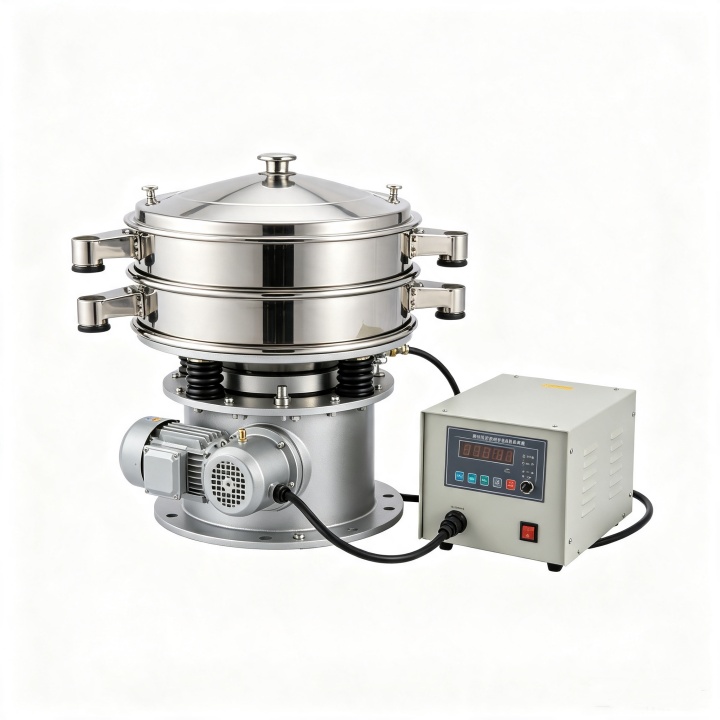
At the heart of this machine lies a carefully engineered dual‑action system that addresses material transport and mesh cleaning simultaneously. The primary motion is generated by a vertically oriented vibratory motor, fitted with adjustable eccentric weights on both its upper and lower ends. As the motor rotates, these weights produce a circular vibrating motion that travels across the entire screen deck. This movement causes incoming material to spread radially from the feed point toward the outer edge in a controlled spiral pattern, ensuring that every particle is presented to the screening surface for an adequate period to achieve effective separation.
Superimposed upon this circular motion is the ultrasonic system, which consists of a generator, a transducer, and a specially constructed screen frame. The generator converts standard electrical power into high‑frequency energy, typically ranging from 18 to 36 kHz, which is then transmitted to the transducer. The transducer converts this electrical signal into mechanical vibrations and passes them through the screen frame to the mesh surface. These microscopic, high‑speed vibrations create a continuous "anti‑blinding" effect: they break the surface tension, electrostatic bonds, and capillary forces that cause fine particles to lodge in the mesh openings. As a result, the screen remains clear and productive even when processing materials that would quickly clog a standard vibrating screen.
What makes this combination particularly effective is that the circular motion handles the bulk material movement while the ultrasonic energy works at the microscopic level, meaning neither function interferes with the other. Operators can independently adjust the vibration amplitude and the ultrasonic frequency to suit different materials, offering a level of process flexibility that is simply unavailable with conventional screening equipment.
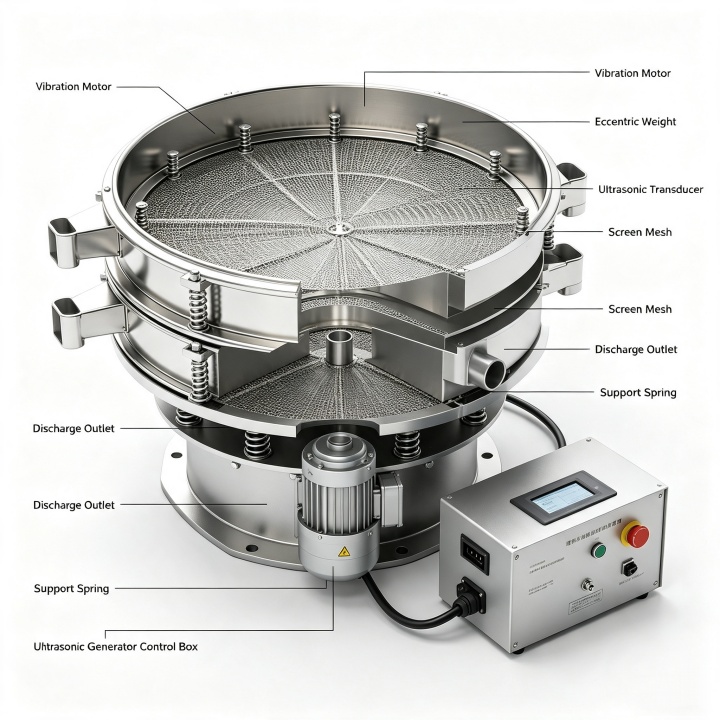
The ultrasonic vibration actively prevents particles from becoming trapped in the screen apertures, which is the leading cause of reduced capacity and inconsistent product quality in traditional systems. This self‑cleaning action allows the machine to maintain its rated throughput continuously, without the need for frequent production stoppages to clean or replace clogged screens.
Because ultrasonic energy reduces the friction and impact forces between particles and the wire mesh, the screen fabric experiences less wear over time. Additionally, the elimination of mechanical cleaning devices such as bouncing balls further reduces physical stress on the mesh. Users typically report screen life extensions of 50% to 300% compared to conventional vibrating screens, resulting in lower consumable costs and less downtime for mesh replacement.
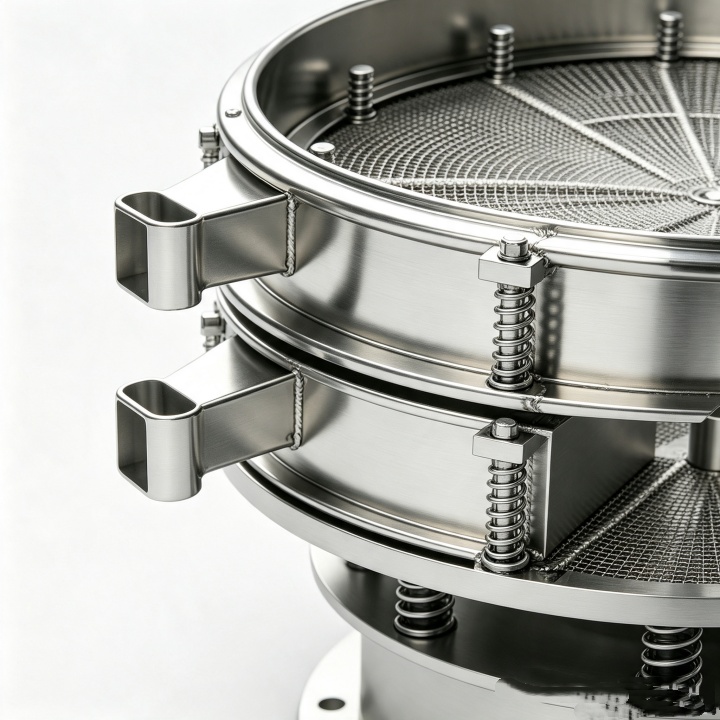
The combination of circular motion and ultrasonic energy enables effective separation of particles as fine as 25 microns (500 mesh) or even smaller, depending on the material characteristics. This level of precision is essential for applications that demand tight particle size distributions, such as pharmaceutical active ingredients, advanced ceramic powders, and lithium‑battery electrode materials.
Unlike anti‑blinding methods that introduce foreign objects—such as rubber balls or brushes—into the screening environment, the ultrasonic system is a non‑contact solution. This makes it ideal for food‑grade, pharmaceutical, and high‑purity chemical applications where product integrity and hygiene are paramount.
The machine is built with industrial‑grade components, including IP65‑rated motors that protect against dust and moisture ingress. Contact parts are available in SS304 or SS316L stainless steel to meet sanitary requirements, while carbon steel options are offered for more cost‑sensitive applications. The ultrasonic generator features built‑in protection against short circuits, phase loss, and voltage fluctuations, ensuring stable performance even in challenging power conditions.
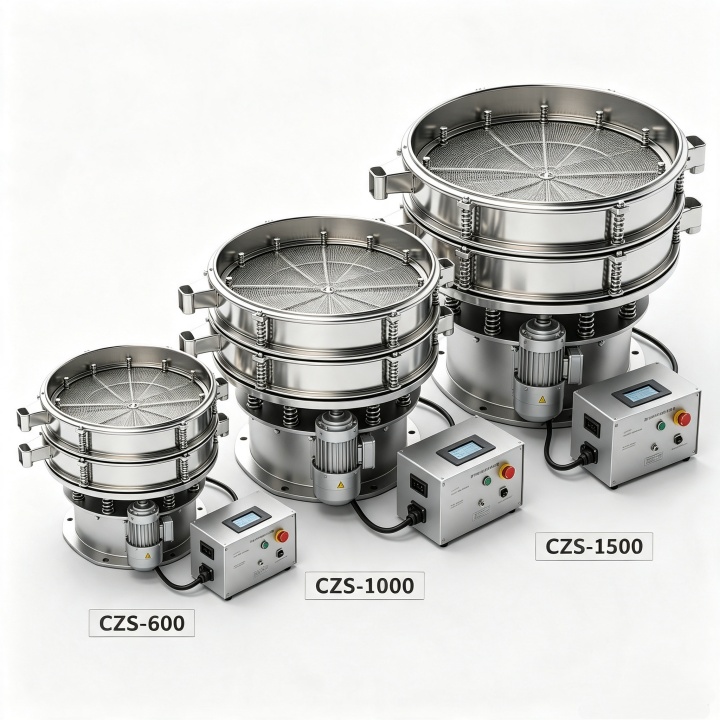
Available in diameters ranging from 400 mm to 2000 mm, and with one to five screen decks, the system can be tailored to meet specific capacity and classification requirements. Single‑deck units are suitable for simple scalping or de‑dusting, while multi‑deck configurations allow for simultaneous separation into multiple particle size fractions in a single pass.
| Model | Screen Diameter (mm) | Effective Area (m²) | Motor Power (kW) | Mesh Range (mesh) | Decks |
| CZS‑400 | 340 | 0.09 | 0.18‑0.25 | 2‑500 | 1‑5 |
| CZS‑600 | 530 | 0.22 | 0.25‑0.55 | 2‑500 | 1‑5 |
| CZS‑800 | 720 | 0.40 | 0.55‑0.75 | 2‑500 | 1‑5 |
| CZS‑1000 | 900 | 0.63 | 0.75‑1.1 | 2‑500 | 1‑5 |
| CZS‑1200 | 1100 | 0.95 | 1.1‑1.5 | 2‑500 | 1‑5 |
| CZS‑1500 | 1400 | 1.50 | 1.5‑2.2 | 2‑500 | 1‑5 |
Note: Custom sizes, multi‑deck configurations, and specialized materials are available upon request.
Chemical Industry – Screening of resins, pigments, coatings, polymer powders, catalysts, and various chemical additives where consistent particle size and contamination control are essential.
Food Processing – Separation of flour, starch, sugar, spices, protein powders, instant coffee, cocoa, and grains. The stainless steel contact parts and contamination‑free design comply with strict food safety regulations.
Pharmaceutical Manufacturing – Classification of active pharmaceutical ingredients (APIs), excipients, and granulated intermediates. The sanitary construction and precise screening capability meet GMP and FDA requirements.
Metal Powder Processing – Screening of aluminum, tungsten, silicon carbide, and specialty alloy powders used in additive manufacturing, friction materials, and metallurgical applications.
Battery Materials – Processing of lithium‑ion battery cathode and anode materials, where ultra‑fine screening is critical for electrode coating consistency and overall cell performance.
Mineral and Construction Materials – De‑dusting, scalping, and classification of cement, calcium carbonate, quartz, and ceramic powders.

What types of materials are best suited for this ultrasonic vibrating screen?
This machine is particularly effective for materials that are prone to clogging due to fine particle size, high adhesion, static charge, or low bulk density. Common examples include metal powders, pharmaceutical ingredients, food powders, resin compounds, and battery materials. It is less necessary for coarse, free‑flowing materials that screen well on standard equipment.
How does the ultrasonic system affect the screen mesh?
Far from damaging the mesh, the ultrasonic vibration reduces mechanical stress by preventing particle impaction and eliminating the need for aggressive cleaning methods. This typically extends mesh life considerably, with many users reporting two to three times longer service intervals.
Can the machine be integrated into an existing production line?
Yes. The circular motion ultrasonic vibrating screen is designed with standard inlet and outlet configurations and can be easily installed between upstream and downstream equipment. Custom adapters and support structures can be supplied to match your existing layout.
What safety certifications are available?
Standard models are CE certified. For potentially explosive environments, ATEX‑compliant motors and explosion‑proof electrical components can be provided upon request.
Is on‑site testing or material evaluation available?
We offer sample testing services at our facility, and for large projects, we can arrange on‑site trials with temporary equipment. This allows you to verify performance with your specific material before making a purchasing decision.
When you purchase a circular motion ultrasonic vibrating screen from our company, you are not simply buying a piece of machinery—you are gaining a long‑term partner in process optimization. Every unit is manufactured under strict quality control procedures, with meticulous attention paid to weld integrity, motor alignment, and electrical safety. Our engineering team works closely with each customer to recommend the optimal screen size, mesh configuration, and ultrasonic settings for their unique material properties.
We also provide comprehensive after‑sales support, including installation guidance, operator training, spare parts availability, and responsive technical assistance. Our goal is to ensure that your screening system continues to deliver peak performance throughout its operational life, helping you maintain product consistency and reduce overall production costs.
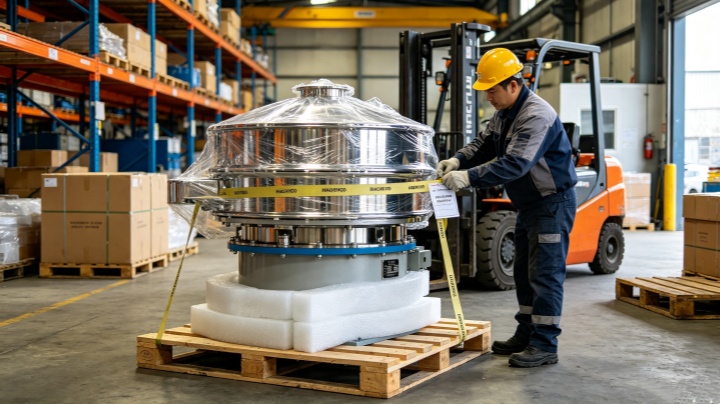
We would be pleased to discuss your specific screening requirements and recommend the most suitable configuration for your application. Whether you are processing food powders, pharmaceutical intermediates, or advanced materials, our team has the expertise to guide you toward the right solution.
Contact us today for a personalized quotation, technical data sheets, or to schedule a material test. We look forward to supporting your success.
Keywords: circular motion ultrasonic vibrating screen, ultrasonic vibrating screen, fine powder screening, anti‑blinding vibrating screen, high‑precision vibrating sifter, industrial ultrasonic separator, circular vibrating screen


Address:China,Yanjin county forest park gate to the west 1000 meters north road.


 Online Chat
 Email
Email