


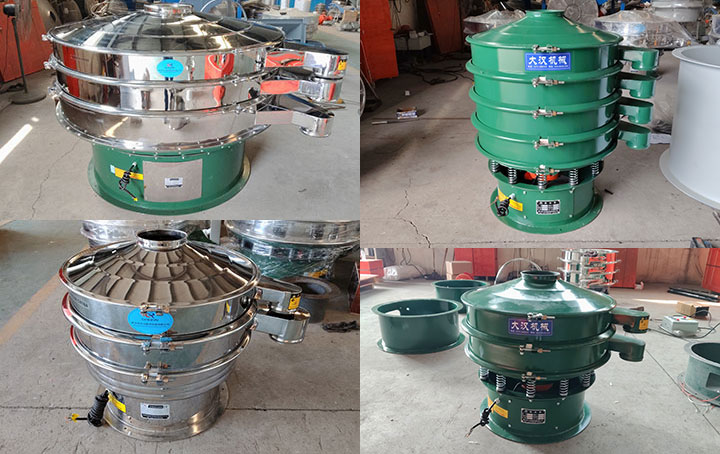
The Multi-Deck Vibratory Separator is designed for applications where one material needs to be separated into several particle-size ranges. Multiple screening decks are arranged in one machine, with each deck using a selected screen opening for a specific separation step.
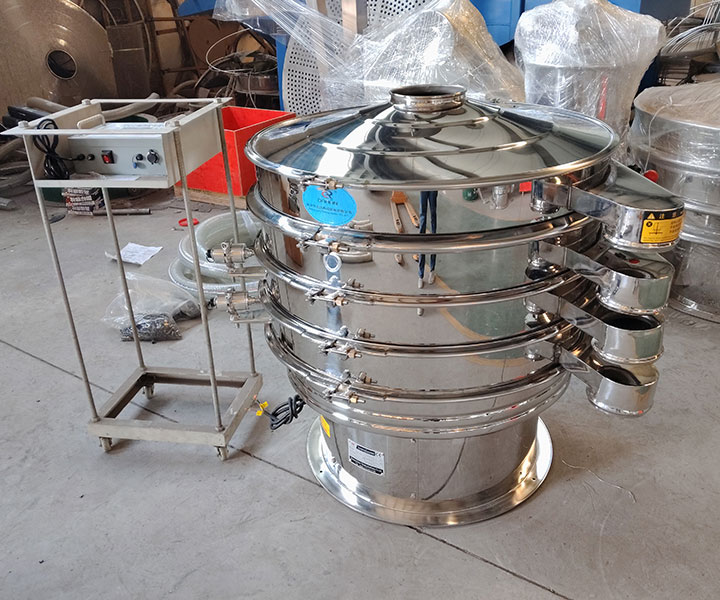
As the material passes through the decks, coarse particles remain on the appropriate screen while smaller particles move to the next screening stage. This allows several fractions to be collected from separate outlets within the same screening process, reducing the need to run the material through separate machines.
The deck number, screen opening, machine diameter, and outlet arrangement can be selected according to the material and required size ranges. It can be used for powders, granules, and other bulk materials that require more than one screening cut.
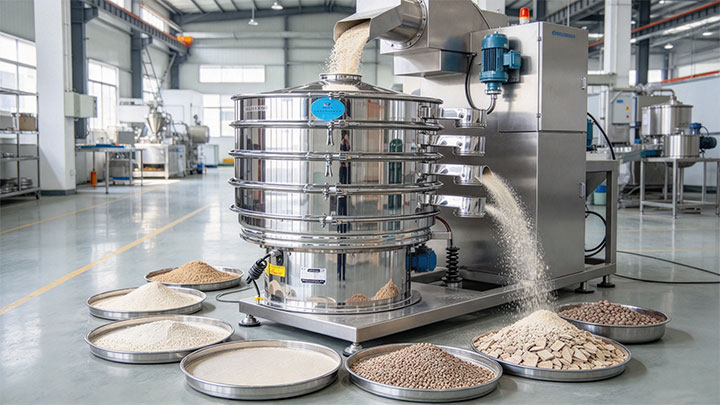
Material enters the Multi-Deck Vibratory Separator through the feed inlet and is distributed across the upper screening deck. Particles larger than the selected screen opening remain on the deck and move toward its discharge outlet, while smaller particles pass through to the next screening level.
Multi-deck screening process showing material separation through multiple screening layers.
Each lower deck applies another screen opening to the material that has passed through the previous deck. By arranging different mesh sizes from one deck to another, the machine can separate the feed into several particle-size fractions during a single screening process.
Each screening level has its own discharge path, allowing coarse, intermediate, and fine fractions to be collected separately. Dahan's Vibro Sifter can be configured with 1–5 screening layers, depending on the number of size cuts required for the material.
The screen opening determines which particles can pass from one screening deck to the next. In a multi-deck arrangement, the openings are selected according to the particle-size cuts required from the finished material, rather than simply using the same mesh on every deck.
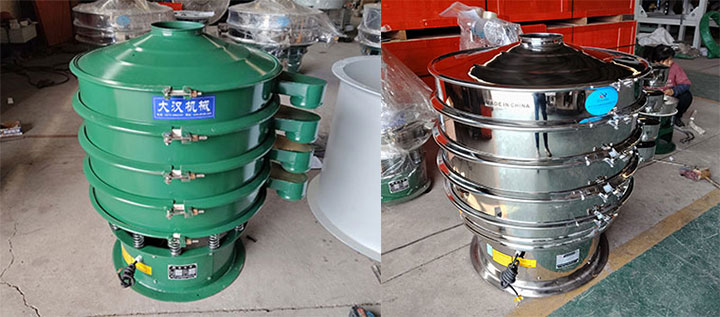
A two-deck separator may use a larger opening on the upper deck to remove oversized particles, followed by a smaller opening on the lower deck. This creates three fractions: material retained on the upper screen, material retained on the lower screen, and material passing through the lower screen.
The required aperture can be specified by mesh number or opening size, depending on the screening material and process requirements. Dahan Vibro Sifters support screen sizes from 2 to 500 mesh, with multiple screening layers available for different separation arrangements.
The number of screening decks is mainly determined by how many particle-size cuts are required from one feed material. A single deck can make one basic separation, while additional decks allow the material to be divided into more size ranges within the same machine.
| Deck arrangement | Typical separation task |
|---|---|
| 2-deck | Separate the feed into coarse, intermediate, and fine fractions using two different screen openings |
| 3-deck | Divide the feed into several particle-size ranges using different screen openings |
| 4-deck | Provide additional size cuts when more fractions need to be collected separately |
| 5-deck | Handle processes requiring multiple screening stages in one separator |
For each additional deck, the screen opening and discharge arrangement should match the required particle-size ranges. The final configuration depends on the material characteristics, target fractions, processing capacity, and available installation space.
The Multi-Deck Vibratory Separator is available in different diameters, screening layers, materials, and drive configurations. The machine can be configured around the required screening area, particle-size cuts, material-contact requirements, and processing conditions.
| Parameter | Available options |
|---|---|
| Machine diameter | 400, 600, 800, 1000, 1200, 1500, 1800, 2000 mm |
| Screening layers | 1–5 layers |
| Screen mesh | 2–500 mesh |
| Machine material | Q235 carbon steel, SS304, SS316L, PP |
| Motor power | 0.18–2.2 kW, depending on machine size and configuration |
| Screen cleaning | Rubber or silicone balls; ultrasonic cleaning available |
| Special configurations | Explosion-proof, anticorrosive, silo-type, and other customized arrangements |
Processing capacity varies with the machine diameter, screen opening, material characteristics, feed rate, and number of screening stages. The final specification should therefore be selected from the actual screening conditions rather than from machine diameter alone.
The screening result depends on more than the machine diameter or screen mesh. The way a material separates across multiple decks is also influenced by its particle size distribution, moisture, bulk density, shape, and feed rate.
Moist or sticky materials may have more difficulty passing through fine screen openings, while materials with a wide particle-size distribution may require carefully selected openings across several decks. Feed rate also matters because an overly thick material layer can limit the particles' contact with the screen surface.
These factors are considered together when selecting the deck arrangement and machine configuration. The objective is to give each screening deck a suitable separation task without adding unnecessary layers or screening area.
The Multi-Deck Vibratory Separator can be used for dry powders, granules, and other bulk materials that need to be divided into two or more particle-size ranges. The suitable screen arrangement depends on the material characteristics and the size fractions required from the process.
For powder processing, multiple decks can separate fine powder, usable product, and oversized particles in one screening operation. For granular materials, different screen openings can be arranged to classify the feed into several specified size ranges.
The machine can be configured with different contact materials, screen openings, deck numbers, and outlet arrangements according to the material being processed and the required separation result.
Fine screening decks can be more sensitive to particles becoming lodged in the screen openings, especially when the material contains fine or irregular particles. As the screen openings become smaller, maintaining clear openings becomes an important part of continuous screening.
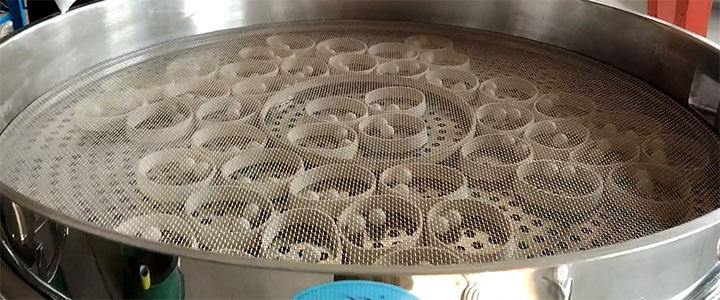
Dahan's Vibro Sifter can use rubber or silicone cleaning balls beneath the screen to help dislodge particles during operation. For finer screening requirements, an ultrasonic screen cleaning system can also be configured to reduce particle buildup on the mesh.
The appropriate cleaning method depends on the screen opening, material characteristics, and screening conditions. For a multi-deck separator, the cleaning arrangement can also be selected separately for the decks that use finer screens.
Selecting a Multi-Deck Vibratory Separator starts with the required particle-size separation rather than the machine model. The number of fractions, target particle sizes, material properties, and required capacity together determine the suitable deck arrangement and machine size.
Define the required size fractions. Identify the particle sizes that need to be separated and how many finished fractions are required.
Select the screen openings. Each screening deck should have an opening that matches its intended separation cut. Mesh number or aperture size can be used to specify the screen.
Determine the number of decks. Additional decks are used when the material needs to pass through more than one screening cut before the required fractions are collected.
Check the required capacity. The machine diameter and screening area should be considered together with the material characteristics and feed rate.
Confirm the construction and cleaning requirements. Material-contact parts, screen cleaning, sealing, outlet arrangement, and other configurations can be selected according to the process.
For an accurate configuration, the most useful information is the material name, feed particle-size range, required separation sizes, capacity, number of fractions, and any material-contact or installation requirements. These details allow the separator to be configured around the actual screening process.
A Multi-Deck Vibratory Separator can be configured beyond the basic combination of machine diameter and screen layers. The construction, feeding and discharge arrangement, sealing, screen cleaning, and motor type can also be selected according to the process conditions.
These configurations allow the separator to be adapted to different materials, screening conditions, and production lines without changing the basic multi-deck screening concept. The final arrangement is determined from the process information provided before production.
A sweetener processing project shows how a screening solution can be selected around a specific powder and production requirement. In this application, the material is sweetener, the screening range is 10–150 mesh, and the required capacity is about 1 t/h.
The main screening purpose is to remove impurities and lumps before further processing. Because the material has a relatively small particle size, Dahan recommended a rotary vibrating sifter for the application.
The recommendation also considered factors such as the number of filters, feed pipe diameter, filter volume, and available site conditions. These details show why screening equipment should be selected from the complete process requirement rather than from mesh size or capacity alone.
Material: Sweeteners
Screening range: 10–150 mesh
Capacity: About 1 t/h
Screening purpose: Removal of impurities and lumps
The required number of decks depends on how many particle-size cuts are needed. One screening deck can make a basic size separation, while additional decks allow the material to be divided into more size ranges within the same machine. Dahan Vibro Sifters are available with 1–5 screening layers.
Yes. Different screen openings can be arranged across multiple decks so that the feed is separated into several particle-size fractions. Each screening level can discharge its corresponding fraction separately.
The screen mesh or aperture should be selected according to the required separation sizes and the actual particle-size distribution of the material. The material name, feed size range, target fractions, and required capacity should be provided when determining the screen configuration.
Yes. Dahan can configure the machine according to the required deck number, screen openings, machine material, feeding and discharge arrangement, screen cleaning method, sealing, and other process requirements. Special configurations such as ultrasonic screen cleaning and explosion-proof motors are also available for applicable applications.
The suitable Multi-Deck Vibratory Separator depends on the material, required particle-size fractions, screening capacity, and process conditions. Instead of selecting a machine from diameter or mesh alone, the complete screening requirement should be considered before the configuration is finalized.
When requesting a quotation, please provide the following information:
Based on these details, Dahan can determine the suitable machine diameter, number of screening decks, screen configuration, material construction, cleaning system, and discharge arrangement for the application.
Send us your material, target particle sizes, and required capacity to discuss the Multi-Deck Vibratory Separator configuration for your process.


Address:China,Yanjin county forest park gate to the west 1000 meters north road.


 Online Chat
 Email