


A 200‑ton‑per‑day calcium carbonate production line can lose over $736.60 daily if the vibro sifter is poorly selected – not because the machine breaks down, but due to screen blinding, reduced yield, and customer returns. This article helps you avoid these three pitfalls.
Whether you produce Ground Calcium Carbonate (GCC) or Precipitated Calcium Carbonate (PCC), the screening process directly determines the particle size distribution, purity, and market price of your final product. However, in our field visits we found that more than 60% of calcium carbonate plants focus solely on “throughput” when purchasing a vibro sifter, while ignoring amplitude, frequency, screen inclination, and other core parameters. As a result, after commissioning, they encounter screen plugging, material leakage, and insufficient capacity.
This article cuts the fluff and directly explains the 5 core technical parameters you must consider for calcium carbonate vibro sifter selection, together with a practical mesh‑to‑micron comparison table, and guides you through a 3‑step precise selection process.
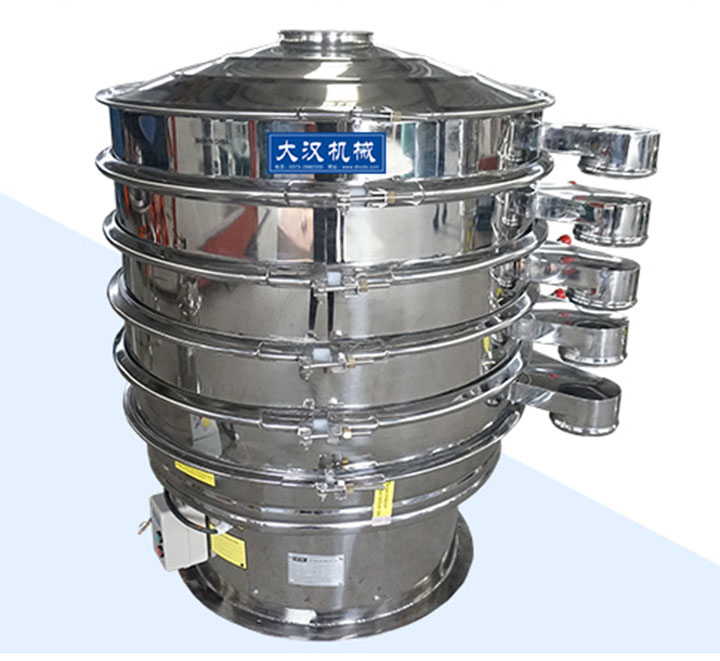
Before selecting, get to know the “character” of the sifter. These 5 parameters determine whether the machine can “handle the job” on your calcium carbonate production line.
This is the most critical indicator for calcium carbonate producers, as it directly defines the fineness grade of the product (e.g., 325 mesh, 800 mesh, 1250 mesh).
Selection focus: Calcium carbonate has low friction and is prone to static electricity, making fine meshes (>600 mesh) highly susceptible to blinding. Therefore, do not just look at the mesh number – you must consider open area (typically required ≥35%) and wire material (304 stainless steel is recommended to avoid iron contamination that reduces whiteness).
Common mistake: The higher the mesh, the thinner the wire and the shorter the service life. Always factor in the cost of screen replacement cycles during selection.
Frequency: This usually refers to the rotational speed of the eccentric blocks, typically between 960 and 1450 r/min. When processing PCC (which is fluffy and has low bulk density), a high frequency (~1450 r/min) with small amplitude is recommended to break up agglomerates. When processing GCC (hard, dense particles), a low frequency (~960 r/min) with large amplitude should be used to ensure material moves forward without piling up.
Amplitude: Typically in the range of 4–8 mm. If the amplitude is too small, the material cannot stratify effectively; if too large, the risk of screen fatigue and breakage increases sharply.
Throughput (tons per hour) is a hard requirement, but it is not linearly related to motor power.
Selection formula reference: Required screening area (m²) ≈ hourly throughput (t/h) ÷ unit area passage rate (t/m²·h). For calcium carbonate, the unit area passage rate is generally 0.5–2.5 t/m²·h (the finer the mesh, the lower the value).
Motor power: Common power range is 1.1 kW to 7.5 kW. Never oversize the motor just to “leave a margin” – excessive excitation force can break the screen and increase energy consumption.
This is a key parameter that distinguishes the selection between circular vibro sifters and linear vibro sifters.
Circular vibro sifter: The inclination angle is generally set to 0°–5° (flat or slightly tilted). Suitable for fine classification of calcium carbonate powders (e.g., above 800 mesh), as the circular motion gives a longer material travel path and higher classification accuracy.
Linear vibro sifter: The inclination angle is usually 5°–15°. Suitable for coarse particles or dewatering/de‑mediating applications (e.g., 80–200 mesh), where material moves forward in a jumping linear motion, providing higher throughput.
Although calcium carbonate is not a corrosive mineral, it is extremely sensitive to iron content (Fe₂O₃) – rust significantly reduces product whiteness.
Mandatory requirement: All metal parts that come into contact with the material must be SUS304 stainless steel (at least 304L) – ordinary Q235 carbon steel is strictly prohibited.
Sealing materials: Silicone or polyurethane (PU) seals must meet industrial/food‑grade standards and be wear‑resistant.
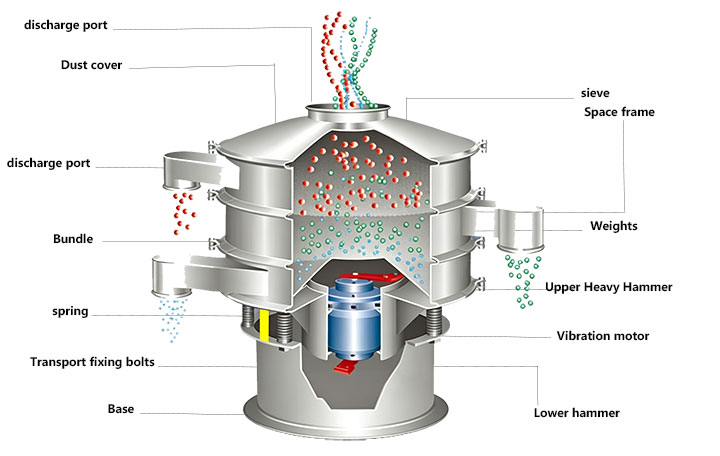
The table below covers the 14 most commonly used mesh sizes in the calcium carbonate industry, from coarse to ultra‑fine. When selecting, send this table directly to the sifter manufacturer and require them to configure the screens according to these standards.
| Mesh | Micron (μm) | Common Application Areas for Calcium Carbonate |
| 30 | 600 | FGD limestone powder (coarse) |
| 50 | 300 | Construction mortar, animal feed |
| 80 | 180 | Artificial stone, agglomerated stone filler |
| 120 | 125 | Plastic masterbatch base filler |
| 200 | 74 | Rubber compound general filler |
| 325 | 45 | Coatings, paints general filler (main GCC grade) |
| 400 | 38 | High-grade ink filler |
| 500 | 30 | Wire and cable sheathing |
| 600 | 23 | PVC profiles and pipe filler |
| 800 | 15 | Paper coating grade GCC |
| 1000 | 13 | High-grade coatings, sealants |
| 1250 | 10 | Premium inks, cosmetic filler |
| 2000 | 6.5 | Nano-grade calcium carbonate transition |
| 2500 | 5 | Ultra-fine high-end specialty calcium carbonate |
Special note: When the mesh exceeds 400, we strongly recommend equipping the unit with an ultrasonic cleaning system; otherwise, the screen will be completely blinded by calcium carbonate powder within 30 minutes.
Exclusive interpretation – The hidden trap in mesh standards
It is worth noting that the commonly used “325 mesh” in the calcium carbonate industry refers to the ASTM E11‑17 (USA) standard, not the Chinese national standard (GB/T 6005‑2008, the R40/3 series). Both standards give 45 μm at 325 mesh, but at finer grades they diverge – for example, 800 mesh is 15 μm under ASTM, but 13 μm under the Chinese standard. If your supplier follows the Chinese standard, the actual particle size will be about 8%–13% finer than ASTM.
What does this mean? If you only write “800 mesh” in your contract without specifying the standard, you may receive coarser material than expected, which can directly affect the gloss of your coatings. Always clearly state “compliant with ASTM E11” in your purchase contract – otherwise you risk getting “nominally 800 mesh, but actually only 700 mesh”.
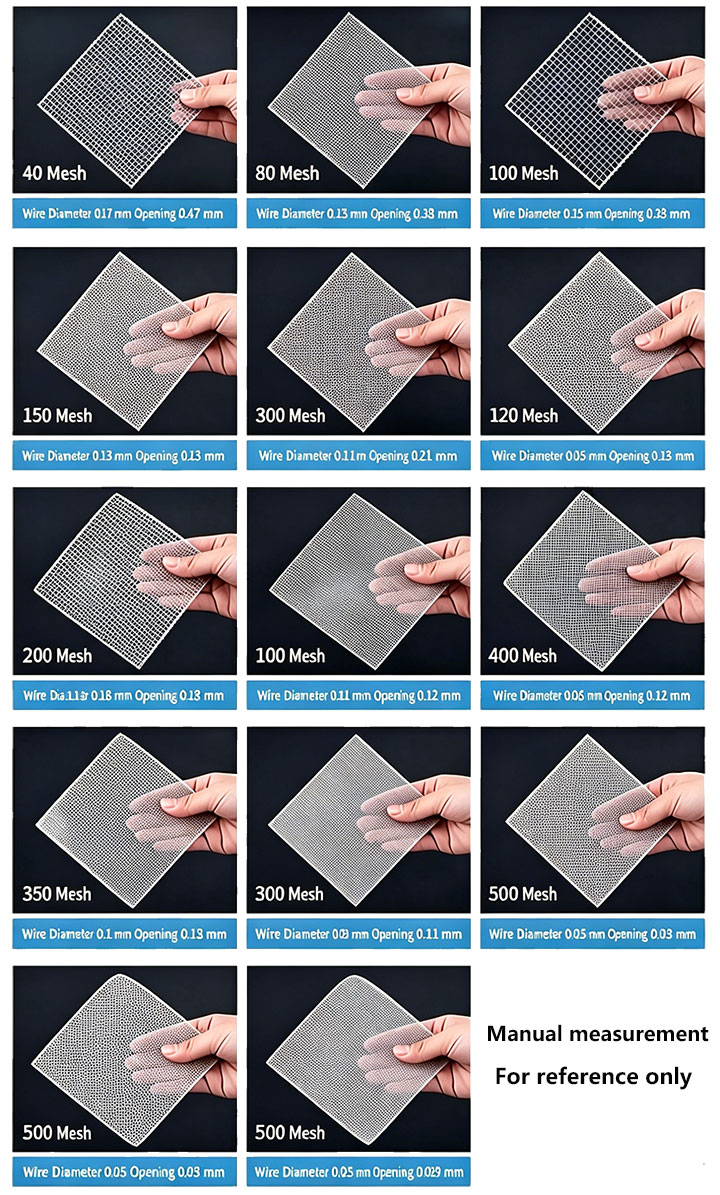
Now that you have the parameters and the table, how do you apply them? Follow these 3 steps and you won’t go wrong.
GCC (Ground Calcium Carbonate): Irregular, hard particles, moisture content typically <0.5%. → Recommend a linear vibro sifter or a circular sifter with large amplitude.
PCC (Precipitated Calcium Carbonate): Spindle‑shaped or chain‑like particles, very low bulk density (about one‑third that of GCC), extremely fluffy. → Must choose a circular vibro sifter (high frequency, with anti‑splashing device) and the feed end must be equipped with a screw forced feeder.
Assume you need 3 tons/hour of 325‑mesh GCC. The unit area passage rate for 325 mesh is about 0.8 t/m²·h.
Required area = 3 ÷ 0.8 = 3.75 (m²).
Check the selection manual: this corresponds to a circular vibro sifter of about Φ1500 mm (effective screening area ~3.8 m²). If you choose Φ1200 mm (area ~2.5 m²), the actual throughput will never reach 3 tons and the screen will wear out very quickly.
This is the most frequently overlooked step, yet it determines success or failure.
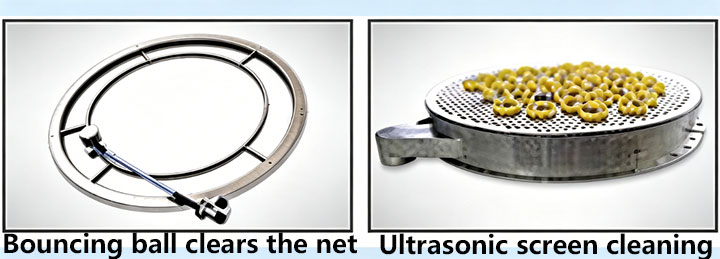
≤200 mesh (coarse powder): Use rubber bouncing balls – low cost and easy maintenance.
≥325 mesh (fine/ultra‑fine powder): Must use an ultrasonic vibration system. The high‑frequency vibration breaks the electrostatic adhesion between calcium carbonate particles and the screen, which can increase throughput by 50%–300% and extend screen life from 3 days to 30 days.
After visiting dozens of calcium carbonate processing plants, we have summarised the three most common selection mistakes – we hope you will not repeat them:
Focusing only on price, not on power matching: Some buyers purchase a cheap sifter with an undersized motor, then force a higher excitation to increase output, resulting in burnt motors and cracked screen boxes. Remember: the excitation adjustment range must not exceed 80% of the motor’s rated power.
Neglecting feed particle size distribution: Many plants have poor crushing upstream and feed oversized particles (>10 mm) directly to the sifter, instantly damaging the screen. You must install a scalping screen or a magnetic separator before the sifter.
Poor sealing leading to dust explosion/environmental pollution: Calcium carbonate dust can be explosive (at certain concentrations) and is highly polluting. During selection, you must choose a fully sealed structure and configure dust collection ports at the inlet and outlet, connected to the plant’s dust extraction system.


Address:China,Yanjin county forest park gate to the west 1000 meters north road.


 Online Chat
 Email
Email