Fine Screening Machine Guide: Types, Selection & Comparison (2026)
Fine Screening Machine Defined: Particle Sizes and Core Functions
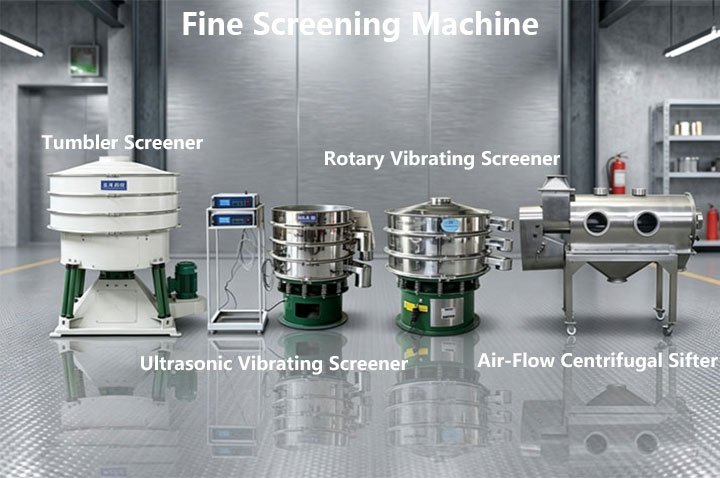
A fine screening machine is an industrial separation device engineered to classify, de-dust, or filter dry powders and wet slurries with particle sizes typically ranging from 200 mesh down to 500 mesh (75 µm to 10 µm). Unlike heavy-duty coarse screeners used for bulk gravel or minerals, fine screeners integrate high-precision mesh structures and advanced anti-blinding systems to ensure consistent throughput and sharp cut-point accuracy without clogging the screen surface.
Core Technical Functions
-
Precision Classification: Separates powders into multiple strict particle size fractions.
-
Safety Scalping: Removes oversized lumps, foreign debris, or contaminants prior to packaging.
-
Solid-Liquid Separation: Filters fine solids out of slurries or liquid suspensions.
4 Main Types of Fine Screening Machines
Selecting the right fine screening equipment depends heavily on the physical properties of your material. Below are the four principal types of fine screening machines used across modern processing industries:
Tumbler Screener (Gyratory Motion)
-
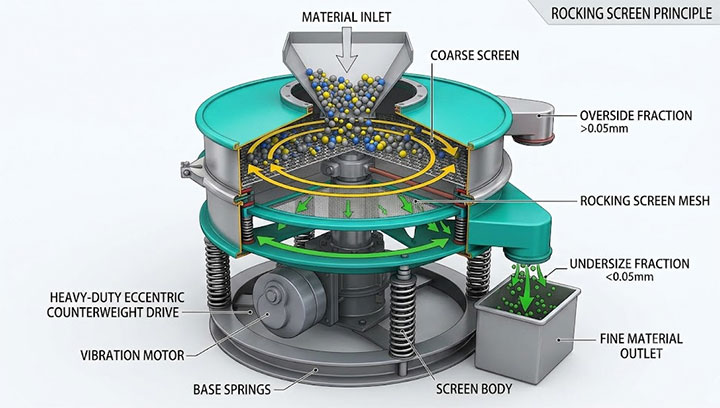
Operating Principle: Replicates gentle, hand-sifting motion through a three-dimensional elliptical trajectory. Material moves in a spiral pattern from the center to the outer edge of the screen mesh.
-
Key Advantages: Extended material residence time yields high separation precision with minimal to low mechanical degradation to fragile particles.
-
Ideal Applications: Heat-sensitive powders, spherical granules, spices, chemical resins, and fragile crystals where particle shape must remain intact.
Ultrasonic Vibrating Screener
-
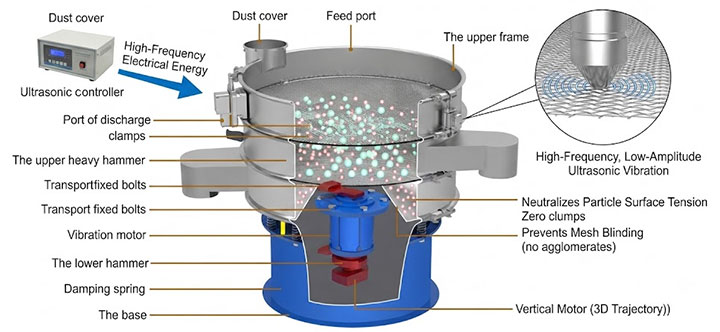
Operating Principle: Combines standard three-dimensional mechanical vibration with a high-frequency ultrasonic wave (typically 36 kHz) applied directly to the screen mesh.
-
Key Advantages: The continuous ultrasonic energy breaks particle surface tension and neutralizes static charges, reducing mesh blinding and maintaining stable throughput on sub-75 micron powders.
-
Ideal Applications: Ultra-fine, cohesive, or static-prone materials such as lithium battery cathode/anode powders, 3D printing metal alloys, and active pharmaceutical ingredients (APIs).
Rotary Vibrating Screener (3D Sifter)
-
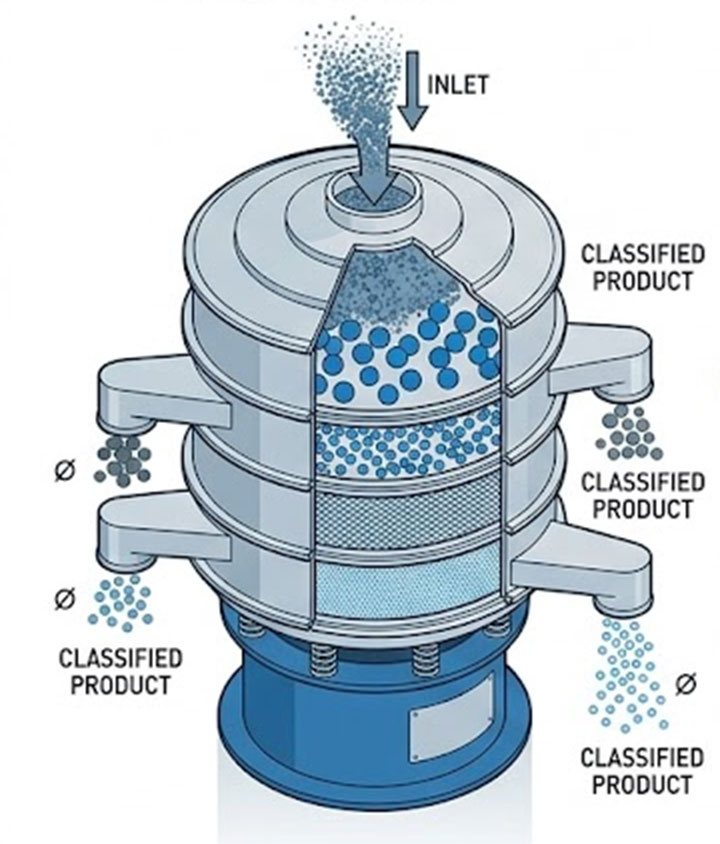
Operating Principle: Utilizes an eccentric motor to generate three-dimensional vibration (horizontal, vertical, and inclined), causing material to disperse outward in a controlled spiral path.
-
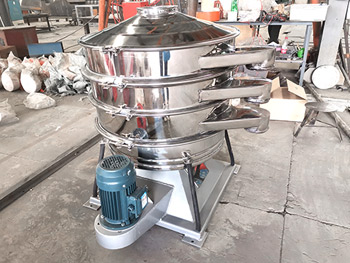
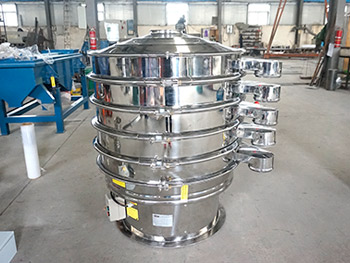
Key Advantages: Versatile, compact footprint, easy to clean, and cost-effective for general-purpose powder sizing and liquid slurry filtration.
-
Ideal Applications: Starch, food seasonings, ceramic slip, coatings, and safety scalping of bulk raw powders before packaging.
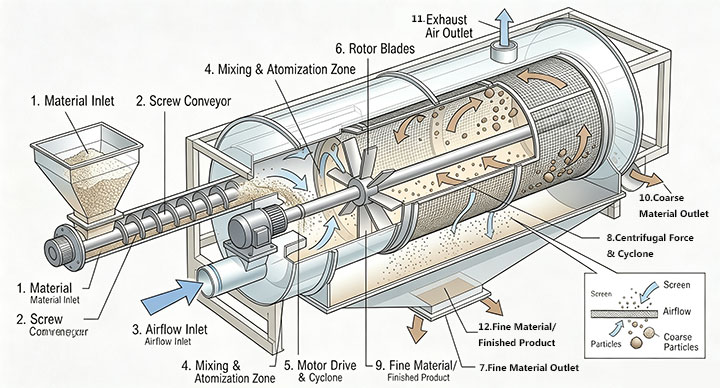
Air-Flow Centrifugal Sifter
-
Operating Principle: Utilizes a high-speed internal rotor or paddle system to propel fine powder along a cylindrical stationary mesh basket via controlled pneumatic airflow.
-
Key Advantages: Forces ultra-light powders through the mesh while automatically discharging oversized lumps, maintaining dust-tight operation without relying on gravitational settling.
-
Ideal Applications: Low-density, fluffy, or easily airborne materials including fumed silica, powdered rubber, fine flour, and cellulose powders.
Fine Screening Machine Comparison: Tumbler vs. Ultrasonic vs. Rotary vs. Air-Flow
To help you determine which equipment aligns with your specific material characteristics and process requirements, the table below provides a side-by-side technical comparison across key operational parameters:
|
Equipment Type |
Primary Motion / Principle |
Key Anti-Blinding Feature |
Mesh Range (Particle Size) |
Best Material Suitability |
|
Tumbler Screener |
3D Elliptical / Gentle hand-sifting motion |
Bouncing balls, rotary brushes, pneumatic air knives |
20 µm – 10 mm (20 to 600 mesh) |
Fragile granules, heat-sensitive powders, spherical pellets |
|
Ultrasonic Screener |
3D mechanical vibration + High-frequency ultrasonic wave |
Ultrasonic wave generator & transducer system |
10 µm – 200 µm (70 to 635 mesh) |
Ultra-fine powders with high static, cohesion, or moisture risk |
|
Rotary Vibrating Screener |
3D eccentric motor vibration (Horizontal / Vertical) |
Under-mesh slider rings, bouncing rubber balls |
40 µm – 5 mm (35 to 400 mesh) |
General dry powder sizing, liquid slurry filtration, safety scalping |
|
Air-Flow Centrifugal Sifter |
Pneumatic centrifugal force with internal rotor paddles |
Continuous airflow sweeps mesh without gravity dependency |
30 µm – 500 µm (35 to 500 mesh) |
Low-density, fluffy, easily airborne or agglomerated dry powders |
Key Technical Selection Takeaways
-
For Fragile & Temperature-Sensitive Products: The Tumbler Screener provides low shear forces and gentle residence times, preserving particle integrity without generating frictional heat.
-
For Ultra-Fine & Static Powders: The Ultrasonic Screener remains the most effective solution for overcoming screen surface tension on particles under 75 microns.
-
For High-Volume Light Powders: The Air-Flow Centrifugal Sifter eliminates reliance on gravity, making it suitable for low-bulk-density materials that tend to float or blind traditional flat meshes.
How to Prevent Mesh Blinding in Fine Powder Screening
Mesh blinding occurs when fine particles lodge into mesh openings or adhere to the screen surface due to static electricity, moisture, or particle bridging. Preventing mesh blinding requires selecting an anti-blinding mechanism tailored to your material’s physical properties.
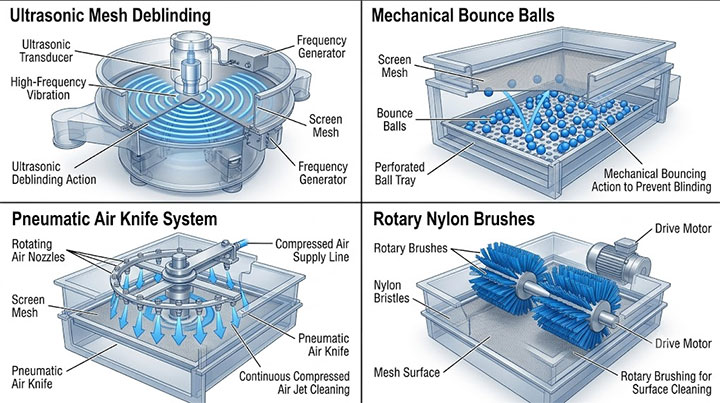
Ultrasonic Mesh Deblinding Systems
-
Mechanism: An ultrasonic generator transmits high-frequency micro-vibrations (typically 30–38 kHz) directly to the screen wire mesh.
-
Best Used For: Sub-75 micron powders with strong electrostatic charges, surface attraction, or moisture adsorption (e.g., battery materials, metal powders).
-
Operation Impact: Breaks particle agglomeration and surface tension without relying on heavy mechanical impact that could wear out delicate fine meshes.
Mechanical Impact (Bouncing Balls & Slider Rings)
-
Mechanism: Elastomer balls (silicone, neoprene, or polyurethane) or plastic slider rings sit in a secondary tray underneath the screen mesh, bouncing against the underside of the mesh during operation.
-
Best Used For: Dry powders with particle sizes above 100 mesh where physical impact is sufficient to dislodge trapped grains.
-
Operation Impact: An economical, low-maintenance mechanical solution for standard screening duties.
Pneumatic Air Knives & Air Sweeping
-
Mechanism: Rotating air nozzles or continuous air-knife systems direct targeted jets of compressed air against the screen mesh surface.
-
Best Used For: Sticky, oily, or hygroscopic materials that tend to smear across metal wires under physical contact.
-
Operation Impact: Cleans the mesh continuously while maintaining a dust-tight enclosure.
Rotary Brushes & Flexible Scrapers
-
Mechanism: Motorized or free-floating nylon brushes roll or sweep gently across the mesh surface to physically push agglomerated particles through or off the screen.
-
Best Used For: Fibrous powders, flat flakes, or soft agglomerates requiring mild mechanical shearing.
Key Factors to Consider When Selecting a Fine Screening Machine
Proper equipment selection supports continuous workflow and stable output across powder processing lines. When evaluating fine screening equipment, engineering teams typically focus on five essential technical factors:
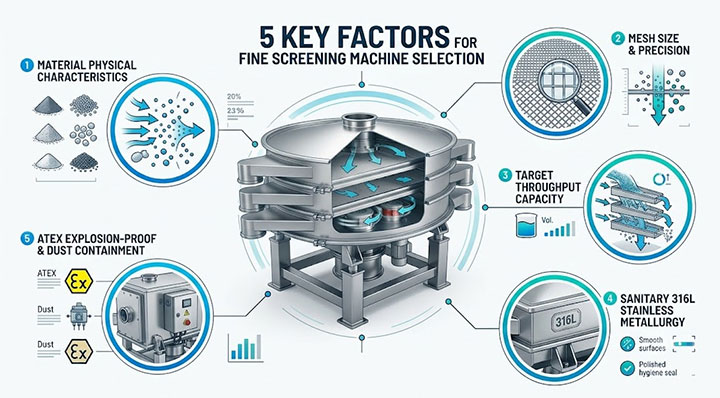
Material Physical Characteristics
-
Bulk Density & Flowability: Low-density powders (e.g., fumed silica) require pneumatic or centrifugal sifting, whereas dense powders respond well to 3D vibratory action.
-
Moisture & Static Charge: Materials prone to electrostatic charge buildup require continuous anti-blinding support, such as ultrasonic deblinding transducers.
-
Particle Degradation Sensitivity: Fragile granules or spherical metal powders require low-impact motion (like gyratory tumbler screening) to prevent friability and edge breakdown.
Required Mesh Size and Cut-Point Sharpness
-
Mesh Count vs. Wire Diameter: Higher mesh counts use finer wire diameters, reducing open area percentage. The screener must provide sufficient screen surface area to maintain throughput without blinding.
-
Separation Accuracy: Multi-deck configurations require precise particle retention time on each mesh deck to achieve tight classification bounds.
Throughput and Target Production Capacity
-
Surface Area Sizing: Screening capacity scales with total screen surface area and residence time, not just motor horsepower.
-
Scalability: Laboratory test results should be extrapolated using verified volumetric or mass flow formulas before final equipment sizing.
Sanitary, Chemical, and Construction Standards
-
Contact Metallurgy: Standard applications use AISI 304 stainless steel; corrosive, pharmaceutical, or high-purity chemical powders require AISI 316L stainless steel or specialized internal coatings.
-
Surface Finish: Food and pharmaceutical installations require internal mirror polishing (Ra < 0.4 µm) with continuous, crevice-free welds to satisfy USDA/FDA standards.
Containment and Explosion Safety (ATEX/Dust Control)
-
Dust Containment: Fine powders create airborne dust hazards. Sealed gasketed housings, quick-clamp connections, and integrated dust extraction ports protect operating environments.
-
Explosion Mitigation: Organic or metallic fine powders pose dust explosion risks. Screening units should support ATEX/IECEx certified explosion-proof drives and grounding bonds.
Industrial Applications of Fine Screening Equipment
-
Energy & Advanced Materials: Cathode powders (LFP/NCM), synthetic graphite, and 3D printing metal alloys (200–500 mesh).
-
Pharmaceuticals & Fine Chemicals: Active Pharmaceutical Ingredients (APIs), excipients, and specialty resins under cGMP standards.
-
Food & Agriculture: Starch, spices, powdered milk, and food additives requiring safety scalping prior to packaging.
Frequently Asked Questions (FAQ) About Fine Screening Machines
How often should fine mesh screens be inspected and replaced?
Inspection schedules depend on material abrasiveness and daily operating hours. Standard fine meshes (200 mesh and above) should be visually checked every 80 to 120 operating hours for tension loss, micro-tears, or frame wear to prevent un-screened particles from passing through.
Can a fine screening machine handle both dry powders and liquid slurries?
Yes, multi-deck rotary and ultrasonic screeners can process both dry and liquid applications. However, liquid slurry filtration requires specialized seal gaskets, wet-mesh mounting rings, and anti-splash covers to handle liquid surface tension and prevent liquid bypass.
How can I determine the exact screening machine size and mesh type for my material?
Because powder bulk density, moisture content, and static behavior vary significantly, physical testing is the safest way to prevent sizing errors. Send us a sample of your material for a laboratory trial, and our engineers will provide a detailed test report with exact throughput data, recommended mesh size, and an optimized equipment proposal.


 Online Chat
 Email
Email