


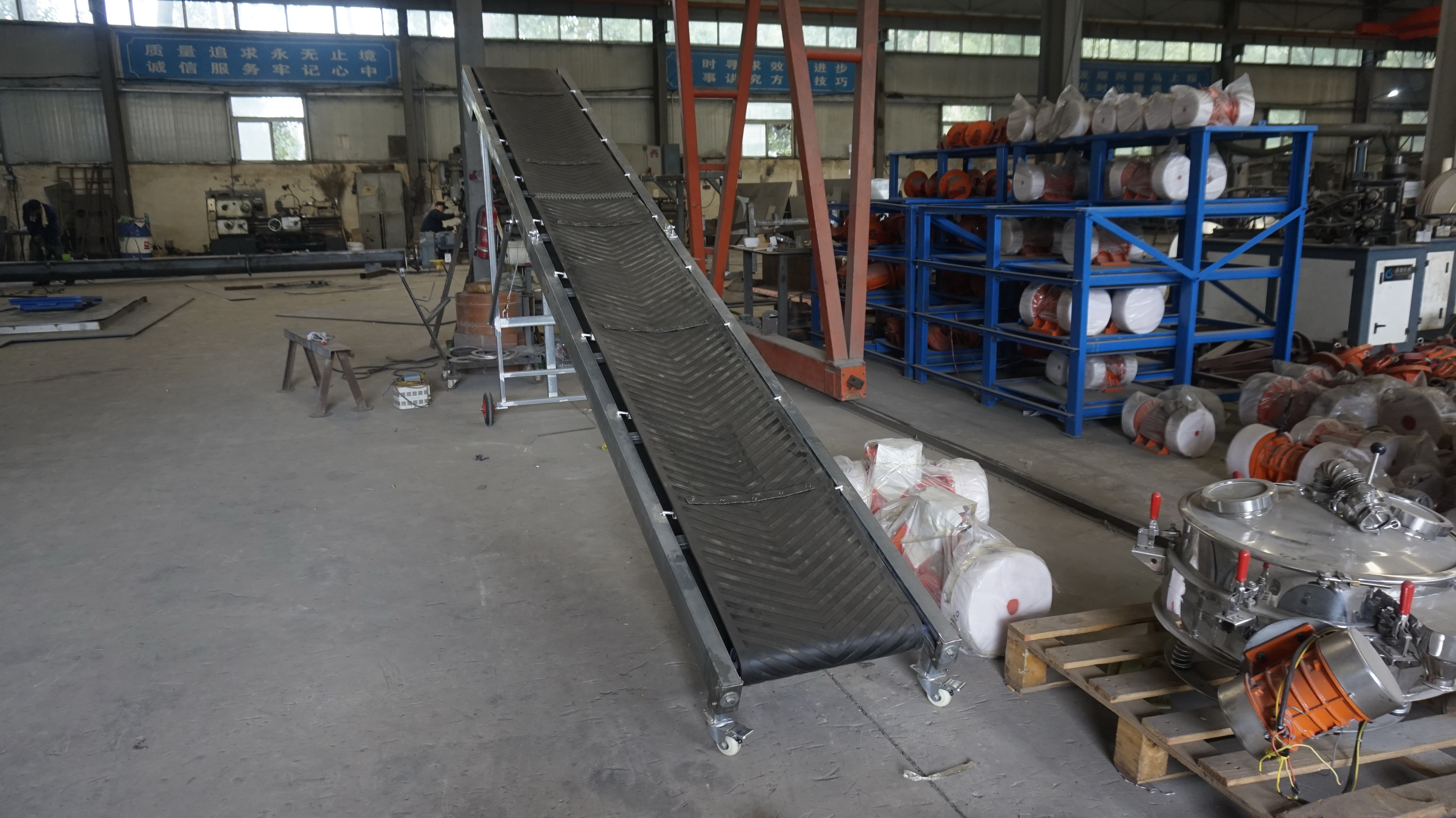
A gold ore belt conveyor is a mining mechanical equipment that uses a conveyor belt as the load-bearing and traction component to continuously transport gold ore. Driven by a drive unit, the conveyor belt circulates between rollers to deliver blasted gold ore from underground mining faces or ore piles to crushing stations in mineral processing plants. This equipment can achieve a maximum conveying distance of several kilometers for a single unit, with a conveying capacity ranging from hundreds to thousands of tons per hour.Gold Ore Belt Conveyorresolve practical difficulties in gold mining such as long ore transportation distances, large transport volumes and high labor intensity. They enable continuous operation of ore circulation from mining faces to processing lines, shorten mining and transportation cycles, cut transfer costs, and lay a fundamental foundation for stable ore supply in mineral processing operations.
Gold ore belt conveyors are primarily divided into two major categories based on installation mode and application scenarios: fixed type and extensible-retractable type.
In terms of conveyor belt load-bearing modes, there are bulk material conveyors supported by trough idlers and finished goods conveyors supported by flat idlers. Trough idler structures are generally adopted in gold mines to prevent ore rolling off. Gold mining enterprises select models with different belt widths and power ratings according to roadway cross-section sizes, transportation distances and volume requirements, with applicable belt widths ranging from 650 mm to 1400 mm.
Extensible-retractable belt conveyors are mostly applied in underground mining working faces, extending forward or retracting backward along with mining progress. Equipped with a belt storage device to store a certain length of conveyor belt, they adapt to the fast advance speed of roadways. In terms of conveyor belt load-bearing modes, there are bulk material conveyors supported by trough idlers and finished goods conveyors supported by flat idlers. Trough idler structures are generally adopted in gold mines to prevent ore rolling off. Gold mining enterprises select models with different belt widths and power ratings according to roadway cross-section sizes, transportation distances and volume requirements, with applicable belt widths ranging from 650 mm to 1400 mm.
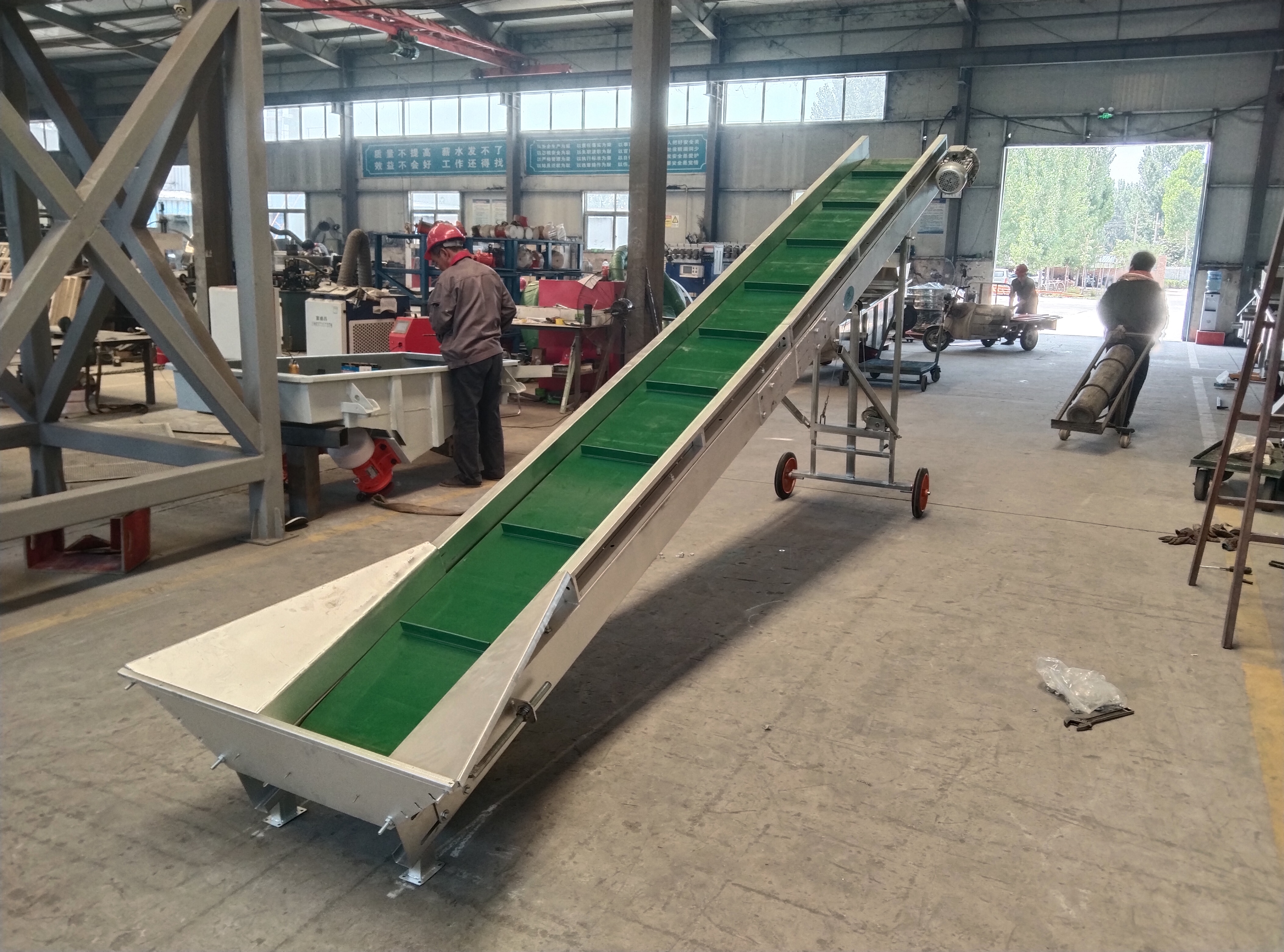
Gold ore belt conveyor systems are the backbone of modern gold mining operations, enabling the efficient, continuous transport of material from underground faces to processing plants. Selecting the right conveyor system is critical for optimizing throughput, reducing costs, and ensuring operational reliability. This comprehensive guide covers everything you need to know about gold ore belt conveyors, including:
Gold ore belt conveyors take conveyor belts as load-bearing and traction media to realize continuous transportation based on the friction drive principle. An electric motor drives the drive pulley to rotate via a reducer, and friction between the pulley and conveyor belt propels the belt to run along the conveying direction.
Gold ore falls onto the load-bearing section of the conveyor belt from feeding devices and moves forward with the belt surface, before being discharged into mineral processing equipment or transfer conveyors through head chutes when reaching the head pulley. The return section of the conveyor belt runs back unloaded under the frame to form a complete circulation loop.
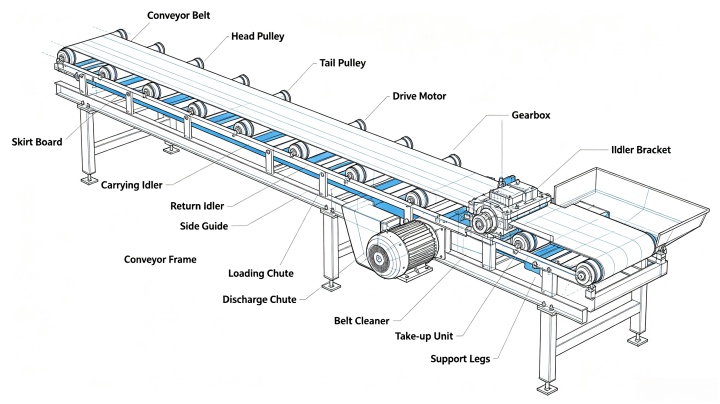
Idlers support the conveyor belt and guide its running direction; upper load-bearing idlers usually adopt a three-roll trough structure to form a V-shaped belt cross-section and expand material stacking capacity. Take-up devices adjust the initial tension of the conveyor belt through tension pulleys to eliminate plastic elongation generated during long-term belt operation and ensure sufficient friction on the drive pulley. Cleaners fit tightly against the conveyor belt surface to scrape off residual ore powder and moisture after discharging, keep the belt surface clean and avoid material accumulation on the return section.
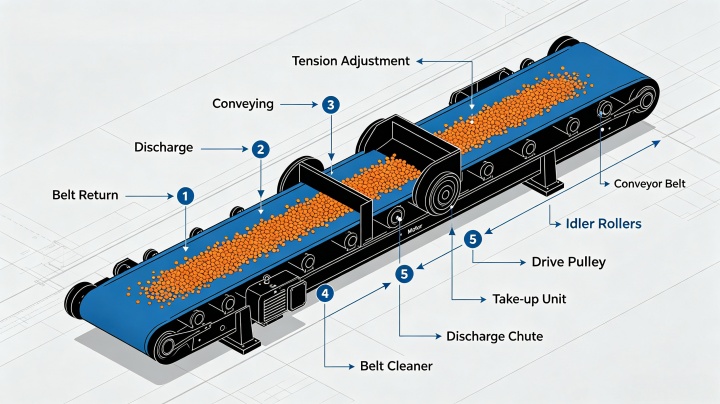
Core components of gold ore belt conveyors include conveyor belts, drive units, pulley groups, idler groups and take-up devices.
When selecting gold ore belt conveyors, equipment specifications shall be determined based on core parameters including conveying capacity, belt width, belt speed, conveying length and installed power. The belt width sets the basic upper limit of conveying capacity; belt speed affects the actual throughput; conveying length and lifting height restrict the selection of driving power. The table below summarizes key selection parameters of common gold ore belt conveyor models for reference during model selection.
| Model / Belt Width (mm) | Conveying Capacity (t/h) | Belt Speed (m/s) | Conveying Length (m) | Pulley Diameter (mm) | Idler Diameter (mm) | Installed Power (kW) | Application Description |
| B500 | 40–80 | 1.25–2.0 | 12–30 | — | — | 3–7.5 | Short-distance transfer in small-scale gold mines |
| B650 | 80–200 | 1.25–2.0 | 12–30 | Φ450 | Φ89 | 4–22 | Transportation from mining faces to ore bunkers in medium and small gold mines |
| B800 | 120–400 | 1.25–2.0 | 6–30 | Φ450–Φ630 | Φ89–Φ108 | 4–30 | Main transportation lines of medium-sized gold mines |
| B1000 | 200–435 | 1.25–2.0 | 10–40 | Φ500–Φ800 | Φ108–Φ133 | 5.5–22 | Coarse crushing feeding in gold mineral processing plants |
| B1200 | 290–655 | 1.25–2.5 | 10–153 | Φ630–Φ1000 | Φ133–Φ159 | 7.5–75 | Underground loading and surface main transportation for large gold mines |
| B1400 | 400–893 | 1.25–2.0 | 10–40 | Φ800–Φ1000 | Φ133–Φ159 | 11–45 | Large-scale continuous conveying lines for gold mines |
| B1600 | 600–1069 | 1.25–2.0 | 10–50 | Φ800–Φ1250 | Φ133–Φ159 | 15–75 | Main belt conveyor systems for super-large gold mines |
For the B800 belt width model, Model DTS80/40/2×30 features a conveying capacity of 400 t/h, a belt speed of 1.63 m/s, a conveying length of 500 m, and a dual 30 kW driving unit. The B1200 wide belt conveyor applied to underground loading belt conveyors in Shaling Gold Mine reaches a length of 153 m with a belt speed of 2.5 m/s. The steep-angle deep-trough belt conveyor used in Jiaojia Gold Mine also adopts the B1200 specification, equipped with a 75 kW drive unit and a belt speed ranging from 1.6 m/s to 2.5 m/s. B650 and B800 belt widths matched with DTII(A) models are adopted in the Western Gold Yili Project, with a belt speed of 1 m/s and 5.5 kW power for transferring mixed materials such as cyanide residue. Comprehensive factors including bulk specific gravity, lump size, moisture content of conveyed materials and on-site inclination conditions shall be taken into account during model selection. The driving power and conveyor belt tensile strength shall be calculated according to actual working conditions.
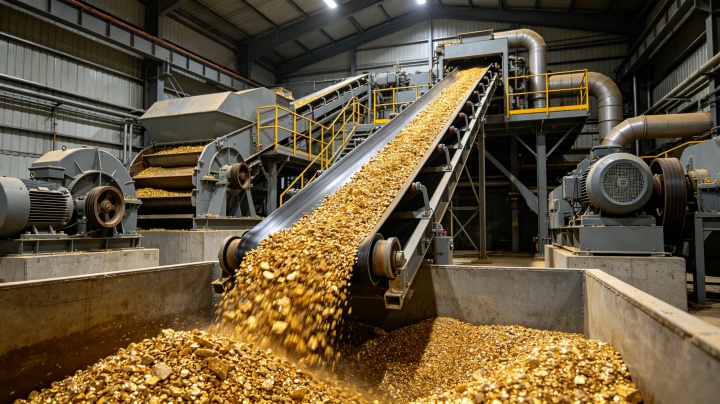
Gold ore belt conveyors undertake ore transportation tasks across the whole gold mine production process. In underground mining links, extensible-retractable belt conveyors deliver raw ore from mining working faces to main ore passes or ore bunkers as mining advances. For surface transportation, fixed belt conveyors transport ore from pit heads to coarse crushing bins of mineral processing plants over distances of hundreds or even thousands of meters. Inside mineral processing plants, belt conveyors connect various crushing and screening equipment to form closed-circuit crushing systems. A gold mine project under China National Gold Group purchased 8 sets of belt conveyors for transportation in mineral processing plants and tailings ponds. The maximum horizontal projection length of a single unit exceeds 60 meters, with belt widths ranging from 500 mm to 1400 mm to match flow demands of different operation points. Through combined layout of belt conveyors, gold mining enterprises achieve full logistics connection from mining sites to mineral processing workshops, eliminate intermittent transportation brought by truck transfer, and realize more stable and balanced ore supply.
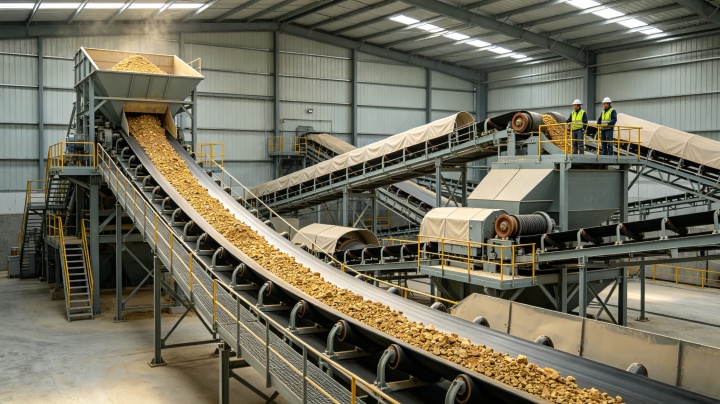
Gold ore belt conveyors continuously transport blasted gold ore from mining faces to feed inlets of mineral processing production lines via circulating operation of conveyor belts. Featuring conveying distances of several kilometers and a transport capacity of thousands of tons per hour per unit, they replace discontinuous transportation modes of traditional trucks or mine cars and form an uninterrupted logistics line for ore flow from underground mines to processing plants. Stable and continuous ore supply is guaranteed for mineral processing operations, enabling crushing and screening systems to run at full load and streamlining connections of the entire production process. Type selection configuration, component material selection and installation methods of belt conveyors are all designed around gold ore lump size, transportation distance and roadway conditions. Different gold mines select appropriate belt widths, belt speeds and drive power ratings based on their own production scales. From underground mining faces to surface processing plants, and from coarse crushing feeding to fine crushing closed circuits, belt conveyors run through all working procedures of gold mine production and become basic equipment for ore handling. Relying on this "mobile transportation road", gold mining enterprises closely link scattered mining operations with centralized mineral processing, making ore transportation from rock masses to processing lines more direct and convenient.


Address:China,Yanjin county forest park gate to the west 1000 meters north road.


 Online Chat


 Email
Email