


When you need to know how to calculate screw conveyor capacity, the starting question is simple: how much material can the screw actually move in one hour? For powder conveying, the answer depends on more than the conveyor diameter. Screw geometry, operating speed, material loading, and powder bulk density all contribute to the final capacity.
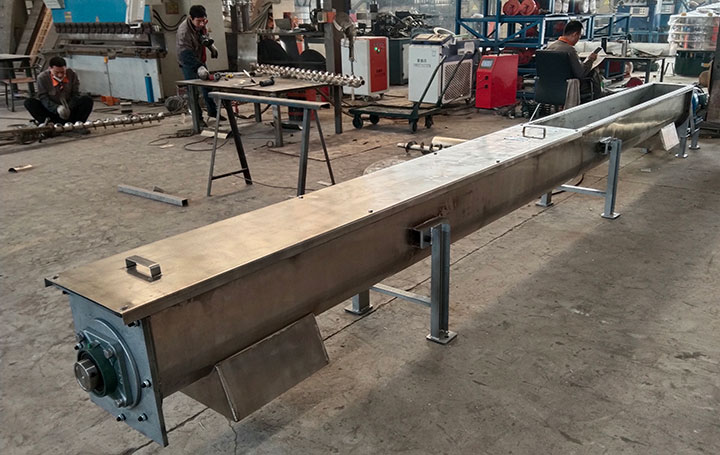
The same screw conveyor can also deliver different capacities when the material or conveying conditions change. This is why capacity should be calculated from the actual screw dimensions and powder properties rather than estimated from conveyor diameter alone.
The calculation begins with the effective conveying area inside the screw. This area is combined with the screw pitch, rotational speed, and loading factor to determine the approximate volumetric capacity. For powder materials, the volumetric result is then multiplied by bulk density to obtain the estimated mass capacity in kg/h or t/h.
The calculation follows three basic steps:
Calculate the effective screw area.
Calculate the volumetric capacity.
Convert volumetric capacity to mass capacity using bulk density.
This provides a preliminary capacity estimate. Actual screw conveyor selection should also account for the powder characteristics, conveying length, inclination, feeding conditions, and drive requirements.
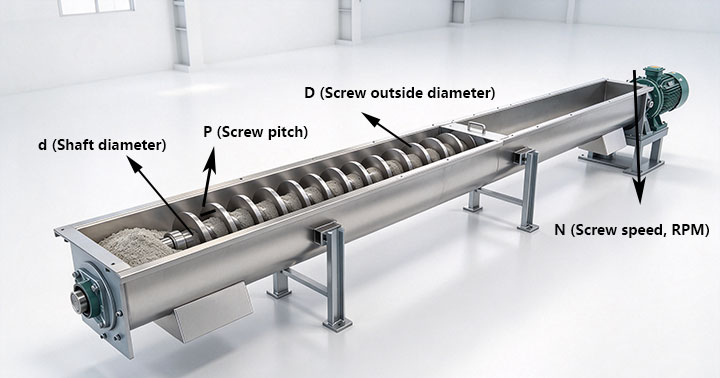
Screw conveyor capacity is governed by the amount of material the screw can carry with each revolution and how often those revolutions occur. The main design and operating factors are the screw diameter, shaft diameter, screw pitch, rotational speed, loading factor, and material bulk density.
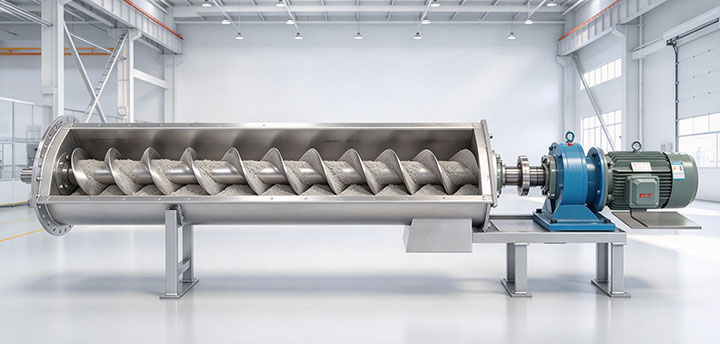
For inclined conveyors, the installation angle must also be considered because the usable conveying capacity can differ from a horizontal arrangement. These factors are used together in the capacity calculation rather than being evaluated independently.
A practical screw conveyor capacity calculation starts with the space available for material inside the screw. For a conventional shafted screw conveyor, the center shaft reduces the effective cross-sectional area, so both the screw diameter and shaft diameter need to be included in the calculation.
Step 1: Calculate the Effective Screw Area
The effective conveying area can be estimated from the outside diameter of the screw and the diameter of the center shaft:
A = π/4 × (D² − d²)
Where:
A = effective screw area, m²
D = screw outside diameter, m
d = shaft diameter, m
This area represents the cross-sectional space available for the material before the selected loading factor is applied. Using the effective area rather than the full screw diameter gives a more useful starting point for estimating the capacity of a shafted screw conveyor.
Step 2: Calculate Volumetric Capacity
Once the effective screw area is known, the next step is to determine how much volume the screw can move over a given period. Screw pitch defines the distance the material is theoretically advanced during one revolution, while rotational speed determines how many such revolutions occur each minute.
The approximate volumetric capacity can be calculated as:
Qv = A × P × N × 60 × φ
Where:
Qv = volumetric capacity, m³/h
A = effective screw area, m²
P = screw pitch, m
N = screw speed, RPM
φ = loading factor
60 = conversion from minutes to hours
The loading factor accounts for the fact that the available screw space is not normally filled to 100% during operation. After this calculation, the result represents the estimated volume of material the screw conveyor can handle per hour. The material's bulk density is then used to convert this volumetric capacity into mass capacity.
Step 3: Convert Volumetric Capacity to Mass Capacity
Volumetric capacity shows how much material the screw conveyor can move by volume, but powder conveying requirements are often specified by weight, such as kg/h or t/h. The material's bulk density provides the connection between these two values.
The mass capacity can be estimated using:
Qm = Qv × ρ
Where:
Qm = mass capacity, kg/h
Qv = volumetric capacity, m³/h
ρ = bulk density, kg/m³
For example, if the calculated volumetric capacity is 12 m³/h and the powder has a bulk density of 700 kg/m³, the estimated mass capacity is 8,400 kg/h, or 8.4 t/h.
This final conversion gives a capacity that can be compared directly with the required powder throughput. For actual equipment selection, the calculated value should still be checked against the material and conveying conditions.
Powder materials require a closer look at their physical condition when estimating screw conveyor capacity. Two powders with similar particle sizes can behave quite differently in the conveyor because their bulk density, flowability, moisture content, and tendency to compact or adhere may not be the same.
For capacity calculation, bulk density is particularly important because the screw first produces a volumetric conveying capacity, while the required output is often expressed in tons per hour. The density used in the calculation should represent the material in the condition in which it will enter and move through the conveyor.
Loading also needs to match the way the powder behaves during conveying. A free-flowing granular powder may maintain a more stable flow through the screw, while a cohesive or easily compacted powder may require a different loading level and operating arrangement.
For this reason, powder screw conveyor capacity should be based on the actual material and operating conditions rather than a capacity value taken only from the screw diameter.
Consider a horizontal screw conveyor handling a powder with a bulk density of 700 kg/m³. The conveyor has a 300 mm screw diameter, a 90 mm shaft diameter, a 300 mm pitch, and operates at 35 RPM. Assume a 30% loading factor.
1. Effective screw area
A = π/4 × (0.30² − 0.09²) ≈ 0.0643 m²
2. Volumetric capacity
Qv = 0.0643 × 0.30 × 35 × 60 × 0.30 ≈ 12.14 m³/h
3. Mass capacity
Qm = 12.14 × 700 ≈ 8,498 kg/h
The estimated capacity is therefore approximately 8.5 t/h under these assumed conditions. This figure represents a preliminary calculation for the specified powder, screw configuration, speed, and loading level rather than a universal capacity for a 300 mm screw conveyor.
If the material, bulk density, loading condition, speed, or installation arrangement changes, the resulting capacity will also change. Final equipment selection should therefore be based on the actual conveying requirements.
Bulk density has a direct effect on the mass capacity of a screw conveyor. The screw moves a certain volume of material, but the weight represented by that volume changes with the density of the powder.
For example, if a screw conveyor provides a volumetric capacity of 12 m³/h:
| Bulk Density | Estimated Mass Capacity |
|---|---|
| 500 kg/m³ | 6.0 t/h |
| 700 kg/m³ | 8.4 t/h |
| 1,000 kg/m³ | 12.0 t/h |
The conveyor has not changed in this comparison; only the bulk density has changed. This is why a capacity stated only in m³/h cannot be directly treated as a fixed tons-per-hour rating for different powders.
When calculating capacity for powder materials, use a bulk density that reflects the material's actual conveying condition. If the powder can expand, compact, or vary significantly in density during handling, this variation should also be considered when selecting the conveyor.
Screw diameter, pitch, and rotational speed are closely related to the amount of material a conveyor can move. Changing one of these parameters can increase or reduce capacity, but the highest possible value is not always the most suitable operating condition.
Screw diameter determines the available conveying space. Increasing the diameter generally allows more material to be carried with each revolution, making it one of the main factors used to increase capacity.
Screw pitch determines how far material is advanced during each revolution. A larger pitch can increase the volume moved per revolution, while a reduced pitch may be selected when a more controlled material flow is required.
Rotational speed determines how frequently the screw moves material through the conveyor. Increasing RPM generally raises capacity, but the practical speed range depends on the material, screw size, conveying length, and operating conditions.
These parameters should therefore be selected as a combination rather than adjusted independently. Increasing diameter, pitch, or speed simply to reach a target capacity may not be appropriate if it causes excessive wear, unstable feeding, material degradation, or other operating problems.
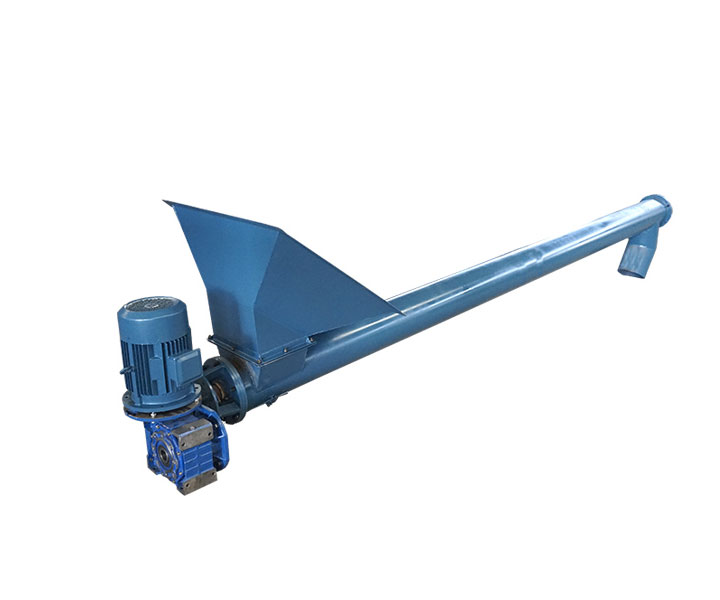
Screw conveyor capacity can decrease when the conveyor is installed at an incline. As the conveying angle increases, part of the material tends to move back toward the lower end instead of advancing continuously toward the discharge point.
A horizontal screw conveyor generally provides the most efficient material transport. When the conveyor is inclined, the actual capacity depends on the installation angle, screw speed, pitch, loading level, and material flow characteristics.
The effect is also different from one powder to another. Free-flowing powders may behave differently from cohesive or easily compacted materials, so a fixed percentage reduction should not be applied to every inclined screw conveyor.
For this reason, the capacity calculated for a horizontal arrangement should be treated as a reference when designing an inclined conveyor. The actual installation angle and material characteristics should be included when determining the final screw diameter, speed, and required capacity.
A preliminary calculation uses effective screw area, pitch, screw speed, loading factor, and bulk density to estimate the conveyor's mass capacity.
Calculate the volumetric capacity in m³/h, multiply it by bulk density in kg/m³, and divide by 1,000 to obtain t/h.
Calculate the screw's volumetric capacity first, then use the powder's bulk density to convert it to kg/h or t/h. Material flowability and conveying conditions should also be considered.
If you know the required capacity but are not sure which screw diameter, pitch, or speed is suitable, you can send us your material name, bulk density, required capacity, and conveying length. Dahan Machinery can help check the screw conveyor capacity and recommend a suitable configuration for your powder handling application.


Address:China,Yanjin county forest park gate to the west 1000 meters north road.


 Online Chat


 Email