


In bulk material handling, selecting the right conveying equipment directly impacts your production efficiency, maintenance frequency, and overall profitability. Whether handling chemical powders, food ingredients, or plastic granules, challenges like material degradation, pipeline clogging, and spatial limitations frequently cause operational bottlenecks.
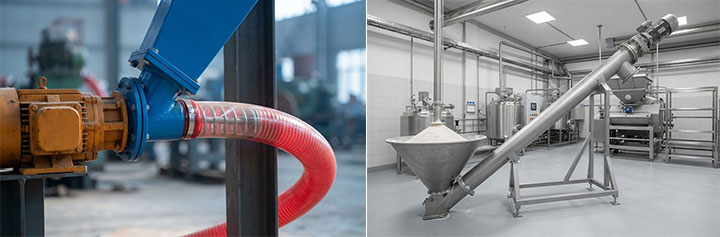
While both flexible auger conveyors and tubular screw conveyors are industry workhorses, they operate on distinct mechanical principles suited for different plant environments. This technical guide provides a direct, engineering-focused comparison to help you evaluate which system best matches your material characteristics, throughput needs, and facility layout.
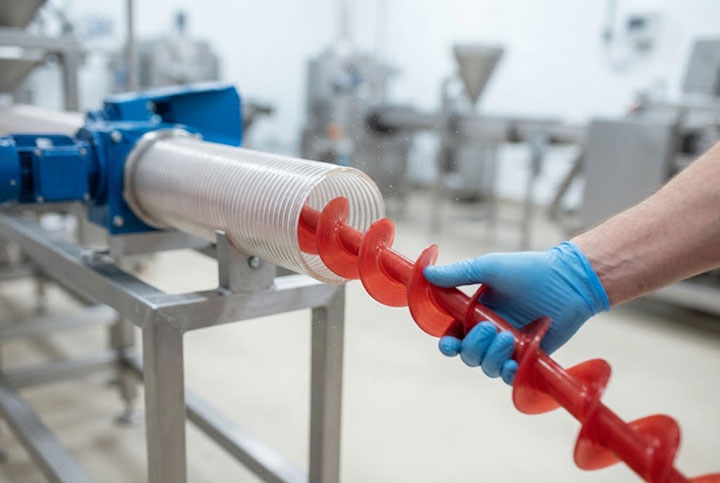
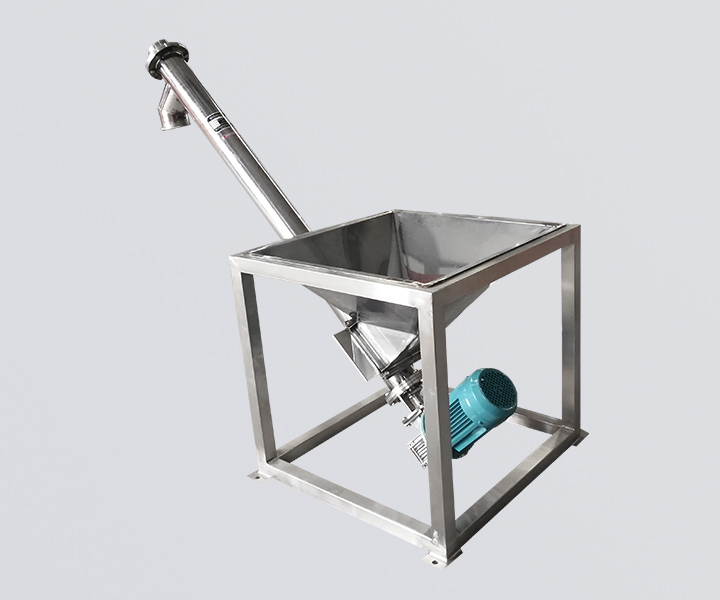
A flexible auger conveyor (also known as a spiral or helix conveyor) relies on a single, rotating helical spring enclosed within a sealed, flexible or rigid polymer tube. As the shaftless spiral spins at high speeds, it continuously moves dry powders and granules forward through friction and centrifugal force.
The defining engineering advantage of this system is its three-dimensional routing flexibility. Unlike rigid mechanical conveyors, a flexible auger can curve around existing machinery, traverse vertical and horizontal planes, and fit tightly into congested processing floors without requiring transfer points.
Ideal Applications & Material Suitability:
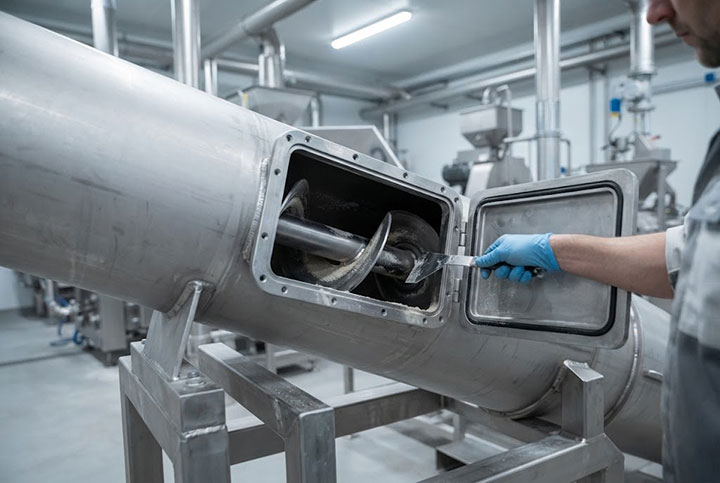
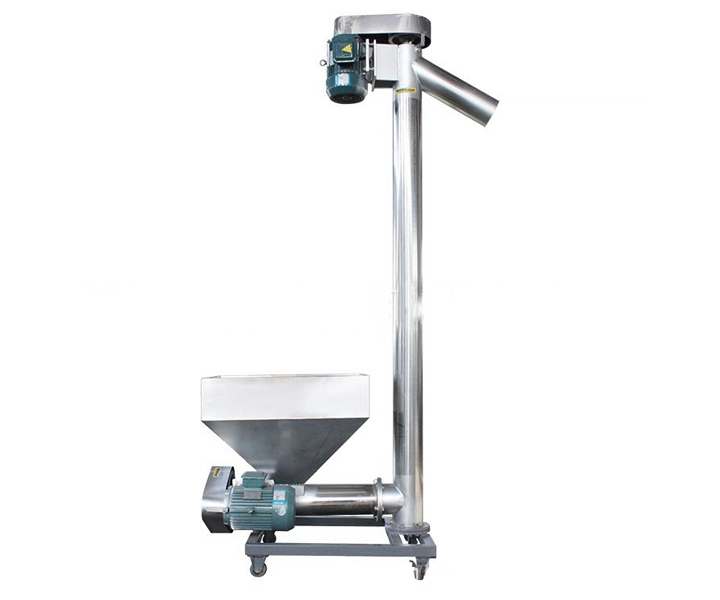
A tubular screw conveyor features a central shaft equipped with helical flights (or a shaftless spiral design) rotating inside a heavy-gauge sealed steel tube or trough. Driven by an external motor and gear reducer, it pushes bulk materials forward through positive displacement rather than centrifugal suspension.
Dahan Tubular Screw Conveyor in Action — Heavy-Duty Material Handling
The primary engineering advantage of a tubular system is its structural rigidity and massive volumetric capacity. Designed to handle continuous, high-duty cycles, it excels in moving heavy, abrasive, or higher-density materials across longer distances with exceptional reliability.
Ideal Applications & Material Suitability:
To determine which system fits your operation, evaluating their mechanical trade-offs side-by-side helps clarify their performance boundaries:
| Evaluation Criteria | Flexible Auger Conveyor | Tubular Screw Conveyor |
|---|---|---|
| Routing Flexibility | High; can bend and curve around obstacles in 3D layouts. | Rigid; strictly linear or fixed-angle configurations. |
| Throughput & Capacity | Moderate; optimized for small to medium batch feeding. | High; built for continuous, high-volume mass flow. |
| Conveying Distance | Short to medium (generally under 15-20 meters per unit). | Long distances (easily exceeds 20 meters with supports). |
| Material Degradation | Higher risk of shear or particle friction at high speeds. | Lower shear force; gentler on bulk aggregate integrity. |
| Initial Footprint | Compact, space-saving design for tight industrial floors. | Requires dedicated clearance and sturdy structural support. |
In short, choose a flexible auger when your plant layout demands complex spatial routing and moderate throughput. Opt for a tubular screw conveyor when heavy-duty, high-capacity, and long-distance bulk transfer are your top priorities.
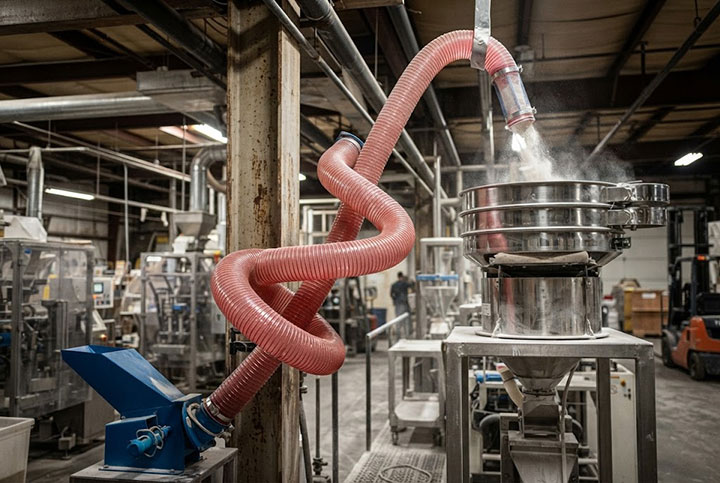
If your facility operates a compact mixing and packaging line—such as feeding fine chemical powders into a rotary vibrating screen or direct-to-bag station—a flexible auger excels. Its ability to snake through existing steel framing and overhead obstructions allows processors to connect disparate machines without redesigning the entire floor layout.
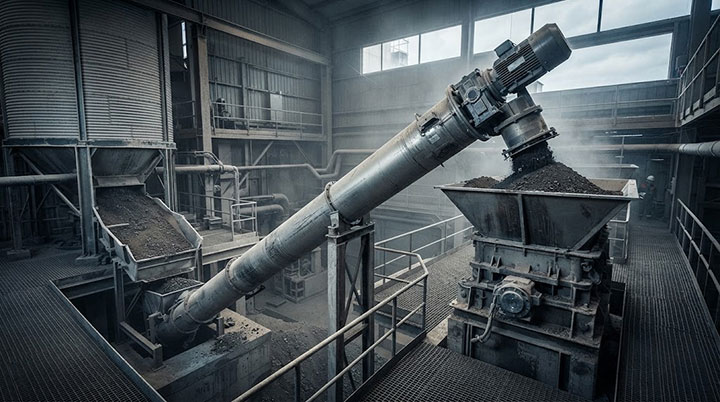
Conversely, if your plant deals with high-tonnage aggregate transfer, building materials, or minerals flowing from silos to primary processing equipment, a tubular screw conveyor is essential. Its heavy-duty steel tube and robust central shaft withstand continuous, punishing workloads where rigidity and high volumetric output outweigh routing complexity.
Operational downtime is directly tied to how easily your conveying equipment can be cleaned, inspected, and maintained between product batches or maintenance shifts.
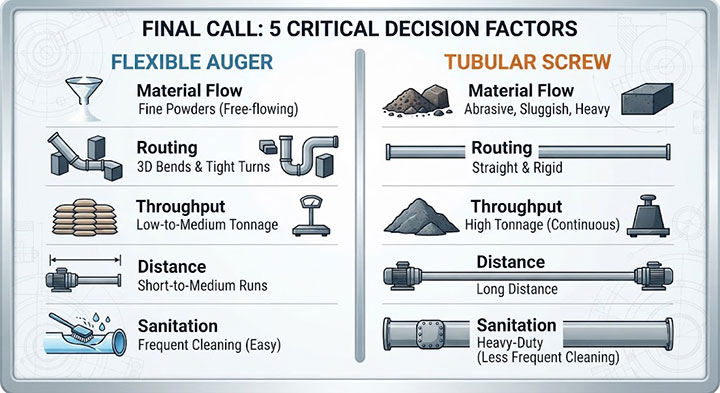
When finalizing your equipment choice, evaluate your project against these five critical engineering parameters:
Yes. Flexible augers can perform vertical and inclined conveying effectively, though vertical lift capacity depends on the bulk density and flowability of the material being handled.
Both systems feature sealed tubular designs that prevent dust escape. However, flexible augers provide a completely enclosed, gasket-sealed path that excels in dust-sensitive chemical and food environments.
Yes. By utilizing heavy-gauge carbon steel or specialized wear-resistant alloy steels, tubular screw conveyors are engineered to withstand abrasive minerals, aggregates, and construction powders.
Selecting the optimal powder handling system doesn't have to be guesswork. Whether you need to integrate a flexible auger into a compact screening line or deploy a high-capacity tubular screw for heavy industrial processing, Dahan Machinery delivers engineered-to-order solutions designed for your exact plant requirements.
Contact our engineering team today to share your material specifications and layout dimensions. We will help you size the ideal conveying system and provide a direct equipment quotation.


Address:China,Yanjin county forest park gate to the west 1000 meters north road.


 Online Chat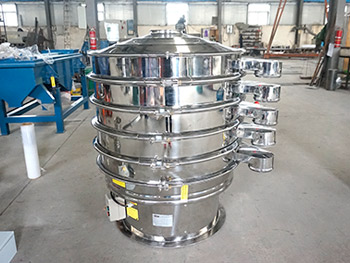
 Email
Email