


How to Choose a Pharmaceutical Powders Sieving Machine is a real decision many pharmaceutical companies face when expanding or changing production lines. Pharmaceutical powder sieving is often underestimated as a simple process until batch waste or repeated cleaning validation failures reveal that the impact of equipment selection goes far beyond expectations.
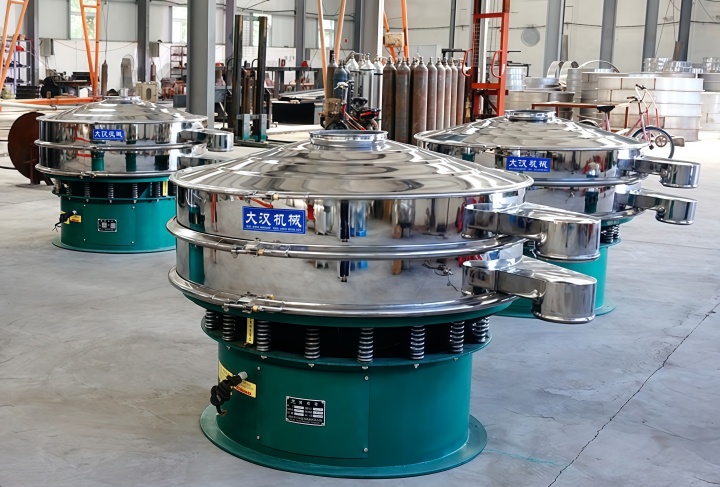
A mismatched machine leads to frequent screen blinding, particle size distribution drift, and longer cleaning cycles, which may become compliance deficiencies in a GMP audit. Saneca Pharmaceuticals in Slovakia faced the same dilemma when expanding its API production line. The company has about 20 API products sold to Japan and the United States, and its original standard vibrating screen could not meet the requirements for mechanical impurity separation and fine adjustment of particle size distribution.
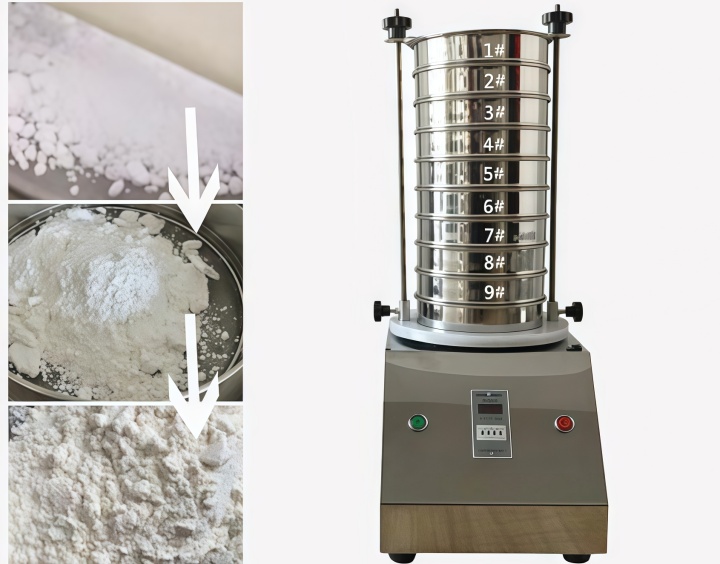
Before touching any parameter table, answer the actual behavior of the powder to be sieved under conveying and vibrating conditions. Academic research shows that both USP and European Pharmacopoeia point out that for drug powders with a high proportion of particles below 75 microns in the particle size distribution, the applicability of sieving methods is significantly limited because these fine powders tend to agglomerate and generate static, causing screen hole blockage, and particles that could have passed cannot pass because the mesh is covered.
The way to judge is not to rely on general parameters, but to run a small batch trial with the actual material, recording the efficiency change in the first 30 minutes and after 2 hours of continuous operation. If efficiency drops noticeably after a short run, the motion pattern of the machine does not match the material characteristics.
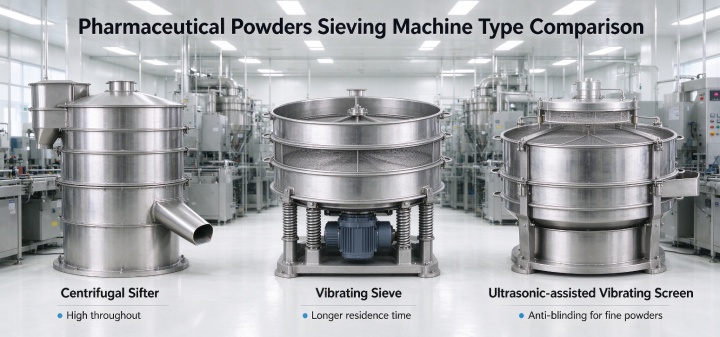
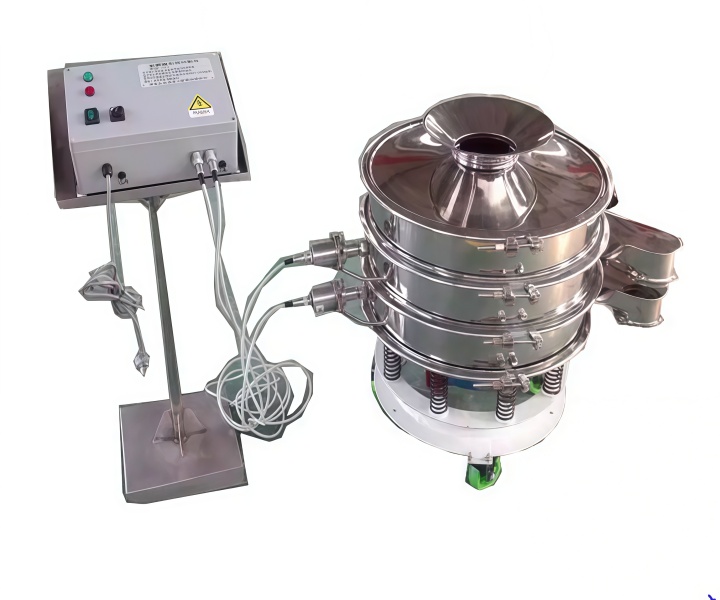
Centrifugal type has higher throughput and is suitable for impurity removal of powders with acceptable flowability, but mechanical shear is stronger. Vibrating type gives longer material residence time and is suitable for fine grading or easily agglomerated powders. Ultrasonic-assisted vibrating screen adds high-frequency micro-vibration on top of traditional vibration, usually operating in the 20kHz to 40kHz range, where the micro-vibration is enough to break the van der Waals force between fine particles and reduce the embedding of near-mesh particles.
The effective throughput decay after product changeover cleaning stops and screen blinding is a part that must be deducted in throughput calculation. When you choose a Pharmaceutical Powders Sieving Machine, this decay range should be used as a baseline.
| Type | Applicable Material | Blinding Risk | Cleaning Convenience | GMP Adaptability |
|---|---|---|---|---|
| Centrifugal | Powders with acceptable flowability | Medium | Medium | Good |
| Vibrating | Easily agglomerated or needing grading | Higher | Higher | Higher |
| Ultrasonic-assisted | Fine powders below 300 microns | Low | Higher | Higher |
After narrowing the range with the table, use the following checklist to judge priority. If 3 or fewer items apply, the selection focus is on basic throughput and material compliance. If 4 to 6 items apply, priority should be given to cleaning design, blinding countermeasures, and changeover downtime. If 7 or more items apply, move into the range of specialized models for sterile or highly active materials.
Whether the powder is hygroscopic or static-prone
Whether product changeover frequency exceeds once per week
Whether sterile or highly active material protection is needed
Whether the current equipment cleaning validation cycle is lengthening
Whether sieving efficiency drops by more than 10 percent within 2 hours
Whether fine powders below 300 microns are processed
Whether online cleaning or bag-in bag-out screen change is required
Whether spare part procurement cycle exceeds two weeks
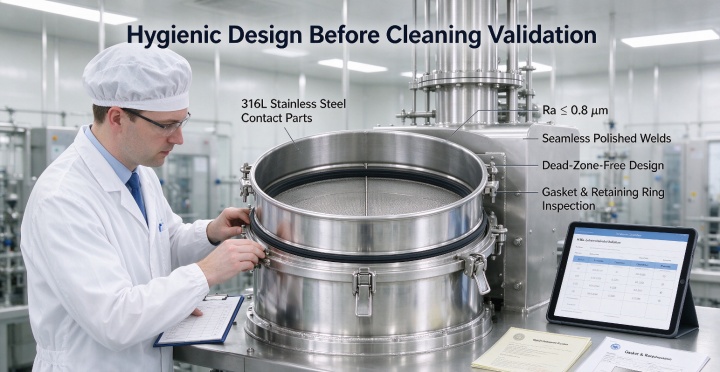
Parts in contact with materials should use 316L stainless steel, with surface roughness controlled at Ra ≤ 0.8 μm, and welds polished to be seamless. Equipment structure should avoid dead corners, threaded connections, and hard-to-reach grooves. An FDA inspection of a pharmaceutical company found that operators touched auxiliary equipment without cleaning gloves, and the cross-contamination investigation lacked analytical verification and broader equipment assessment, which was listed as a non-compliant item.
In multi-product shared production, cross-contamination risk often concentrates in the screen frame connection gap, the seal ring installation groove, and the back of the screen tensioning ring. When you choose a Pharmaceutical Powders Sieving Machine, hygienic design needs to be determined before cleaning validation, because once the structure is fixed, the cost of later modification is much higher than early design adjustment. In sterile production environments, isolator interfaces usually need to reach OEB5 level to match the protection standard for highly active materials.
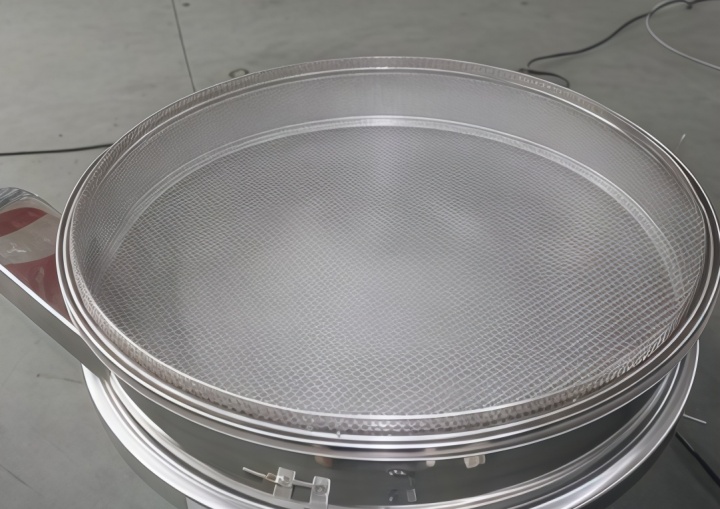
Blinding is essentially particles close to the screen hole size stuck in the holes, or fine powder forming a covering layer on the screen surface and back due to static and moisture. A study on 1mm screens recorded that at a throughput of 8kg/h, the screen became blocked during manual grinding, and particles stayed much longer because they could not pass through the screen, resulting in an abnormally high proportion of fine powder in the final particles.
Simply increasing vibration intensity often backfires. Effective methods include configuring an ultrasonic screen cleaning system, controlling environmental humidity, and evaluating whether the wear products of mechanical cleaning elements constitute a cross-contamination risk. When you choose a Pharmaceutical Powders Sieving Machine, the motion frequency and amplitude of the cleaning device need to match the screen tension, otherwise it may aggravate local screen wear.
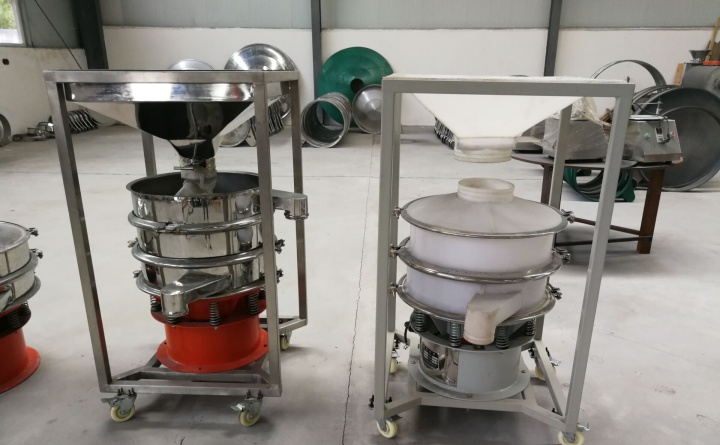
A complete validation package usually includes material certificates, surface roughness inspection reports, screen aperture verification records, and electronic records compliant with 21 CFR Part 11. When you choose a Pharmaceutical Powders Sieving Machine, the degree of screen specification standardization and procurement cycle should also be considered.
New Zealand GMP manufacturer Alaron increased powder sieving throughput considerably after switching to a compact vibrating screen. The core reason was not a change in screen material, but the straight-through structure and higher effective sieving area. Non-standard screen replacement cycles can be as long as several weeks, while standardized screen spares are usually available within days.
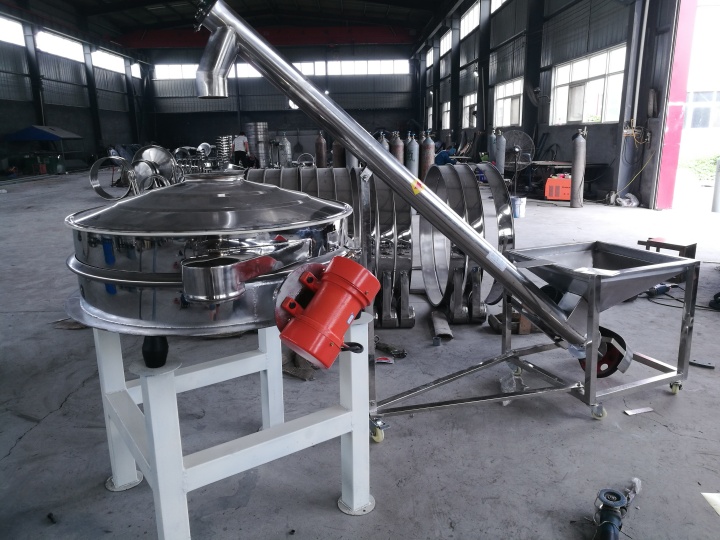
Trial sieving validation should use actual production material, run continuously for no less than 4 hours, and record the efficiency change curve, blinding frequency, and actual cleaning and disassembly time. If efficiency drops by more than 15 percentage points within 4 hours, it indicates a conflict between motion parameters and the material.
When evaluating a Choose a Pharmaceutical Powders Sieving Machine for trial sieving validation, also watch for abnormal noise, discharge speed changes, and vibration amplitude fluctuations. Abnormal noise points to insufficient screen tension or loose fasteners. A gradual drop in discharge speed without obvious blinding often means seal aging causes material leakage or bypass between layers. Large vibration amplitude fluctuations may mean displacement of motor eccentric blocks or bearing wear.
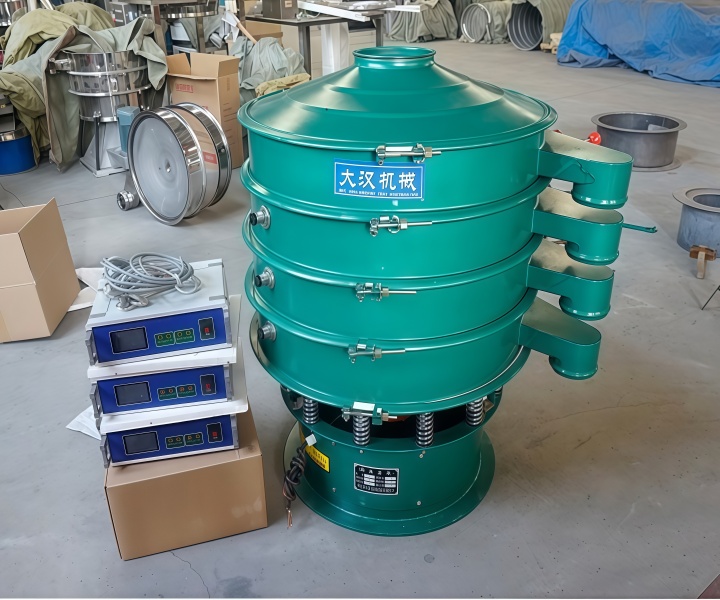
India's Sri Krishna Pharmaceuticals, when expanding its acetaminophen API production line, used three 900mm diameter vibrating screens equipped with ultrasonic anti-blinding systems to address blinding risk under high throughput.
A: Industrial equipment is usually controlled between 70 and 85 decibels. Actual measured data should be requested rather than nominal values.
A: It depends on the lower ignition temperature of the powder and the dust cloud explosion index. In combustible dust environments, the equipment interior usually needs to reach Zone 20 or Zone 21.
A: The equipment needs a reliable grounding system, with grounding resistance usually controlled within 10 ohms.
A: Some vibrating machines can be compatible by changing the screen assembly, but the sealing structure and liquid discharge method need targeted design.
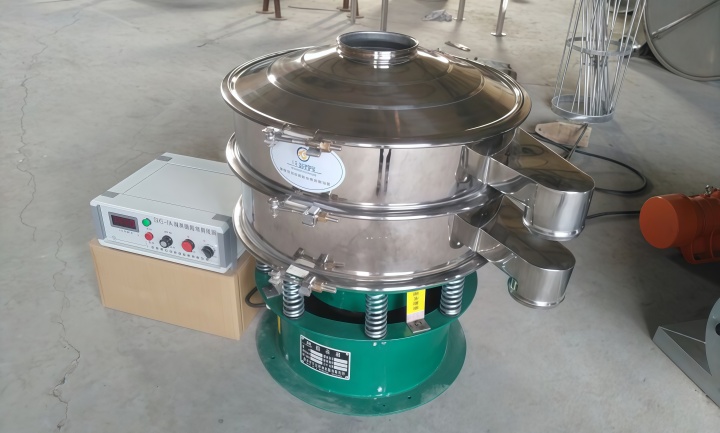
The decision chain for Choose a Pharmaceutical Powders Sieving Machine starts with powder behavior judgment, then goes through type matching, hygienic design evaluation, blinding countermeasures, validation support and running cost accounting, and finally lands on trial sieving validation and fault signal identification.
Saneca Pharmaceuticals locked the stable processing capacity of its compact vibrating screen at 100 to 400 kg per shift, a figure that corresponds directly to the actual needs of its API product portfolio. If you are evaluating a specific selection plan, it is advisable to run continuous trial sieving with actual material. Running data is more persuasive than a specification sheet.


Address:China,Yanjin county forest park gate to the west 1000 meters north road.


 Online Chat
 Email