


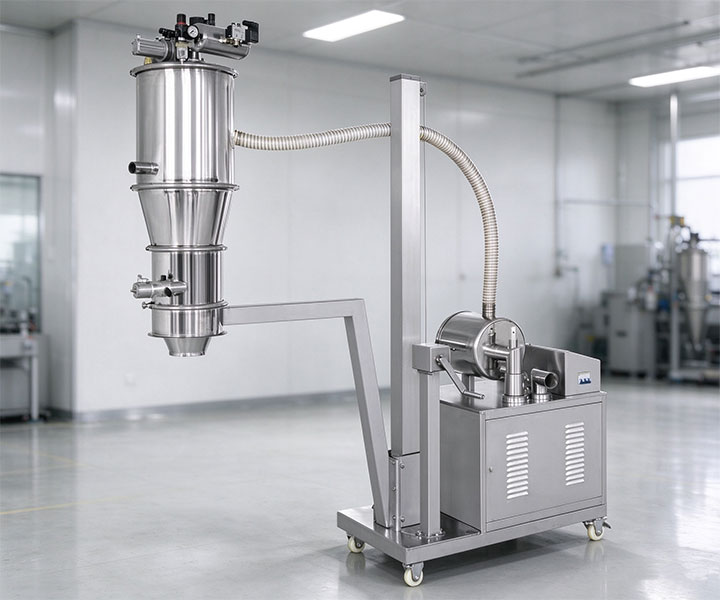
The Pneumatic Vacuum Conveyor (also referred to as a vacuum feeder, pneumatic vacuum loader, or suction transfer system) is a compressed‑air‑driven bulk handling solution designed for the dust‑free, contamination‑free transfer of dry powders, granules, and small pellets across food, pharmaceutical, chemical, and battery material production lines.
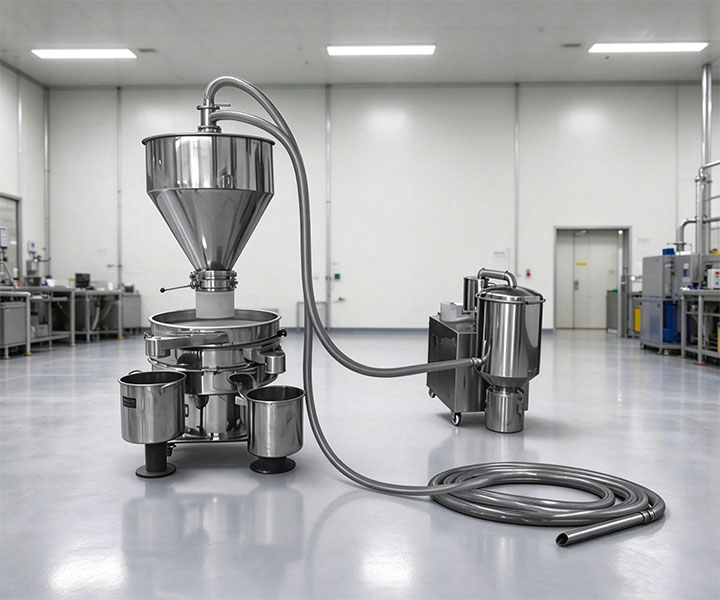
Operating on the negative pressure principle, the system uses a venturi‑type vacuum generator powered by standard plant compressed air (0.4–0.6 MPa) to draw materials through a fully sealed pipeline into a receiving hopper. Inside the hopper, a high‑efficiency filter separates the material from the airflow, while an automatic discharge valve releases the product into downstream equipment — such as mixers, granulators, tablet presses, packaging machines, or reactors.
Key engineering benefits of this pneumatic design:
No moving parts in contact with the product — minimizing wear, particle degradation, and contamination risk
Fully enclosed conveying path — eliminating dust emission, moisture pick‑up, and cross‑batch contamination
No electrical components in the conveying zone — making it intrinsically safe for explosive dust atmospheres (ATEX‑ready options available)
Compact, modular footprint — easily integrates into existing production lines with minimal layout changes
Our standard models cover conveying capacities from 50 kg/h up to 6,000 kg/h, with horizontal distances up to 20 meters and vertical lifts up to 9 meters, offering flexible solutions for both single‑point feeding and multi‑point distribution systems.
All material‑contact parts are manufactured from SUS304 or SUS316L stainless steel with mirror‑polished interior surfaces (Ra ≤ 0.4µm), fully compliant with GMP, FDA, and EHEDG sanitary standards
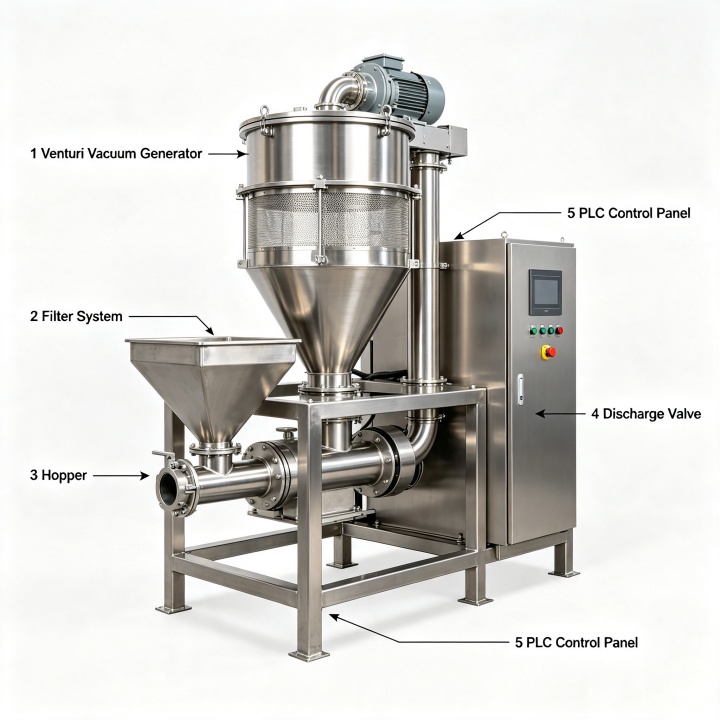
With decades of experience serving over 200 clients across 30+ countries, our pneumatic vacuum conveyor stands out for its reliability, hygiene, and operational intelligence. Here is what sets it apart:
Robust Sanitary Construction
Made from premium SUS304 or SUS316L stainless steel with fully ground, crevice‑free welds and mirror‑polished internal surfaces — eliminating bacterial harborage and simplifying regulatory audits
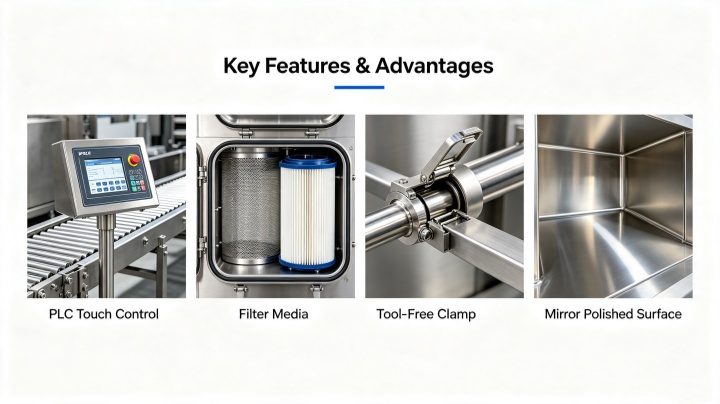
All material‑contact parts are tool‑lessly detachable via tri‑clamp or quick‑release couplings, enabling thorough cleaning and rapid product changeovers in under 5 minutes
Intelligent Automation
Equipped with a PLC controller and HMI touchscreen for setting suction time, discharge time, and filter cleaning intervals
Optional material level sensors (capacitive or vibrating fork) enable fully automatic start/stop operation — the conveyor feeds only when the hopper level drops, reducing compressed air waste by 40–60%
Supports Modbus, Profibus, or Ethernet/IP communication for integration into factory SCADA systems
Advanced Filtration & Anti‑Clogging
High‑efficiency main filter (available in PE, PTFE‑coated, titanium, or SUS316L sintered elements) achieves filtration precision down to 0.1μm with ≥ 99.99% retention — critical for containing potent APIs and fine powders
Reverse‑pulse compressed air jet cleaning activates automatically to blow accumulated dust off the filter, maintaining consistent suction power without production stops
Versatile Material Handling
Handles a wide spectrum of bulk solids — from free‑flowing powders (flour, starch, sugar) to cohesive materials (milk powder, protein isolate, carbon black), granules (plastic resin, pharmaceutical pellets), and even fibrous or abrasive substances with optional wear‑resistant linings. Custom hopper configurations and filter media are available for sticky or hygroscopic products.
Low Operating Cost & High Safety
Optimized venturi nozzle design delivers up to 30% higher vacuum efficiency per unit of compressed air compared to generic ejectors
Sealed pipeline fully isolates operators from toxic, allergenic, or potent compounds, meeting OEL requirements down to < 1 µg/m³
Built‑in anti‑static grounding and optional ATEX Zone 22 / 1 / 2 certifications for hazardous environments
Typical annual maintenance cost is less than 2% of the initial investment, with no gearboxes, bearings, or seals to replace in the product zone
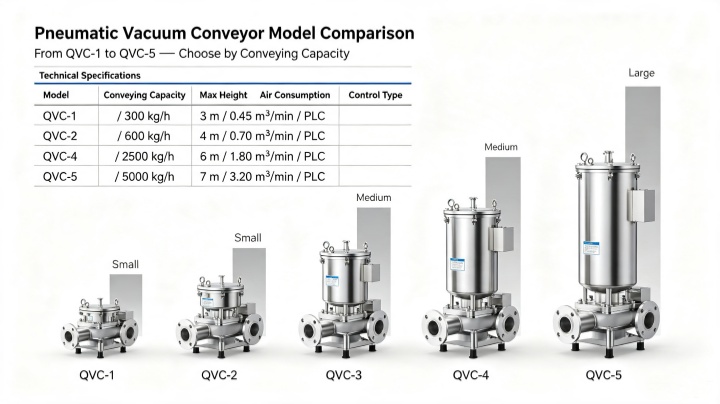
Our modular pneumatic vacuum loader series is available in multiple models to suit varying production capacities. All models are customizable based on your specific material characteristics and conveying requirements.
| Model | Hopper Capacity | Conveying Capacity (kg/h)* | Air Pressure | Air Consumption | Material Finish |
| QVC-1 | 3.5 L | Up to 350 kg/h | 0.4–0.6 MPa | 180 L/min | SUS304 / 316L |
| QVC-2 | 6.0 L | Up to 700 kg/h | 0.4–0.6 MPa | 360 L/min | SUS304 / 316L |
| QVC-3 | 12.0 L | Up to 1,500 kg/h | 0.4–0.6 MPa | 720 L/min | SUS304 / 316L |
| QVC-4 | 42.0 L | Up to 3,000 kg/h | 0.4–0.6 MPa | 1440 L/min | SUS304 / 316L |
| QVC-5 | 58.0 L | Up to 6,000 kg/h | 0.6 MPa | 2880 L/min | SUS304 / 316L |
*Note: Capacity based on wheat flour at 4‑meter horizontal distance and 3‑meter vertical lift. Actual rates depend on material bulk density, particle size, flowability, and conveying distance/lift.
General Specifications:
| Parameter | Details |
| Vacuum Source | Pneumatic Venturi Pump (oil‑free / water‑free operation) |
| Max. Conveying Height | Up to 9 meters |
| Max. Conveying Distance | Up to 20 meters |
| Filter Element Options | PE, Titanium, SUS316L sintered, PTFE‑coated bag filter |
| Filtration Precision | 0.1μm – 5μm (depending on filter type) |
| Filter Cleaning Method | Reverse‑pulse compressed air jet (automatic timed or pressure‑triggered) |
| Discharge Valve Type | Flap valve / Butterfly valve (sanitary design) |
| Surface Finish | Internal mirror polish (Ra ≤ 0.4µm) / External bead‑blast or satin finish |
| Inlet / Outlet Connections | Tri‑clamp / Quick‑release couplings / Flanged (customizable) |
| Control System | PLC with HMI touchscreen (manual / auto modes) |
| Communication Protocols | Modbus RTU, Profibus DP, Ethernet/IP (optional) |
| Certification | GMP compliant; optional FDA, ATEX, CE |
Fully Automated Operation: The PLC‑based control system manages the entire conveying cycle — suction, filtration, discharge, and filter cleaning — without requiring constant operator intervention. Users can easily adjust timing parameters via the touchscreen interface, and the system logs operational data for quality traceability.
Rapid Disassembly & Cleaning: All material‑contact components are connected via sanitary clamp fittings that can be loosened and tightened without tools. This design enables quick access for visual inspection, manual cleaning, or complete sterilization between batches — essential for pharmaceutical and food applications with frequent product changeovers.
Anti‑Bridging Hopper Design: For cohesive or hygroscopic materials that tend to form arches or bridges inside the hopper, we offer optional mechanical agitators or pneumatic vibrators mounted on the hopper cone. These devices promote consistent material flow and ensure complete discharge, preventing accumulation and reducing waste.
Flexible Installation Options: The conveyor can be mounted directly on top of receiving equipment (e.g., mixer inlet, granulator bowl) using a support stand, or positioned remotely with a flexible suction hose feeding from multiple pickup points. The compact vertical design occupies minimal floor space, making it ideal for crowded production rooms.
Silent & Clean Operation: Unlike electric blower‑type vacuum conveyors that generate significant noise and require exhaust filtration, our pneumatic venturi system operates quietly (typically < 75 dB) and exhausts clean air directly into the plant environment without additional dust filtering — simplifying installation and reducing total cost of ownership.
We understand that different products require different material grades. We offer:
‑ SUS304 for standard food and general chemical applications
‑ SUS316L for corrosive chemicals, salt‑containing foods, and pharmaceutical injectable products
‑ Wear‑resistant ceramic linings for abrasive materials (e.g., silicon carbide, metal powders)
‑ FDA‑compliant gaskets and seals (silicone, EPDM, or PTFE) to match your product contact requirements
Our pneumatic vacuum conveyor serves as a reliable material feeding solution across a broad range of industries. It integrates seamlessly with downstream equipment to automate powder and granule transfer, improving production efficiency while maintaining product integrity.
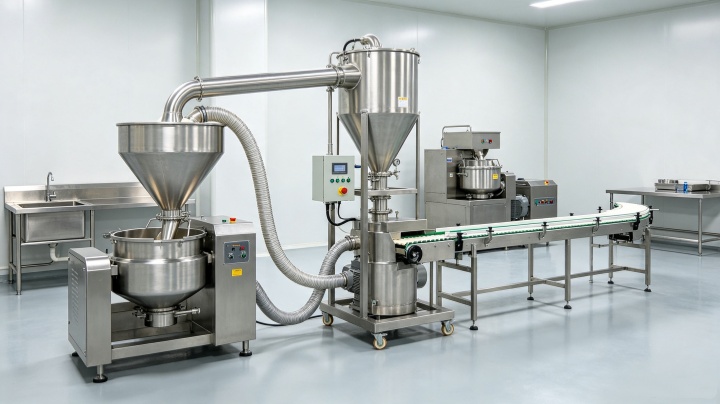
Food & Beverage Industry
Conveying flour, starch, sugar, salt, milk powder, cocoa powder, spices, and instant coffee granules
Feeding ingredient dosing systems, ribbon blenders, continuous mixers, and packaging filling lines
Handling hygroscopic materials with optional heated filters to prevent caking
Meets FDA and GMP standards for direct and indirect food contact
Pharmaceutical & Nutraceutical Industry
Transferring APIs (active pharmaceutical ingredients), excipients, lactose, and vitamin premixes
Feeding tablet presses, capsule fillers, granulators, and coating pans
Contained transfer of potent or toxic compounds with OEL compliance down to < 1 µg/m³
Stainless steel construction with crevice‑free welds for cleanroom and GMP‑compliant installations
Chemical & Fine Chemical Industry
Handling pigments, dyes, carbon black, titanium dioxide, resin pellets, and catalyst powders
Feeding reactors, extruders, and compounding lines
ATEX‑certified configurations available for explosive dust environments (e.g., organic peroxides, metal powders)
Corrosion‑resistant SUS316L and PTFE‑lined options for acidic or alkaline materials
Battery Material Production
Transferring lithium cobalt oxide, lithium iron phosphate (LFP), graphite, and conductive carbon blacks
Feeding electrode slurry mixing tanks and coating machines
Moisture‑sensitive material handling with dry‑air purge options and sealed conveying lines
Cosmetic & Personal Care
Conveying talc, mica, titanium dioxide, zinc oxide, and botanical powders
Feeding powder pressing machines and cream mixing vessels
Sanitary design with mirror‑polished surfaces to prevent microbial growth
Plastics & Polymers: Feeding injection molding machines, film extruders, and pellet dryers
Agriculture & Feed: Transferring grain, soybean meal, animal feed additives, and seed coatings
Minerals & Metals: Handling silica sand, bentonite, alumina, and metal shot (with wear‑protected configurations)
The pneumatic vacuum conveyor operates on a simple, reliable, and fully automatic four‑phase cycle. The entire sequence is controlled by the PLC and repeats continuously to maintain a steady material supply.
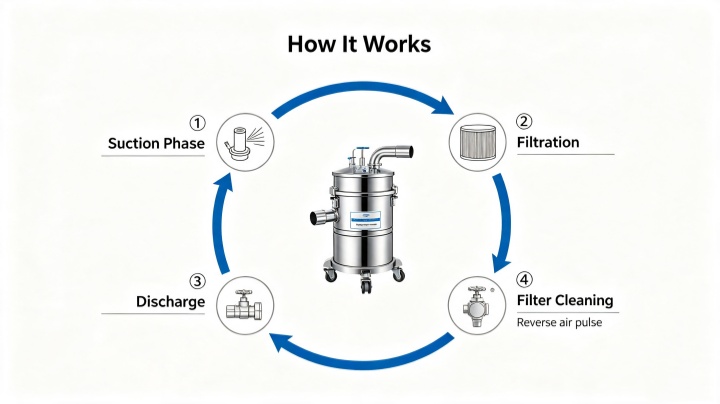
Phase 1: Suction (Loading)
Compressed air (0.4–0.6 MPa) is supplied to the venturi vacuum generator, creating a strong negative pressure inside the sealed hopper. With the discharge valve firmly closed, the suction hose draws material from the source container (e.g., drum, silo, or storage bin) directly into the hopper. The material flows through the hose and enters the hopper tangentially, reducing impact and minimizing particle breakage.
Phase 2: Filtration & Separation
As the material‑laden air enters the hopper, the high‑efficiency filter element separates the conveyed solids from the airflow. Clean air passes through the filter and exits via the venturi exhaust, while the material drops by gravity and accumulates at the bottom of the hopper. The filter retains even sub‑micron dust particles, ensuring zero emission to the surrounding environment.
Phase 3: Discharge
After a preset "suction time" (or when the material level sensor indicates a full hopper), the PLC cuts off the compressed air supply to the venturi, instantly dropping the vacuum inside the hopper to atmospheric pressure. The discharge valve opens, and the accumulated material is released into the downstream receiving equipment (e.g., mixer inlet, packaging hopper, or reactor neck). The discharge duration is adjustable to ensure complete emptying without spillage.
Phase 4: Filter Cleaning
Simultaneously with the discharge phase, a short, high‑pressure burst of compressed air is directed in reverse flow through the filter element (reverse‑pulse cleaning). This shock dislodges any fine dust particles adhering to the filter surface, restoring full filtration efficiency for the next cycle. The dislodged dust falls back into the hopper and is discharged along with the main product — eliminating material waste and avoiding filter blinding.
The discharge valve closes, the venturi re‑engages, and the entire four‑phase cycle repeats automatically. When the downstream equipment does not require material, the system enters a standby state with zero compressed air consumption, saving energy during production pauses.
A: A pneumatic conveyor uses a compressed‑air‑driven venturi generator to create vacuum, while an electric version uses an electric motor‑driven blower or pump. Pneumatic systems have no electrical components in the conveying area, making them inherently safer for explosive (ATEX) environments. They are also simpler, lighter, and easier to install. Electric systems are generally more energy‑efficient for very high continuous throughputs. We offer both types and recommend the pneumatic version for wet environments, explosion‑risk zones, or when explosion‑proof electrical equipment is cost‑prohibitive.
A: It handles a wide range of dry bulk solids including: free‑flowing powders (flour, starch, sugar, salt), cohesive powders (milk powder, protein powder, carbon black), granules (plastic pellets, pharmaceutical granules, coffee beans), and small flakes. However, materials with > 15% moisture content, high oil content, or extreme adhesiveness may require specialized configurations (e.g., heated hoppers, special filter media, or mechanical agitation). We recommend sending a sample for our engineers to conduct a feasibility test.
A: We need the following information to make a proper recommendation:
Material name and bulk density (kg/L or g/cm³)
Required conveying capacity (kg/h)
Horizontal conveying distance and vertical lift height
Number of pickup points and discharge points
Downstream equipment inlet size and mounting constraints
Special requirements (ATEX, FDA, cleanroom, etc.)
Our engineering team will provide a model selection and layout drawing within 24 hours.


Address:China,Yanjin county forest park gate to the west 1000 meters north road.


 Online Chat
 Email