


If you've ever walked up to your mining vibrating screen and seen material building up on the deck instead of passing through, you already know the problem: blinding and pegging. Selecting the optimal screen media for your mining vibrating screen is not just about wear life—it's the most critical decision for preventing costly downtime and maximizing throughput per tonne.
These two issues are the silent killers of screening efficiency. They force you to stop production, climb into the screen box, and manually clean the deck—every time costing you tons of output and increasing your cost per tonne. The good news is that choosing the right screen media can eliminate most of these headaches. Here's how to make the right choice for your operation.
These two issues are the silent killers of screening efficiency. They force you to stop production, climb into the screen box, and manually clean the deck—every time costing you tons of output and increasing your cost per tonne.
The good news is that choosing the right screen media can eliminate most of these headaches. Here's how to make the right choice for your operation.
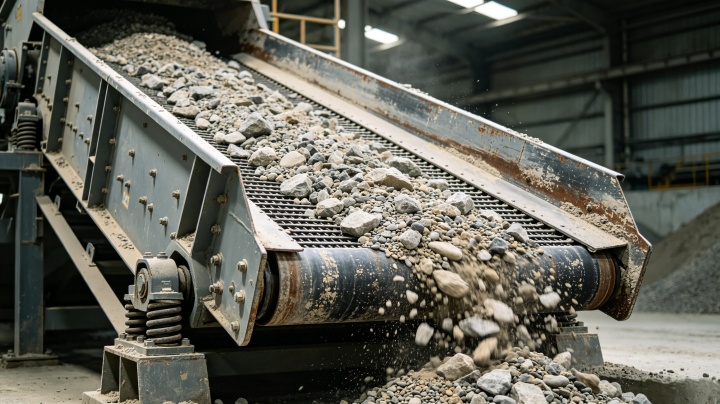
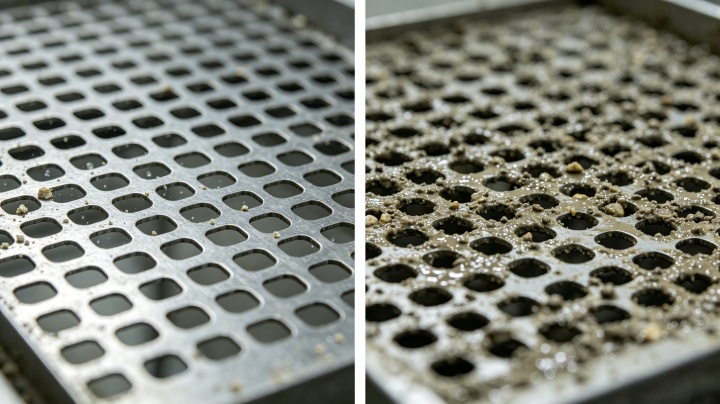
Before we talk solutions, let's be clear about what we're fighting.
Blinding happens when moisture or static electricity causes fine particles to stick to the screen surface, gradually covering the openings and preventing material from passing through.
Pegging occurs when a particle gets physically wedged between the wires of the screen media and won't fall through.
Both problems reduce your open area—the percentage of the screen surface that actually has holes for material to pass through. Less open area means less throughput, more recirculation, and a product that may not meet spec.
Every tonne of material processed in your operation must pass over at least one vibrating screen. If that screen isn't performing efficiently, your entire operation suffers.
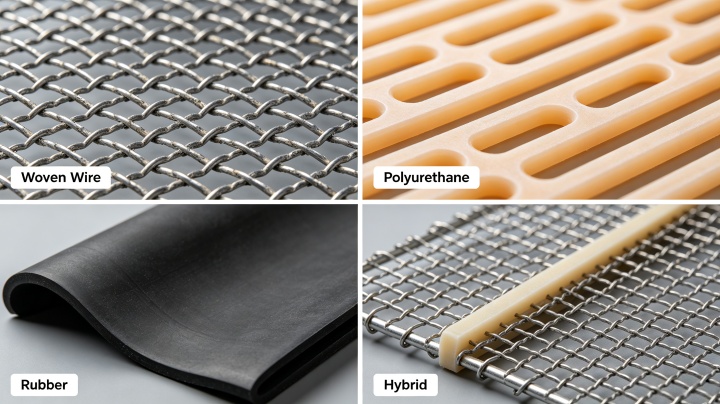
When it comes to screen media, you have four primary options. Each has its own strengths and weaknesses.
Woven wire is the most widely used screen media for mining vibrating screens because it offers high open area and efficient screening.
| Aspect | Details |
| Open Area | 50–70% in most configurations |
| Vibration Frequency | 8,000–10,000 cycles per minute |
| Best For | Dry, clean materials like crushed stone, sand, and gravel |
| Wear Life | Shorter than polyurethane or rubber |
| Visual Inspection | Easy—just look at it each shift |
Woven wire's high-frequency vibration helps speed up material separation and virtually eliminates pegging and clogging when used on the right applications. The trade-off? It needs more frequent replacements.
Polyurethane is a synthetic material that offers excellent wear resistance and longer service life.
| Aspect | Details |
| Open Area | 30–40% less than woven wire |
| Vibration Frequency | 800–900 cycles per minute (more rigid, relies on screen motion) |
| Best For | Wet or sticky applications where blinding is common |
| Wear Life | 1.5–2 times longer than injection-molded products when open-cast poured |
| Noise Level | Up to 10 dB quieter than wire |
Polyurethane is often chosen because it requires fewer replacements. However, the trade-off for durability is less open area, which can decrease throughput and actually invite blinding and pegging with finer minerals.
Rubber media is ideal for high-impact and highly abrasive materials.
| Aspect | Details |
| Best For | Materials with top size larger than 30 cm (12 inches) or openings bigger than 10 cm (4 inches) |
| Advantages | Handles high impact, resists abrasion, reduces noise |
| Open Area | Less than wire cloth, so lower throughput |
Rubber screens dramatically reduce noise and can be made thicker than polyurethane for improved durability.
Hybrid media combines wire screen with reinforced rubber or urethane strips to fit screen supports.
| Aspect | Details |
| Best For | Dry screening with high moisture content materials and high proportion of fines |
| Advantages | Eliminates blinding and pegging; more open area than polyurethane; lasts longer than woven wire |
| Production Increase | Up to 40% depending on application |
Hybrid media is highly effective for sticky materials because the wires are not woven but bonded to polyurethane strips, allowing each wire to vibrate independently for faster material stratification.
Here's a step-by-step approach to selecting the right screen media for your specific application.
Start by understanding what you're screening. Consider these factors:
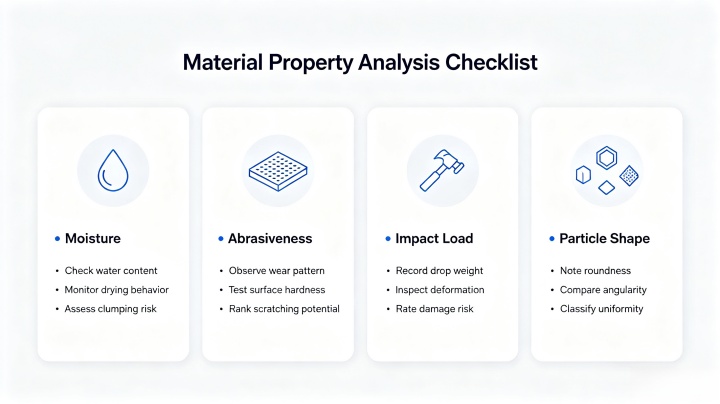
Material moves through three phases as it passes over the screen deck:
You can actually mix different screen media types on different sections of the same deck to maximize efficiency.
Example: Use polyurethane on the top deck (feed end) for impact resistance, then switch to woven wire on the bottom decks for high throughput and precision sizing.
This is the core trade-off you need to manage.
More open area → higher throughput, better efficiency → but shorter wear life (woven wire)
Less open area → lower throughput → but longer wear life (polyurethane, rubber)
Industry data shows that high-vibration woven wire has as much as 50% more open area than polyurethane, allowing more material to be sized accurately in less time. The gap in wear life is also closing: adding polyurethane strips to high-vibration wire boosts durability without sacrificing open area.
Don't just look at the cost per panel or cost per tonne. The real formula is:
Cost per Tonne = (Media Cost + Downtime Cost + Maintenance Cost) ÷ Total Tonnes Processed
A cheaper panel that blinds frequently and requires constant cleaning can end up costing more than a premium screen that runs consistently.
Here are proven solutions you can implement today:
If your material is wet, clay-heavy, or sticky, standard mesh will blind quickly. Anti-clogging designs with tapered openings or slotted openings reduce the risk of particles getting wedged.
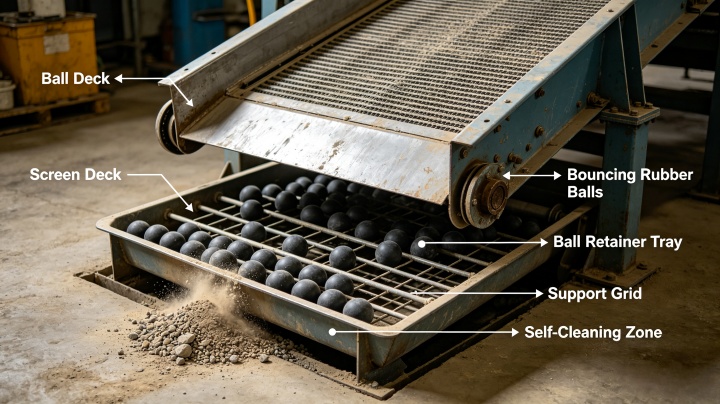
A ball deck is a tray installed underneath the screen media containing rubber balls that bounce up and hit the underside of the screen surface during operation. This continuous action helps dislodge wedged material.
Multiple strands of nylon chain draped along the screen panel create a "snaking" motion during operation that helps keep the screen surface clear.
A pneumatic tensioning system periodically slackens and re-tensions the screen cloth, causing it to rattle and shake off stuck particles.
Uneven feed distribution causes localized overloading and increases blinding risk at the feed end.
Producers who switch to the right screen media see measurable improvements:
There is no one-size-fits-all solution for screen media. The right choice depends on your specific ore, moisture level, throughput requirements, and equipment configuration.
Here's a simple decision matrix to help you start:
| Condition | Recommended Media |
| Dry, clean material, need max throughput | Woven wire mesh |
| Wet/sticky material, need to prevent blinding | Polyurethane or hybrid/self-cleaning |
| High impact, abrasive material | Rubber or heavy-duty polyurethane |
| Mix of impact and fines | Hybrid (polyurethane strips + wire) on bottom deck |
| Need both durability and high open area | High-vibration wire with polyurethane strips |
Stop letting blinding and pegging steal your production. Audit your current mining vibrating screen media setup and evaluate whether you're using the right type for each deck. Contact us today for a free consultation and let our screen media specialists help you choose the right solution for your specific mineral processing needs.
If you're unsure which media is right for your operation, send us your feed specifications—ore type, moisture content, target cut size, and current panel measurements. We can help you match the right aperture, wire diameter, and media type to maximize your throughput and minimize downtime.
Q: What's the difference between blinding and pegging?
A: Blinding is caused by moisture or static causing particles to stick to the screen surface. Pegging is when a particle gets physically wedged between the wires.
Q: Which screen media lasts the longest?
A: Rubber generally offers the longest wear life for high-impact applications. Polyurethane also offers excellent durability—1.5 to 2 times longer than injection-molded products in open-cast form.
Q: Can I mix different screen media types on the same vibrating screen?
A: Yes. Many producers use polyurethane on the top deck for impact resistance and high-vibration woven wire on lower decks for maximum throughput.
Q: How often should I inspect screen media?
A: Conduct weekly inspections of screen media. Woven wire can be visually checked each shift; polyurethane requires more thorough assessment since tears aren't always visible.
Q: How do I know if I need self-cleaning mesh?
A: If you're frequently stopping production to clean blinding material off your deck, or if you're processing material with high clay content or moisture, self-cleaning/anti-clogging mesh is likely your answer.
Contact us today for a free consultation and let our screen media specialists help you choose the right solution for your specific mineral processing needs.


Address:China,Yanjin county forest park gate to the west 1000 meters north road.


 Online Chat
  Email
Email