


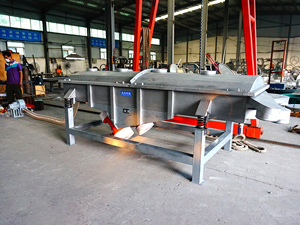
The Inline Vibrating Screen (commonly referred to as the Direct Discharge Vibrating Screen) is a specialized, high-performance screening device engineered for the continuous and efficient separation of oversize contaminants, agglomerates, and foreign particles from dry powders, granular materials, and liquid-solid slurries within automated production lines.
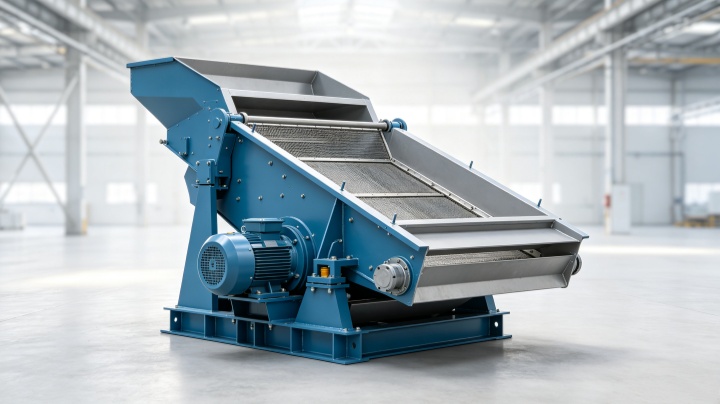
Distinguished from conventional vibrating screens that employ tangential or side-discharge outlets, this equipment incorporates a vertical, straight-through discharge configuration. This design innovation enables material to flow directly downward through the screening deck under the influence of vibration, thereby maximizing throughput capacity, minimizing material retention, and ensuring seamless integration into vertically oriented conveying or gravity-fed processing systems.
The ZPS Series inline vibrating screen is extensively deployed across the food processing, chemical manufacturing, pharmaceutical production, metallurgical powder processing, and recycling industries, where stringent hygiene standards, operational reliability, and ease of maintenance are paramount.
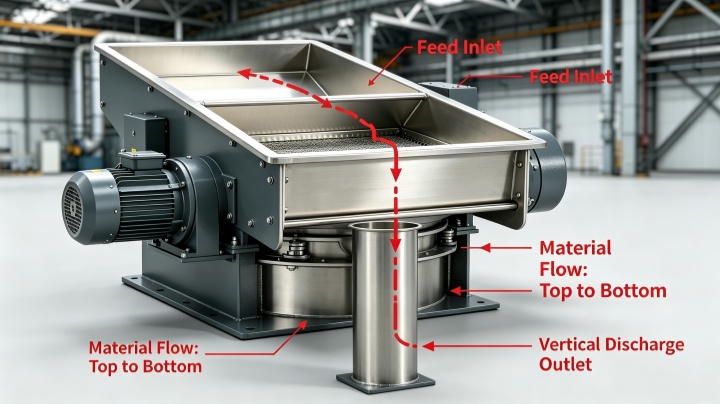
The engineering of the inline vibrating screen prioritizes three fundamental objectives: operational efficiency, sanitary compliance, and maintenance accessibility. The following features distinguish this equipment within the industrial screening sector:
| Feature | Description | Benefit |
|---|---|---|
| Vertical Direct Discharge | Material exits vertically from the underside of the screen frame without intermediate chutes or redirection | Eliminates product accumulation; reduces cross-contamination risk; increases effective screening area utilization |
| High-Frequency Vibratory Motor | Custom-engineered vibration motor delivering adjustable amplitude and consistent frequency (1000–1500 RPM) | Prevents screen blinding and pegging; ensures efficient separation of materials with high moisture content or fine particle size |
| All-Stainless Steel Contact Parts | Product-wetted components fabricated from SUS304 or SUS316L stainless steel with electropolished surface finish | Corrosion resistance; compliance with FDA, GMP, and EHEDG guidelines; facilitates CIP/SIP cleaning protocols |
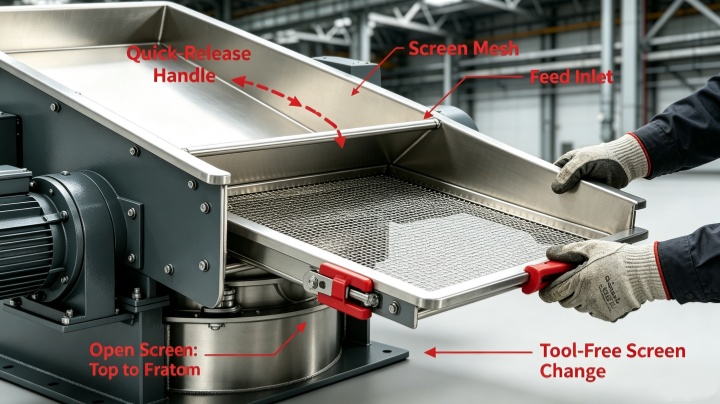
| Tool-Free Screen Frame | Quick-release clamping mechanism with cam-lock or toggle-clamp design | Screen mesh replacement completed in under two minutes; reduces production downtime significantly |
| Compact Vertical Profile | Minimal floor space requirement with low overall height | Suitable for installation in space-constrained production environments and retrofitting into existing process lines |
| Integrated Sealing System | Food-grade silicone or PTFE gaskets between all mating surfaces | Prevents dust leakage and product loss; maintains positive pressure differential where required |
| No Dead Corners | 360° discharge periphery with sloped internal surfaces | Ensures complete material evacuation; simplifies batch changeover and cleaning procedures |
| Balanced Vibration Isolation | Rubber isolation springs or air-bag suspension system | Minimizes force transmission to supporting structures; reduces noise levels during operation |
| Parameter | ZPS-800 | ZPS-1000 | ZPS-1200 | ZPS-1500 |
|---|---|---|---|---|
| Screening Diameter | 800 mm | 1,000 mm | 1,200 mm | 1,500 mm |
| Effective Screening Area | 0.45 m² | 0.70 m² | 1.00 m² | 1.60 m² |
| Vibration Motor Power | 0.55 kW | 0.75 kW | 1.10 kW | 1.50 kW |
| Rotational Speed | 1,460 RPM | 1,460 RPM | 1,460 RPM | 1,460 RPM |
| Vibration Amplitude | 3.0 – 5.0 mm | 3.0 – 5.0 mm | 3.0 – 5.0 mm | 3.0 – 5.0 mm |
| Mesh Range | 2 – 500 mesh | 2 – 500 mesh | 2 – 500 mesh | 2 – 500 mesh |
| Approximate Capacity¹ | 500 L/h | 800 L/h | 1,000 L/h | 1,500 L/h |
| Overall Dimensions (L×W×H) | 900×800×850 mm | 1,100×1,000×950 mm | 1,300×1,200×1,050 mm | 1,600×1,500×1,200 mm |
| Net Weight | 120 kg | 180 kg | 250 kg | 350 kg |
| Standard Material | SUS304 | SUS304 | SUS304 | SUS304 |
| Optional Material | SUS316L | SUS316L | SUS316L | SUS316L |
Capacity is material-dependent and varies with bulk density, moisture content, particle size distribution, and mesh aperture. Laboratory testing is recommended for precise throughput determination.
Electrical & Utility Requirements
| Parameter | Specification |
|---|---|
| Power Supply | 220V / 380V / 415V, 50/60 Hz, three-phase |
| Motor Type | TEFC (Totally Enclosed Fan-Cooled), IP55 protection |
| Control Options | Manual start/stop; optional variable frequency drive (VFD) for amplitude adjustment |
| Connection Flanges | DIN / ANSI / JIS standard flanges; custom configurations available upon request |
| Inlet Connection | Standard round flange (diameter matches screen diameter); reducer adapters available |
| Outlet Connection | Standard round flange (full-screen diameter) for vertical gravity discharge |
The inline vibrating screen operates on the principle of controlled vibratory motion to facilitate particle separation.
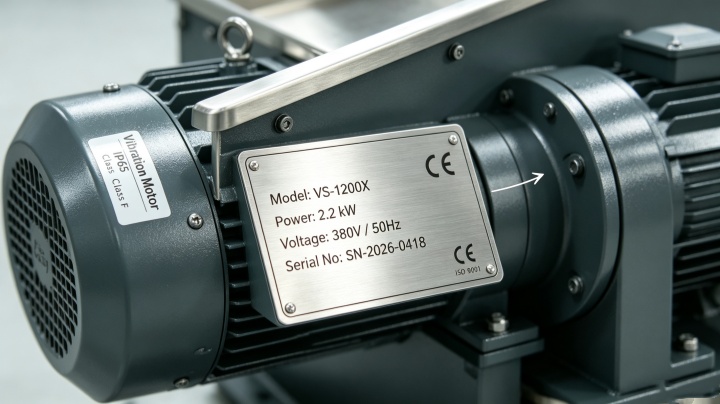
The vibration motor, mounted directly to the screen body, generates unbalanced rotational forces that are transmitted to the screening deck. These forces produce a combination of vertical and horizontal acceleration components, causing material on the screen surface to:
Fluidize – Particles are lifted momentarily from the screen mesh, reducing inter-particle friction and promoting stratification.
Stratify – Finer particles migrate through the bed of material toward the screen surface, while larger particles remain on top.
Transmit – Oversize material is conveyed radially outward toward the screen periphery, where it is discharged vertically through the bottom outlet. Undersize material passes through the mesh apertures and exits through the same central bottom discharge, having been separated from the oversize fraction.
The straight-through vertical discharge is critical: unlike side-discharge screens that require material to travel horizontally across the deck before exiting, the inline design ensures that once material passes through the mesh, it immediately falls out of the unit. This reduces residence time, minimizes particle attrition, and significantly increases the effective screening capacity per unit area.
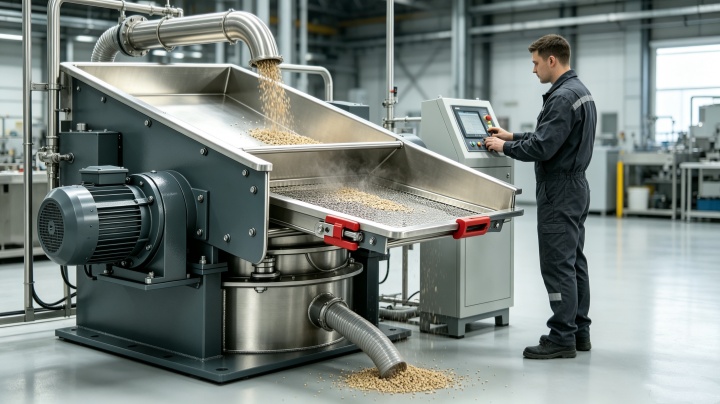
The ZPS Series inline vibrating screen is a versatile separation solution suitable for a broad spectrum of industries and material types. Representative applications include, but are not limited to:
Food & Beverage Industry
Powdered ingredients: Flour, starch, maltodextrin, milk powder, soy protein isolate, spices, seasonings, and icing sugar – removes lumps, fiber, and foreign matter before packaging or further processing.
Liquid products: Fruit juices, sauces, liquid sugars, and edible oils – clarifies and removes suspended solids or pulp residues.
Bakery & confectionery: Cocoa powder, gelatin, and binder materials – ensures uniform particle size for consistent product quality
Chemical & Petrochemical Industry
Resin and polymer powders: PVC, polyethylene, polypropylene, epoxy resins – classifies by particle size and removes oversize pellets.
Pigments and coatings: Titanium dioxide, carbon black, paint powders, and ink formulations – ensures fineness and eliminates agglomerates.
Fertilizers and agrochemicals: Compound fertilizers, urea, potash, and pesticide powders – achieves uniform granule sizing for application consistency.
Pharmaceutical & Nutraceutical Industry
Active Pharmaceutical Ingredients (APIs): Fine chemical powders requiring strict particle size control.
Excipients and granulations: Lactose, cellulose, starches, and pre-mix blends – meets GMP and USP specifications.
Herbal extracts and botanicals: De-lumping and de-dusting of plant-based powders.
Metal Powder & Ceramic Industry
Metal powders: Aluminum, copper, iron, titanium, and alloy powders – precise classification for additive manufacturing (3D printing) or powder metallurgy.
Ceramic materials: Silicon carbide, alumina, zirconia, and glaze powders.
Abrasives: Silicon carbide, aluminum oxide, and sand – grading for grinding wheel production.
Recycling & Environmental Applications
Plastic regrind: Removal of fines and contaminants from recycled plastic flake.
Waste treatment: Separation of solids from liquid streams in industrial effluent treatment.
As a manufacturer committed to international quality standards, every inline vibrating screen supplied undergoes rigorous inspection and testing procedures prior to shipment.
Material & Fabrication Quality
Raw material certification: Mill test reports (MTRs) are provided for all stainless steel plates, pipes, and structural components.
Welding procedure: Full-penetration TIG (Tungsten Inert Gas) welding with argon back-purging is employed on all product-contact joints. All welds are inspected by dye penetrant or radiographic testing as applicable.
Surface finish: All product-wetted surfaces are pickled, passivated, and electropolished to Ra ≤ 0.4 µm (optional higher polish available upon request).
Gasket materials: FDA-grade silicone, EPDM, or PTFE gaskets are standard; other elastomers can be specified for solvent resistance or elevated-temperature operation.
Certifications
CE Marking: Compliance with the Machinery Directive (2006/42/EC) and Low Voltage Directive (2014/35/EU).
ISO 9001:2015: Certified quality management system covering design, production, and after-sales service.
ATEX Compliance: Explosion-protected versions are available for potentially explosive atmospheres (Zone 21/22) – please consult with our engineering team.
Factory Acceptance Testing (FAT)
Each unit is subject to:
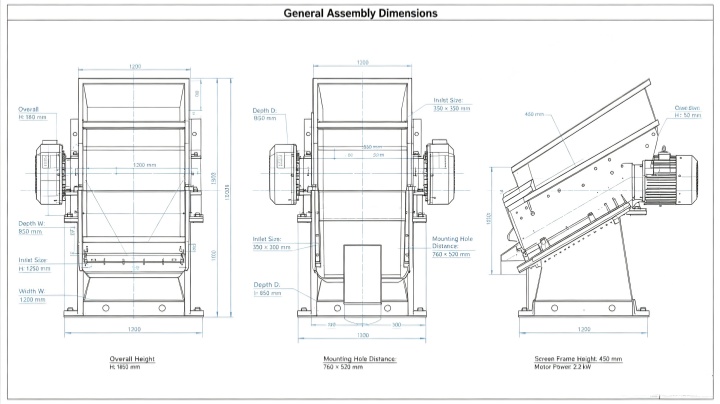
Dimensional verification against approved GA drawings
No-load operational test (4 hours) to verify vibration amplitude and bearing temperature rise
Leakage test with pressurized air (0.5 MPa) to validate seal integrity
Electrical continuity and insulation resistance testing
Installation Guidelines
The screen should be installed on a level, rigid concrete foundation or structural steel support capable of bearing the dynamic loads.
Anti-vibration mounts (supplied as standard) should be correctly adjusted to ensure uniform support and proper vibration isolation.
Inlet and outlet connections should utilize flexible connectors to prevent transmission of vibratory forces to upstream and downstream equipment.
Electrical connections must be performed by qualified personnel in accordance with local regulations.
Operational Best Practices
Start-up: Always start the vibration motor with the screening deck empty to avoid overloading.
Feed rate control: Maintain a consistent, controlled feed rate to achieve optimal screening efficiency – excessive feed causes material bed depth to exceed the effective stratification zone.
Monitoring: Regularly observe vibration amplitude and listen for abnormal bearing noise. A sudden drop in amplitude may indicate wear in the vibration motor eccentric weights.
| Frequency | Task |
|---|---|
| Daily | Visual inspection of screen mesh for tears or wear; check for material accumulation around seals. |
| Weekly | Tighten all clamping bolts and fasteners; inspect vibration motor mounting bolts. |
| Monthly | Lubricate vibration motor bearings according to manufacturer's schedule; inspect isolation springs for cracking or sagging. |
| Quarterly | Check screen frame tension; replace worn gaskets; verify motor insulation resistance. |
| Annually | Complete overhaul of vibration motor; replacement of bearings and eccentric weights as needed; general mechanical inspection. |
Understanding that no two processing lines are identical, we offer the following customization services:
| Customization Option | Available Variants |
|---|---|
| Material of Construction | SUS304, SUS316L, duplex stainless steel, or carbon steel with protective coating |
| Surface Finish | Standard mill finish, electropolished, mechanically polished (mirror finish), or powder-coated exterior |
| Inlet/Outlet Flanges | Custom diameters, bolt-hole patterns, and flange standards (DIN, ANSI, JIS, GB) |
| Screening Mesh | Woven wire cloth, perforated plate, wedge-wire, or polyurethane screen panels |
| Motor Options | Standard single-speed, VFD-ready, explosion-proof (Ex d), or dual-motor configuration for enhanced amplitude |
| Accessories | Inlet butterfly valve, discharge rotary valve, viewing ports, sampling points, and CIP spray nozzles |
| Explosion Protection | ATEX-certified versions available (II 2/3D c T6) |
We are committed to the long-term performance and reliability of every inline vibrating screen we deliver.
Warranty Terms
Mechanical components: 12 months from the date of commissioning, covering defects in materials and workmanship.
Vibration motor: 12 months from the date of commissioning (subject to proper installation and maintenance).
Wear parts: Screens, gaskets, and springs are excluded from warranty coverage as consumable items but are available as stocked spare parts.
Technical Support
Commissioning assistance: Remote video guidance or on-site commissioning (by arrangement) for first-time installations.
Documentation: Comprehensive operation and maintenance manual, GA drawings, electrical schematics, and spare parts list provided with every shipment.
Spare parts availability: A dedicated inventory of commonly required wear and replacement parts is maintained for rapid dispatch.
Training
On-site operator training and basic maintenance instruction can be arranged at the customer's facility upon request.
To assist in equipment selection, the following comparative overview highlights the key distinctions between the ZPS Series inline vibrating screen and a conventional rotary (trapezoidal) vibrating screen:
| Criterion | Inline Vibrating Screen (ZPS) | Conventional Rotary Vibrating Screen |
|---|---|---|
| Discharge Direction | Vertical, straight-through downward | Tangential, side-discharge |
| Material Residence Time | Short (immediate discharge after separation) | Longer (material traverses deck to periphery) |
| Screening Efficiency | Higher per unit area due to direct discharge | Lower due to longer travel path and re-circulation effects |
| Integration Ease | Ideal for gravity-fed vertical lines | Requires horizontal space for discharge chutes |
| Cleaning Accessibility | Tool-free disassembly; no discharge chute cleaning required | More complex due to multiple discharge outlets and chutes |
| Product Retention | Minimal (<2% typical) | Higher due to chute and deck configuration |
| Typical Applications | Inline impurity removal, high-capacity powder security screening | Classification, grading, and de-dusting of granular solids |
A: In standard configuration with silicone gaskets, the maximum continuous operating temperature is 80°C. For higher temperature applications (up to 150°C), high-temperature silicone or PTFE gaskets and specialized motor insulation can be supplied upon request.
A: Yes. The high-frequency vibration (1,460 RPM) effectively breaks down weak agglomerates. For materials with significant cohesive tendencies, we recommend incorporating a bouncing ball cleaning system or ultrasonic de-blinding system as optional accessories.
A: Mesh selection depends on your target particle size cut point. Our application engineering team can recommend an appropriate mesh aperture based on your material's particle size distribution and separation requirements. We also offer sample testing services.
A: Yes, ATEX-certified variants (II 2/3D c T6) with explosion-proof vibration motors and anti-static gaskets are available for use in Zone 21 and Zone 22 dust explosion hazard areas.
A: Standard models are typically delivered within 15 to 20 working days from order confirmation. Custom configurations may require 25 to 35 working days, depending on engineering and sourcing requirements.


Address:China,Yanjin county forest park gate to the west 1000 meters north road.


 Online Chat
 Email
Email