


Choosing the right industrial drying equipment is a critical decision that directly impacts your production efficiency, product quality, and operating costs
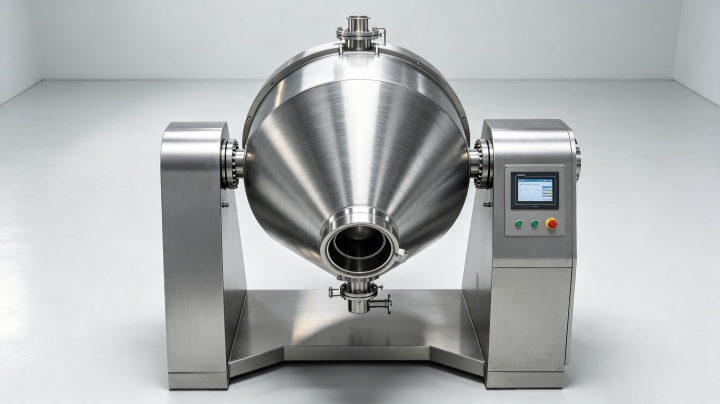
For manufacturers in the pharmaceutical, chemical, and food processing industries, the SZG Series Double Cone Rotary Vacuum Dryer has become a go‑to solution for handling heat‑sensitive, easily oxidized, or toxic materials.
However, with multiple models ranging from the compact SZG‑100 to the industrial‑scale SZG‑5000, understanding the price differences and technical specifications for each model is essential before making a purchase decision. This comprehensive guide compares all SZG series models to help you find the best fit for your production requirements and budget.
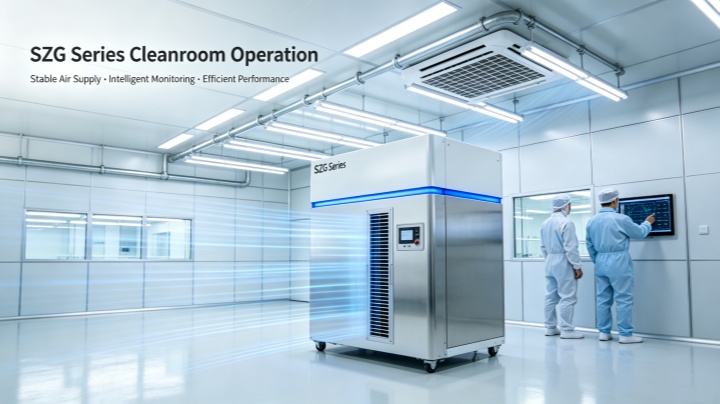
The SZG series offers a wide price spectrum to accommodate different production scales and budget constraints. Based on current market data from multiple manufacturers, here is the general price range you can expect:
Model Price Reference:
| Model | Total Volume | Reference Price Range |
| SZG‑100 | 100L | $7,500 – $50,000+ |
| SZG‑350 | 350L | $7,500 – $50,000+ |
| SZG‑500 | 500L | $7,500 – $50,000+ |
| SZG‑1000 | 1000L | $25,000 – $55,000+ |
| SZG‑2000 | 2000L | $25,000 – $55,000+ |
| SZG‑5000 | 5000L | $25,000 – $55,000+ |
Note: Prices vary significantly based on configuration, material (SS304 vs. SS316L), control system (manual vs. PLC automatic), and additional features like solvent recovery systems. The actual quote depends on your specific requirements.
The wide price range—from approximately $7,500 for entry‑level models to over $55,000 for fully equipped large‑capacity units—reflects the customization options available for the SZG series.
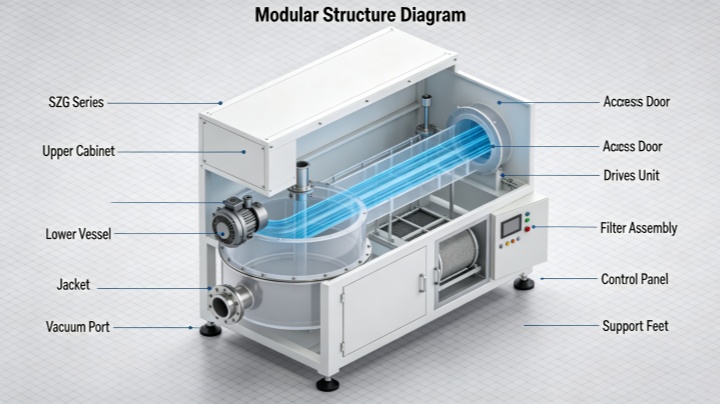
Understanding the technical parameters of each model helps you match the equipment to your production needs. Below is a comprehensive comparison of key specifications for the full SZG series lineup.
Complete SZG Series Specification Table
| Model | Total Volume (L) | Max Loading Volume (L) | Heating Area (m²) | Motor Power (kW) | Rotating Speed (rpm) | Overall Weight (kg) |
| SZG‑100 | 100 | ≤50 | 1.16 | 0.75 | 4‑6 | 800‑825 |
| SZG‑350 | 350 | ≤175 | 2.00 | 1.1 | 4‑6 | 1,100 |
| SZG‑500 | 500 | ≤250 | 2.63 | 1.5 | 4‑6 | 1,200‑1,650 |
| SZG‑750 | 750 | ≤375 | 3.50 | 2.0‑2.2 | 4‑6 | 1,480‑1,800 |
| SZG‑1000 | 1,000 | ≤500 | 4.61 | 3.0 | 4‑6 | 2,800‑3,070 |
| SZG‑1500 | 1,500 | ≤750 | 5.58 | 3.0 | 4‑6 | 3,300 |
| SZG‑2000 | 2,000 | ≤1,000 | 7.50 | 4.0 | 4‑6 | 3,580‑3,600 |
| SZG‑3000 | 3,000 | ≤1,500 | 9.60 | 5.5 | 4 | 4,300‑4,565 |
| SZG‑5000 | 5,000 | ≤2,500 | 14.10 | 11.0 | 3‑4 | 5,500‑8,347 |
Common Operating Parameters:
Tank Inner Pressure: -0.09 to 0.15 MPa
Jacket Pressure: ≤0.3 MPa
Working Temperature: Inner tank ≤85°C, jacket ≤140°C
Heating Media: Steam, hot water, or thermal oil
The SZG series price reflects its advanced engineering and performance advantages. Here's what you're paying for:
Operating temperatures range from 20°C to 160°C, making this equipment ideal for heat‑sensitive biochemical and pharmaceutical products that would degrade in conventional ovens.
The integrated condenser and receiver allow efficient recovery of volatile solvents—a major cost‑saving feature for chemical processing operations. This system reduces waste and operational costs while improving environmental compliance.
The indirect heating method achieves thermal efficiency more than twice that of ordinary drying ovens, significantly reducing energy costs over the equipment's lifespan.
All contact parts can be manufactured from AISI 316/316L stainless steel, ensuring a non‑contaminated, sanitary drying process that meets pharmaceutical industry standards.
The vacuum system prevents oxidation and degradation of sensitive materials, making it suitable for easily oxidized, explosive, or highly toxic substances.
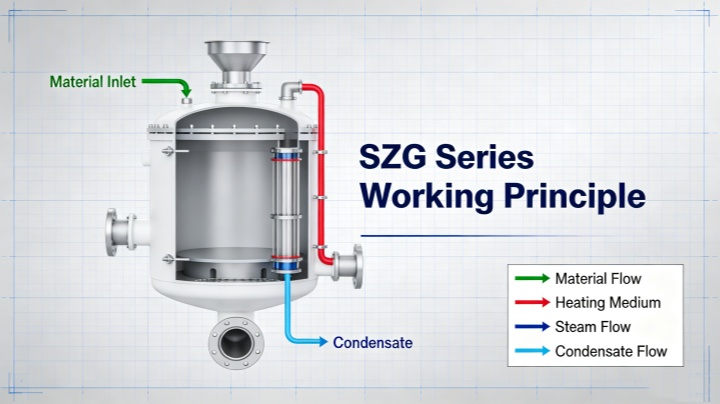
Understanding the working principle helps you appreciate the value proposition of different models:
Heating Stage: Heat source (low‑pressure steam, hot water, or thermal oil) passes through the sealed jacket, transferring heat to materials through the inner shell.
Tumbling Action: The tank rotates slowly (typically 4‑6 RPM) under power drive, continuously mixing materials to achieve uniform drying.
Vacuum Evaporation: Materials are maintained under vacuum; the reduced steam pressure causes moisture (or solvent) on material surfaces to reach saturation and evaporate.
Recovery Process: Evaporated solvents are discharged through the vacuum pump and recovered in a separate receiver tank. Internal moisture continuously penetrates, evaporates, and discharges—three simultaneous processes that achieve rapid drying.
Best for: Laboratory testing, small‑batch production, pilot plants, or high‑value pharmaceutical intermediates.
Key Considerations:
Compact footprint; suitable for limited production space
Lower initial investment (entry‑level pricing available)
Ideal for R&D and small‑scale commercial production
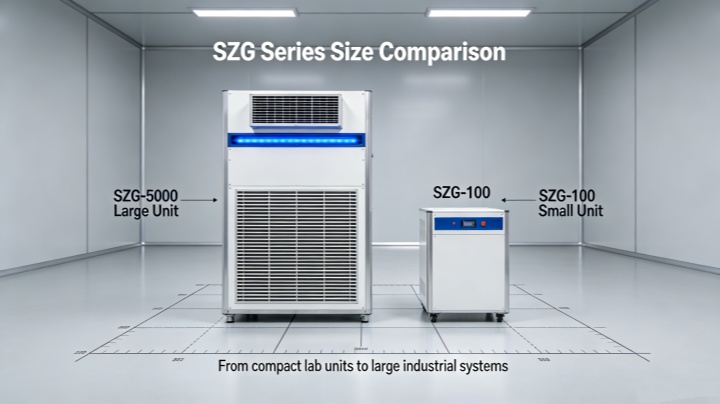
Best for: Small to medium‑scale pharmaceutical manufacturing, fine chemical production, and food processing operations.
Key Considerations:
Balance between capacity and cost
Most popular range for contract manufacturers
Versatile enough for multiple product lines
Best for: Large‑scale chemical production, high‑volume pharmaceutical manufacturing, and industrial operations.
Key Considerations:
Higher throughput with economies of scale
Advanced automation options available
Significant energy efficiency benefits at scale
Best for: High‑volume continuous production, large chemical plants, and major pharmaceutical manufacturers.
Key Considerations:
Maximum batch capacity—up to 2,500L loading volume
Heavier duty construction; requires substantial floor space (4,770×2,300mm footprint)
Significant investment but lowest per‑unit drying cost
When evaluating quotes, consider these factors that influence final pricing:
| Factor | Impact on Price | Details |
| Material of Construction | +20‑40% | SS316L vs. SS304 stainless steel |
| Control System | +15‑30% | PLC with HMI touch screen vs. manual controls |
| Solvent Recovery System | +10‑25% | Condenser and receiver tank configuration |
| Heating Media Type | Variable | Thermal oil systems typically cost more than steam |
| Sealing Technology | +5‑15% | Advanced mechanical seals for deep vacuum applications |
| Certifications | +5‑10% | CE, SGS, or GMP documentation and compliance |
1. What industries use the SZG series dryer?
The SZG series is widely used in pharmaceutical, chemical, and food processing industries for drying heat‑sensitive and easily oxidized materials.
2. Can the dryer recover solvents?
Yes, the system can be equipped with a condenser and receiver to efficiently recover solvents—a major advantage for chemical processing operations.
3. What is the loading capacity?
The loading capacity is typically 40% to 60% of the total volume. For example, a 500L model can load up to 250kg of material.
4. What's the typical drying time?
Drying time varies depending on material moisture content and temperature sensitivity. The vacuum and tumbling action significantly speed up the process compared to traditional methods.
5. Is the dryer easy to clean?
Yes. The GMP‑compliant design features polished internals and is easy to maintain and clean.


Address:China,Yanjin county forest park gate to the west 1000 meters north road.


 Online Chat
  Email
Email