


Choosing the right vibrating screen for your aggregate operation is one of the most critical decisions you will make. The wrong choice can lead to poor separation efficiency, constant blinding, lower throughput, and costly downtime.
In this guide, we break down the practical differences between linear vibrating screens and circular vibrating screens — including how each one works, their strengths and limitations, and a clear framework to help you decide which one fits your specific application.
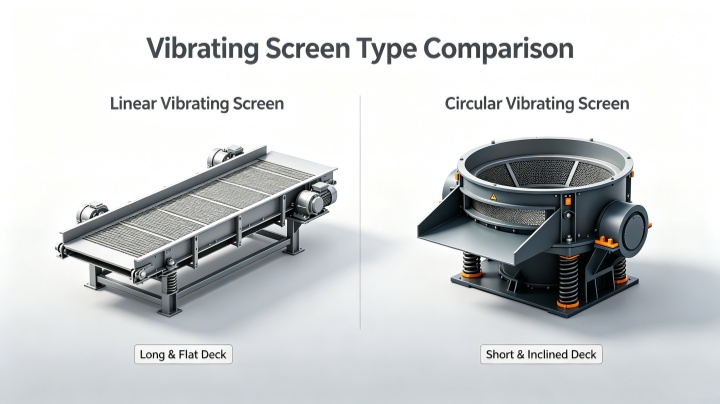
Every vibrating screen has the same basic job: separate material by particle size. Material lands on an inclined screen deck — a metal frame holding mesh or perforated plate. The deck shakes, driven by a vibrator motor or eccentric weight, and the shaking moves material across the surface. Particles smaller than the mesh openings fall through to the next deck or onto a discharge conveyor. Larger particles travel along the surface and exit at the deck end as oversize.
What separates one vibrating screen type from another is the motion pattern of the deck. The way the deck moves changes how material behaves on the surface — how fast it travels, how much it bounces, how often each particle is presented to the mesh openings, and how the screen handles wet, sticky, or fine material.
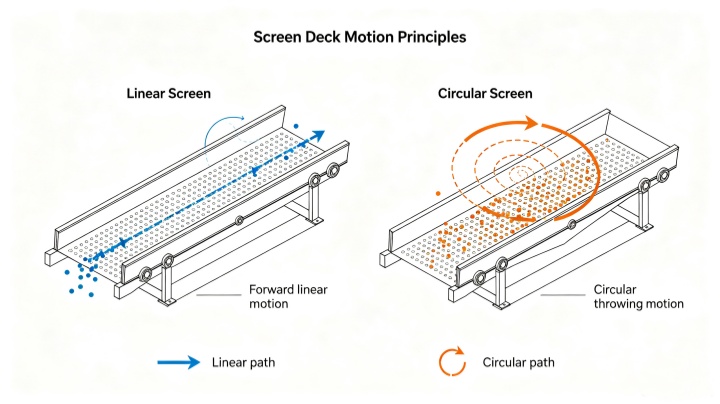
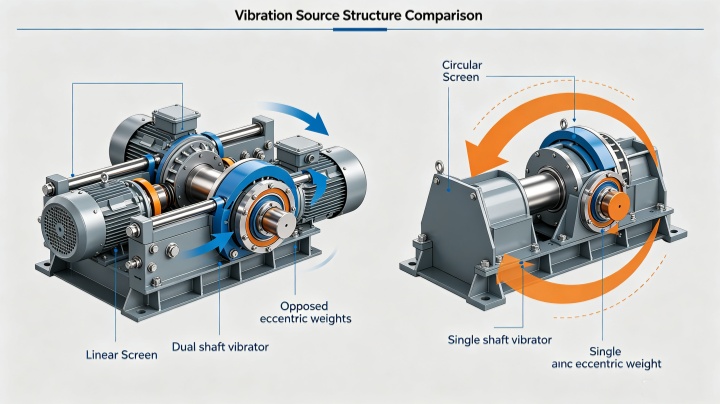
A linear vibrating screen uses two counter-rotating eccentric shafts or two synchronized vibrator motors mounted at opposing angles that produce vibration forces. The result is a vibration force that pushes material in a straight line — typically forward and slightly upward — along the deck surface.
Material on a linear screen advances steadily across the deck in a controlled trajectory. Each particle is presented to the mesh openings repeatedly during travel, giving a high probability of correct separation for any given particle.
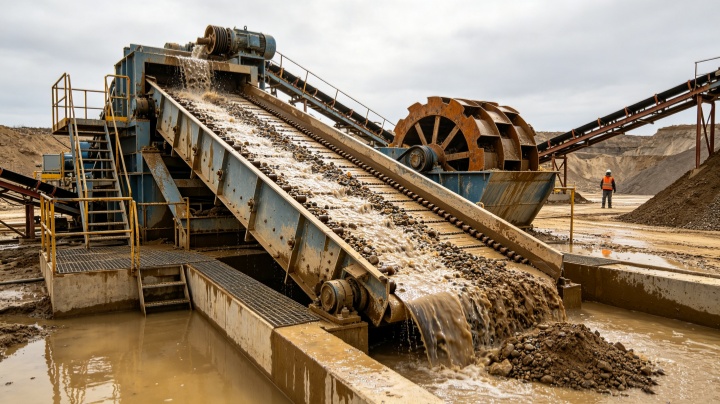
Linear screens dominate in operations requiring high accuracy at fine cuts: spec aggregate production where gradation tolerance matters, recycling facilities sorting mixed feed by size, washing plants where material is screened wet, and any application demanding tight control of the separation cut. They are also widely used for coal dewatering, desliming, and dry screening of fine materials.
A circular vibrating screen uses an eccentric weight on a single rotating shaft. The rotating eccentric mass creates centrifugal force that vibrates the entire deck in a roughly circular pattern. Each point on the deck moves through a small circle (typically 4-12mm diameter) thousands of times per minute.
Material on a circular screen bounces aggressively as it travels down the inclined surface. This bouncing action lifts the bed of material off the mesh repeatedly, giving smaller particles many opportunities to find an opening and pass through.
Circular screens dominate in high-volume dry aggregate production, quarry operations, road base material screening, recycled concrete aggregate (RCA) production, and any scalping application where throughput matters more than tight tolerance at fine cuts. They are the standard choice for most contractor-scale and mid-size aggregate operations.
| Feature | Linear Screen | Circular Screen |
| Motion Path | Straight line along deck | Circular (or elliptical away from center) |
| Drive System | Twin counter-rotating shafts/motors | Single eccentric shaft |
| Deck Angle | 0-10 degrees typical | 15-25 degrees typical |
| Throughput per Deck Area | Lower | Higher |
| Separation Accuracy (Fine Cuts) | Best | Fair |
| Wet/Sticky Material Tolerance | Better | Worse (prone to blinding) |
| Screen Blinding | More likely with moist materials | Less likely — self-cleaning action |
| Typical Construction | Lighter plates or stainless steel | Thicker plates, manganese steel box for impact resistance |
| Environmental Protection | Can be fully enclosed, no dust spillage | Standard open design |
According to industry experts, the right choice depends on what you are screening, how much volume you need, and how accurate the cut has to be. Here is a decision framework:
Beyond motion type, consider these factors when sizing and selecting a vibrating screen for your aggregate operation:
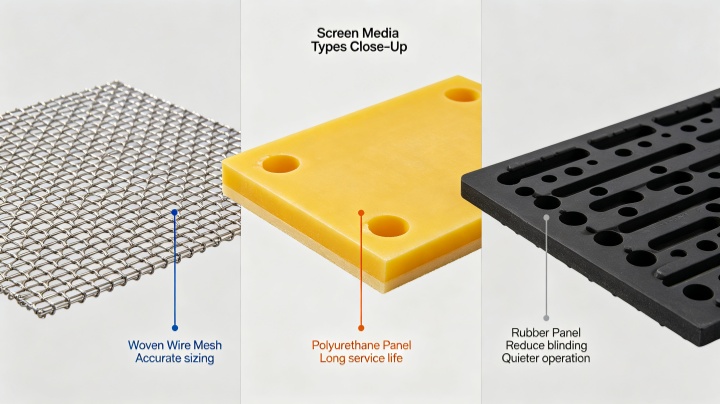
Your choice of screen media also impacts performance:
| Selection Criteria | Linear Vibrating Screen | Circular Vibrating Screen | Best Choice |
|---|---|---|---|
| Motion Pattern | Straight-line, forward-and-upward throw | Elliptical or circular throw | Depends on material flow requirement |
| Separation Accuracy | Excellent (for fine cuts) | Good (for coarse separation) | Linear for fine, Circular for coarse |
| Throughput Capacity | Moderate | High | Circular |
| Handling Wet/Sticky Material | Excellent | Poor (prone to blinding) | Linear |
| Drive System Complexity | Complex (two synchronized motors) | Simple (single eccentric shaft) | Circular |
| Typical Applications | Dewatering, desliming, fine screening, spec aggregate | High-volume quarry production, scalping, dry aggregate | Match to your primary application |
Can a circular screen achieve the same accuracy as a linear screen?
For fine cuts, no. The aggressive bouncing action of a circular screen reduces particle-mesh contact time, making it less accurate than a linear screen for tight-tolerance applications.
Which screen is better for wet material?
Linear screens handle wet material better. The controlled, straight-line motion reduces water turbulence and allows water and fine media to pass through the screen more effectively.
Do circular screens require more power?
Not necessarily. Circular screens are actually more power-efficient at high throughput because the single eccentric drive produces strong vibration with relatively modest motor draw.
How many decks do I need?
Three decks are common in the aggregate industry. The number depends on how many products you need to make. Top deck makes the coarse cut, middle makes a mid cut, and bottom makes the fine cut.
| If Your Priority Is... | Choose... |
| Tight tolerance, fine cuts | Linear Screen |
| Washing/dewatering applications | Linear Screen |
| High throughput, dry material | Circular Screen |
| Coarse aggregate, quarry production | Circular Screen |
| Self-cleaning, less blinding | Circular Screen |
Both linear and circular vibrating screens have legitimate roles in aggregate operations. The right choice depends on your specific material characteristics, throughput requirements, and product specifications.
Still unsure which screen is right for your application? Contact our team with your material details (feed gradation, moisture content, desired throughput, and target products) and we will help you select the optimal vibrating screen equipment for your operation.


Address:China,Yanjin county forest park gate to the west 1000 meters north road.


 Online Chat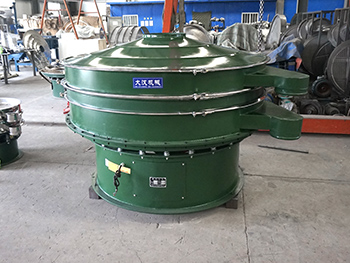
 Email
Email