Top 5 Common Industrial Screening Problems and How to Solve Them
Industrial Screening machines are the workhorses of countless industries—from mining and mineral processing to food, pharmaceuticals, and chemicals. An efficient industrial screening process is vital for maintaining product quality, maximizing throughput, and controlling operational costs. However, even the best industrial screening equipment can encounter issues. When problems arise in your screening operation, the consequences can be costly: unplanned downtime, rejected product, and skyrocketing maintenance expenses.
This comprehensive guide covers the five most common industrial screening problems operators face and provides practical, proven solutions to keep your equipment running at peak performance and ensure your screening line operates with maximum industrial screening efficiency.
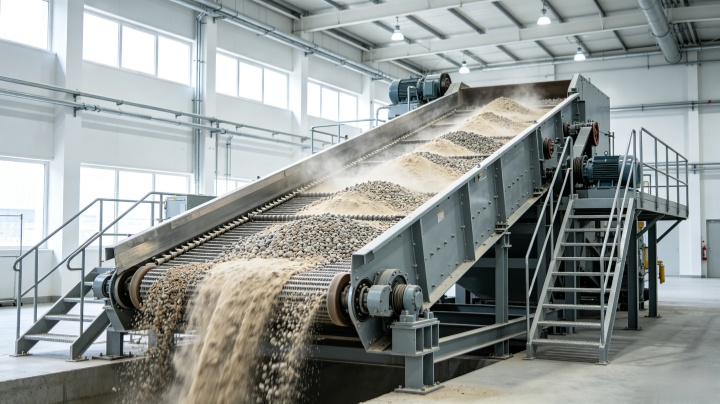
This article covers the five most common industrial screening problems operators face and provides practical, proven solutions to keep your equipment running at peak performance.
Problem 1: Screen Blinding and Clogging
The Issue
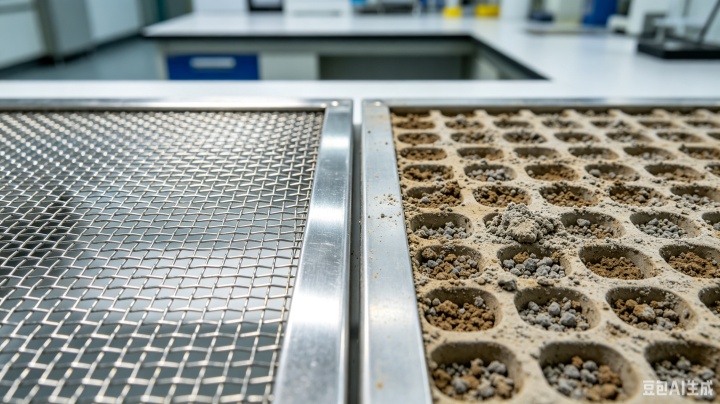
Screen blinding is arguably the most persistent headache in industrial screening. It occurs when particles block the mesh apertures, preventing material from passing through. Blinding typically happens in two ways:
-
Near-size particles—material that is close to the aperture size—become wedged in the holes
-
Sticky or statically charged materials adhere to the wire surface, gradually building up and closing the openings entirely
When blinding occurs, throughput plummets, and operators must spend valuable time manually cleaning the screen. In severe cases, production can grind to a halt.
The Solution
Several effective countermeasures exist, ranging from simple and low-cost to advanced technological solutions:
-
Self-cleaning kits and ball trays: These use rubber balls or sliders mounted below the screen that continuously tap the mesh from underneath, dislodging lodged particles. This is a cost-effective solution for dry applications with coarser cuts.
-
Ultrasonic deblinding systems: For fine powders and difficult materials, ultrasonic systems create a high-frequency, low-amplitude secondary vibration on the screen surface. This prevents blinding and significantly improves fine mesh screening performance, even for materials carrying electrostatic charges.
-
Sandwich-style screens: These contain deblinding components between two layers of mesh, making them durable and easy to change out for cleaning or production changeovers.
-
Advanced variable-frequency technology: Newer innovations like variable-frequency screens harness natural and induced frequencies to generate movement that keeps the screen cloth clear, requiring no external power source.
If blinding persists despite using self-cleaning devices, check your motor weight settings—insufficient vertical amplitude may prevent the balls or sliders from effectively impacting the screen.
Problem 2: Low Screening Efficiency
The Issue
Efficiency issues manifest as poor separation, inconsistent product quality, or undersized material failing to pass through the screen. Common root causes include:
-
Worn or broken screen mesh
-
Loose screen tension
-
Incorrect screen size for the application
-
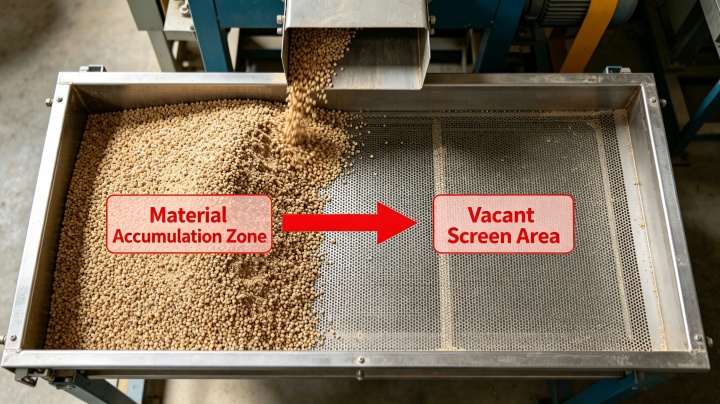
Uneven feed distribution across the screen surface
-
Machine wear over time
The Solution
-
Regular tension checks: Mesh cloth can stretch or break over time. Regular inspection and retensioning of screens is essential to prevent oversized particles from compromising product quality.
-
Even feed distribution: Uneven feed creates uneven wear and reduces screening area efficiency. Check that material is distributed uniformly across the entire screen width.
-
Prompt mesh replacement: Keep recommended spare screens on hand to minimize downtime when replacement is needed. Frequent breakage may indicate a need to adjust product feed rate or switch to a more durable screen type.
-
Check symmetry of operation: Observe the screen while running—is one side moving identically to the opposite side? Asymmetric operation immediately affects efficiency and can cause long-term damage. A simple manual "stroke tracing" test with a pencil on the sidewall can reveal uneven motion patterns.
Problem 3: Frequent Breakdowns and High Maintenance Costs
The Issue
Some operations seem to spend more time fixing screens than running them. Frequent breakdowns lead to costly downtime, rushed repairs, and escalating maintenance budgets. This is often the result of:
-
Inadequate preventive maintenance program
-
Poor-quality or incompatible replacement parts
-
Neglected inspections allowing small issues to become major failures
The Solution
-
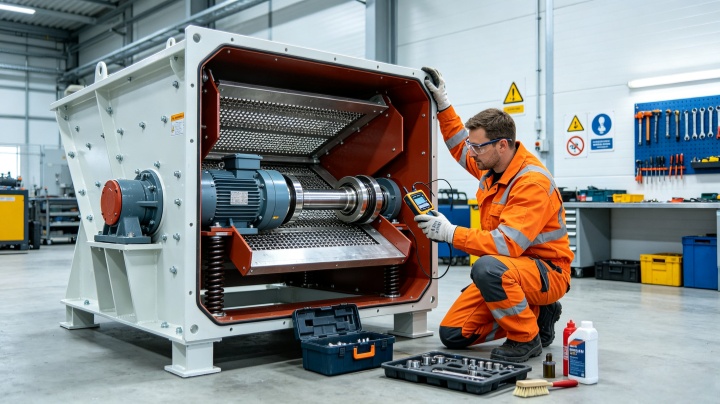
Implement a preventive maintenance schedule: Regular inspections are the best defense against unexpected breakdowns. This includes checking tension, inspecting gaskets and seals, verifying vibration levels, and monitoring motor condition for unusual noise or heat.
-
Stock essential spares: Keep recommended spare parts on hand—screens, gaskets, seals, and wearable components—to enable quick replacement and minimize production interruption.
-
Listen to your machine: Use your senses during operation. Bangs, clangs, or hammering noises are obvious distress signals. Hot rubber smell may indicate slipping belts. Pay attention to what experienced operators notice, as they are often the first to detect subtle changes.
-
Consider professional inspections: Regular expert inspections can detect issues you might miss. Comprehensive checks can include vibrating stroke measurement, stroke angle verification, natural frequency analysis, and structural integrity assessment.
Problem 4: Screen Overloading and Feed Rate Imbalance
The Issue
Both overloading (too much feed) and underloading (too little feed) degrade screening performance. Overloading causes material bed depth to become too thick, preventing fines from reaching the mesh surface and passing through. Underloading reduces throughput without improving efficiency.
The relationship between screening efficiency and feed rate is not linear—there is a threshold beyond which efficiency begins to decline sharply with increasing feed rate.
The Solution
-
Maintain consistent feed rates: Uneven material distribution across parallel screening lines can cause some screens to overload while others starve. Adjust feeder speeds individually based on real-time conditions rather than running all feeders at the same speed.
-
Adjust speed and stroke together: Speed (RPM) and stroke (amplitude) work together. In general, finer screening requires less stroke and higher speed, while coarse separation needs increased stroke and lower speed.
-
Monitor material characteristics: Feed moisture content, particle size distribution, and humidity all affect how material moves across the screen. Elevated moisture promotes agglomeration and blinding, which may require reducing the feed rate to allow effective separation.
Problem 5: Screen Damage and Premature Wear
The Issue
Screens have a finite lifespan, but premature failure is frustrating and expensive. Common causes include:
-
Impact damage from large or heavy materials
-
Excessive vibration causing fatigue
-
Abrasive materials wearing through the mesh
-
Improper cleaning methods that damage the wire
The Solution
-
Use appropriate cleaning methods: Clean mesh with soft brushes, cloths, or compressed air—never abrasive materials that will damage the wire.
-
Inspect for diagonal differences: Spring lengths should be checked side-to-side. A ¼-inch difference from one corner to the opposite corner indicates a ½-inch twist in the support structure—a serious problem that accelerates wear.
-
Choose the right screen for your application: Different materials and mesh sizes have different life expectations—some screens last weeks, others years. Match the screen specification to your specific application demands.
-
Consider re-screening options: Quality screens with epoxy-bonded construction can be returned and re-screened multiple times before the support mesh needs replacement, significantly reducing long-term costs compared to purchasing new screens.
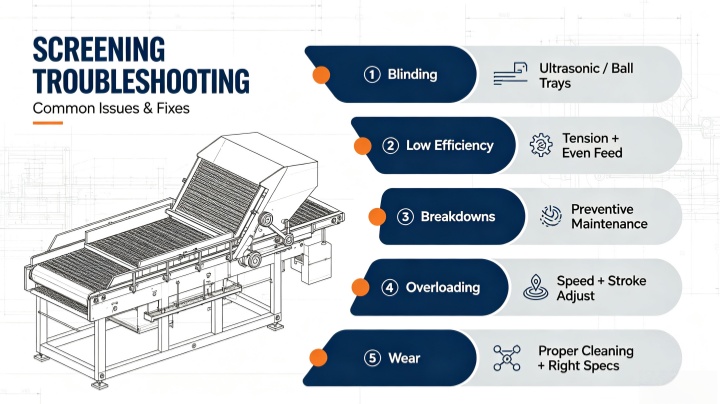
Industrial screening challenges are inevitable, but they are not insurmountable. By understanding the root causes of common problems—blinding, low efficiency, breakdowns, feed imbalance, and premature wear—operators can take targeted action to keep their screening equipment running reliably.
The most effective approach combines:
-
Proper equipment setup with correct speed and stroke settings
-
Regular inspections using comprehensive checklists
-
Proactive maintenance with quality replacement parts
-
Appropriate cleaning systems matched to your material characteristics
-
Operator awareness—training staff to observe and report subtle changes
When these elements work together, screening machines deliver consistent performance, lower operating costs, and fewer production interruptions. And isn't that what every production manager wants?
Frequently Asked Questions About Industrial Screening
What is industrial screening and why is it important?
Industrial screening is the process of separating materials by particle size using a vibrating screen machine. It's crucial for quality control, process efficiency, and meeting product specifications in industries like mining, food processing, and pharmaceuticals.
How can I improve the efficiency of my industrial screening process?
Improving industrial screening efficiency involves optimizing feed rate distribution, maintaining proper screen tension, using appropriate deblinding systems (like ultrasonic or ball trays), and conducting regular maintenance checks on your screening equipment.
What are the common problems with industrial screening equipment?
The most common industrial screening equipment problems include screen blinding (clogging), low separation efficiency, frequent mechanical breakdowns, feed rate imbalances, and premature wear or damage to the screen mesh.
Need help solving a specific screening problem at your facility? Contact our technical team for a free consultation and on-site assessment.


 Online Chat
 Email
Email