


Our heavy duty vibrating screen is engineered for continuous, high-load screening of bulk materials in mining, aggregates, and recycling industries. With reinforced frames, up to 600 TPH capacity, and customizable deck options, this heavy duty vibrating screen delivers reliable classification for feed sizes up to 300 mm. Unlike standard screens, our heavy duty vibrating screen features abrasion-resistant polyurethane decks and oversized bearings, ensuring minimal downtime in the harshest environments.
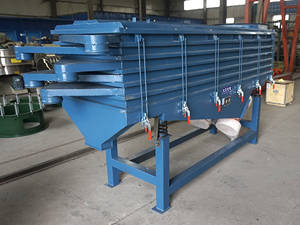
A heavy duty vibrating screen is an industrial screening machine built to separate, classify, and grade bulk materials by particle size under continuous, high-load operating conditions. Unlike standard vibrating screens, heavy duty models feature reinforced steel frames, larger vibration motors, abrasion-resistant decks, and enhanced bearing systems designed to withstand impact loading, high tonnage, and 24/7 operation.
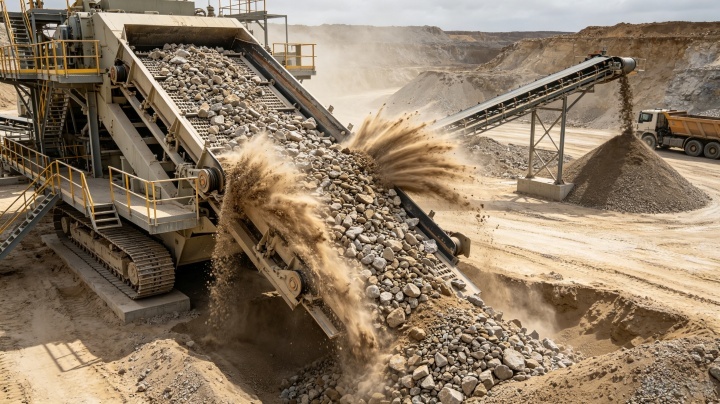
Common applications include:
Key differentiator: Heavy duty screens typically handle feed sizes up to 300 mm and throughputs exceeding 500 tons per hour (t/h) , whereas standard screens are limited to lighter materials and intermittent use.
Selecting the right heavy duty vibrating screen type is critical. Below we compare circular, linear, and banana-style heavy duty vibrating screens to help you decide.
Choosing the right screen type is the single most important decision in your purchasing process. Here is a clear breakdown:
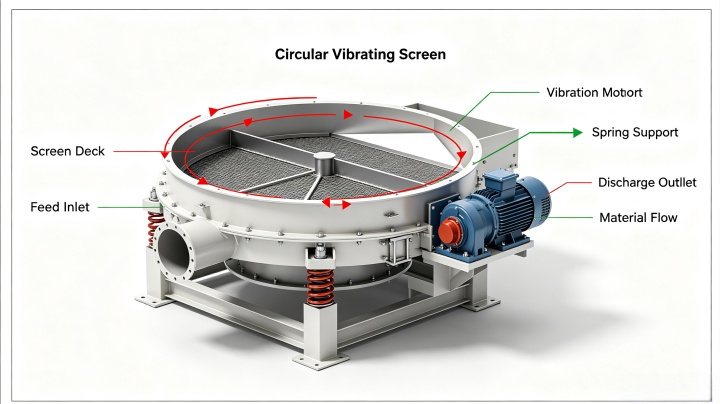
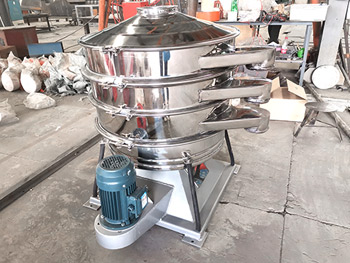
Motion pattern: Circular or elliptical trajectory
Best for: Wet materials, sticky ores, and coarse screening (feed size >50 mm)
Advantage: Self-cleaning action prevents mesh blinding when processing high-moisture materials
Typical capacity: 100–600 t/h
Choose this if: Your material has >5% moisture content or you are processing run-of-mine (ROM) ore.
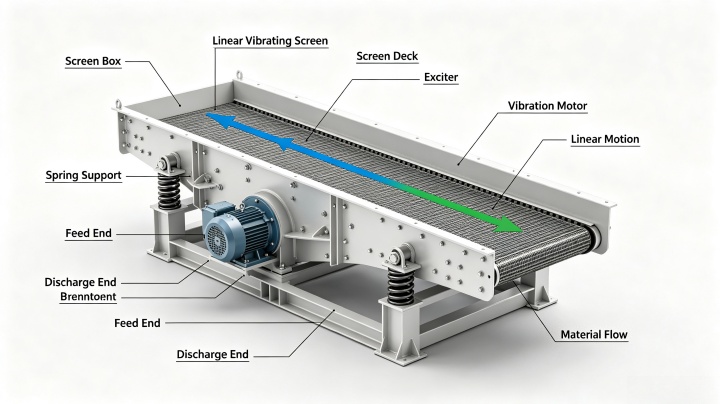
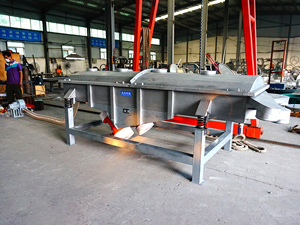
Motion pattern: Straight-line reciprocating motion
Best for: Dry, free-flowing materials and fine screening (0.5–50 mm)
Advantage: Higher screening efficiency for precise particle size classification
Typical capacity: 50–400 t/h
Choose this if: You need sharp cut-point separation on dry materials like sand, limestone, or recycled aggregates.
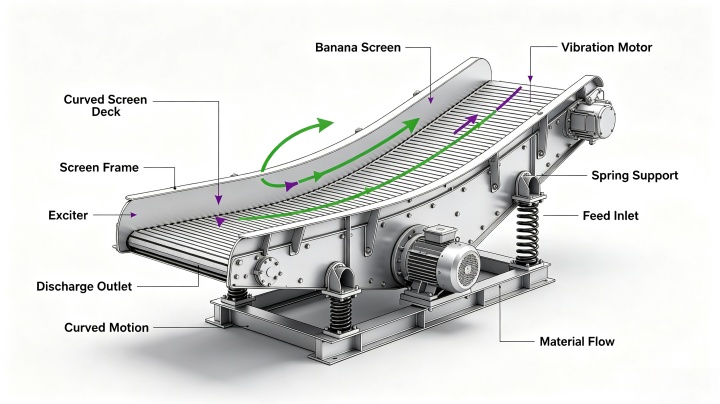
Motion pattern: Variable linear motion with multiple deck angles
Best for: High-capacity, high-efficiency screening where floor space is limited
Advantage: Up to 40% higher throughput than conventional screens of the same area
Typical capacity: 300–900 t/h
Choose this if: You have high tonnage requirements and need maximum throughput per square meter of screen area.
When comparing quotes from different suppliers, focus on these five technical parameters:
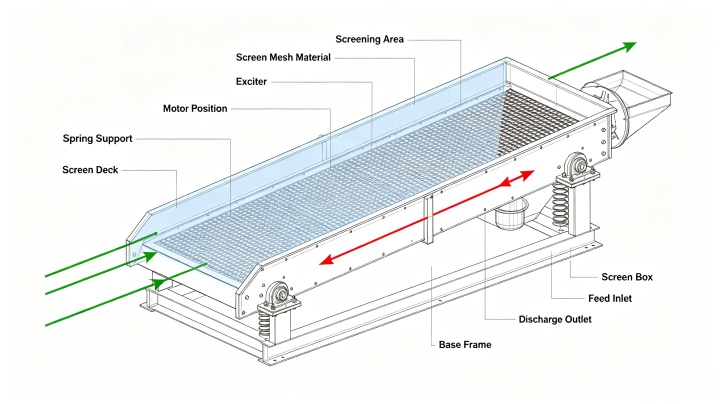
| Model Reference | Screen Size (mm) | Effective Area (m²) | Typical Capacity (t/h) | Motor Power (kW) |
| Small / Pilot | 900 × 1800 | 1.6 | 10–80 | 0.75 × 2 |
| Medium / Single-deck | 1800 × 6000 | 10.8 | 80–200 | 15 |
| Large / Double-deck | 2400 × 6000 | 14.4 | 200–400 | 30 |
| Extra-large / Mining | 3000 × 7200+ | 21.6+ | 400–600+ | 45+ |
Vibration frequency: 750–950 RPM (lower frequency = higher amplitude for coarse materials)
Double amplitude: 6–12 mm (larger amplitude improves material stratification)
Installation angle: 15°–25° (steeper angles increase material travel speed)
| Material | Best Use Case | Wear Life | Cost Level |
| Manganese Steel | Hard, abrasive ores (iron, granite) | Excellent (6–12 months) | High |
| Polyurethane | Wet, sticky materials with blinding risk | Excellent (self-cleaning) | High |
| Rubber | High-impact feed, noise-sensitive sites | Good (3–6 months) | Medium |
| Stainless Steel (304/316) | Corrosive or food-grade environments | Good | Medium |
Pro Tip: If your budget allows, polyurethane decks offer the best total cost of ownership for abrasive applications due to longer wear life and reduced downtime for mesh changes.
When you need a heavy duty vibrating screen that operates 24/7 under impact loading, our designs provide unmatched durability. Key advantages include:
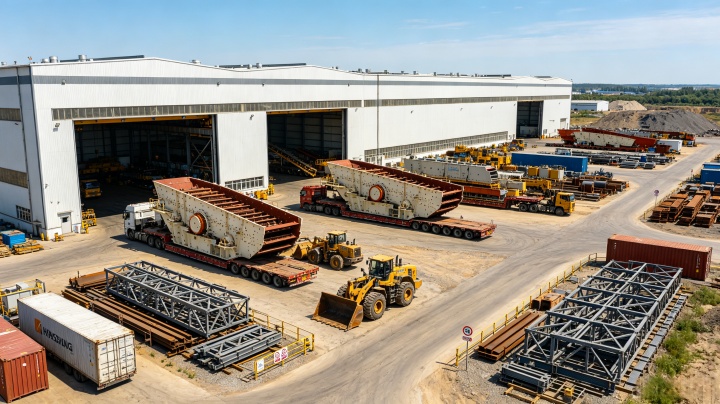
Sourcing from China's manufacturing hub in Xinxiang and Zhengzhou, Henan Province is the industry standard. However, not all suppliers are equal. Use these five screening questions to separate premium manufacturers from fly-by-night traders:
Question 1: "What is your standard warranty period and what does it cover?"
Benchmark answer: 18–24 months covering structural frame and vibration motor defects
Red flag: Less than 12 months or "warranty excludes motor"
Question 2: "Can you provide a CAD drawing with all key dimensions before order?"
Why it matters: Serious manufacturers have engineering teams ready to customize layouts. Traders will delay or provide generic drawings.
Question 3: "What is your on-time delivery rate over the last 12 months?"
Benchmark answer: ≥95%
Why it matters: Late delivery stops your production line. This is the #1 complaint in B2B industrial procurement.
Question 4: "Do you stock replacement mesh and eccentric blocks for this model?"
Why it matters: If they don't stock spares, your maintenance downtime will stretch from hours to weeks.
Question 5: "Can you share 3 customer references running similar materials to mine?"
Benchmark answer: Immediate referral to existing clients in your industry
Red flag: "We can share after you place the order" – this usually means they have no relevant experience.
| Criterion | What to Look For |
| Certification | ISO 9001:2015, CE marking (for EU exports) |
| Response time | Initial quote within 4 hours |
| Transaction history | Over $100,000 in verified online sales (if sourcing via B2B platforms) |
| After-sales support | 24/7 technical hotline or on-site service availability |
Q: What is the difference between a heavy duty and a light duty vibrating screen?
A: Heavy duty screens use thicker steel plate (8–16 mm vs. 4–6 mm), larger bearings, and more powerful motors (15 kW+ vs. 2.2–5.5 kW). They are designed for continuous operation with feed sizes up to 300 mm and throughput exceeding 100 t/h.
Q: How long does a heavy duty vibrating screen typically last?
A: With proper maintenance, the structural frame lasts 8–15 years. Wear parts like screen mesh and bearings are consumables – mesh lasts 3–12 months depending on abrasiveness, bearings last 2–5 years.
Q: Can I convert a single-deck screen to a double-deck?
A: Not typically – the motor power, spring support, and structural design are specific to each deck configuration. It is more cost-effective to purchase the correct model upfront.
Q: What is the typical lead time for a custom heavy duty screen?
A: Standard models: 7–15 days. Customized sizes or materials: 20–30 days. Always confirm with your supplier before ordering.
Q: Do I need a variable frequency drive (VFD) for my screen?
A: VFDs allow you to adjust vibration frequency on the fly, which is useful if you process varying material types. However, they add 15–20% to the motor cost – only recommend if you regularly change products.
Q: How do I calculate the required screen area for my application?
A: A general rule of thumb is 0.8–1.2 m² of screening area per 10 t/h for aggregate applications. For hard-to-screen materials (clay, high-moisture), increase to 1.5–2.0 m² per 10 t/h.
Selecting the right heavy duty vibrating screen comes down to three factors:
Ready to get a quote? Compile your material specifications (feed size, moisture %, desired output t/h, and particle size distribution) and send them to 2–3 shortlisted suppliers. This ensures you receive accurate, comparable proposals – not generic price lists.


Address:China,Yanjin county forest park gate to the west 1000 meters north road.


 Online Chat
 Email
Email