


A powder sieving machine is critical for quality control across pharmaceuticals, chemicals, food, and battery materials. However, screen blinding remains the most persistent challenge, reducing throughput and product consistency. This comprehensive guide explores why your powder sieving machine blinds and provides actionable fixes—from adjusting motor weights to implementing ultrasonic deblinding systems.
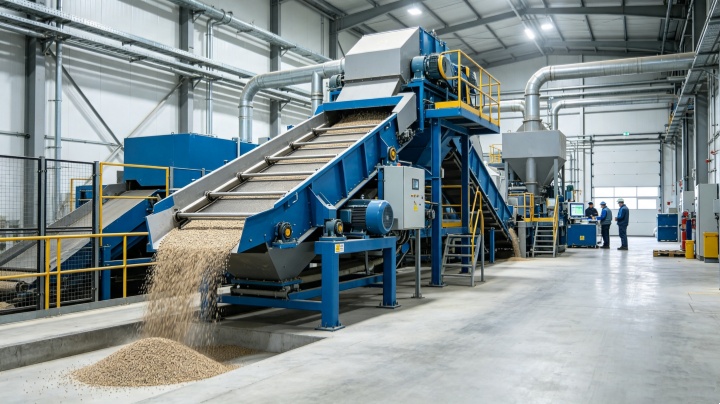
Screen blinding occurs when material lodges in the screen apertures, blocking the openings and reducing separation efficiency. The result? Lost production time, increased maintenance costs, and inconsistent product quality.
This guide walks you through the 7 most common causes of screen blinding and provides practical solutions to keep your particle separator running at peak efficiency.
Screen blinding happens when particles become trapped in the screen apertures, partially or completely blocking the mesh. This reduces the open area of the screen, causing:
The problem can occur with any type of particle separator—vibratory screens, centrifugal sifters, and gyratory separators all face blinding challenges.
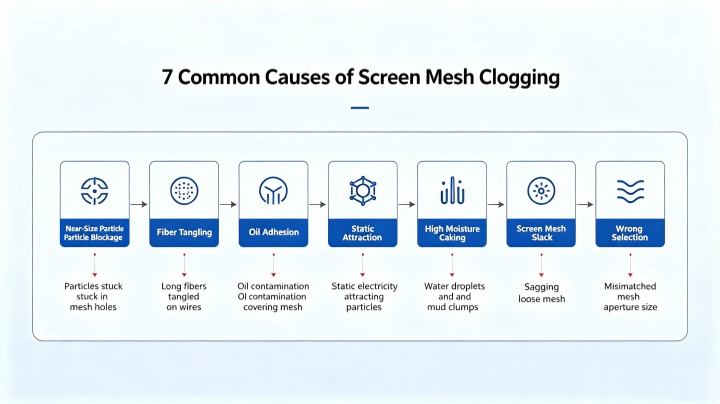
What happens: Particles approximately one-half to one-and-one-half times the size of the screen aperture compete for the openings and become lodged within them.
Why it's a problem: Near-size particles are too large to pass through easily but small enough to enter the opening. Once lodged, they block the aperture for other material.
Solution:
What happens: Wet or dry fibrous material partially protrudes through an aperture and, due to screen motion, winds itself around the wire, blinding the opening.
Why it's a problem: Once fibers wrap around the wire, they create a "nest" that catches more material, quickly reducing open area.
Solution:
What happens: Materials containing fats, oils, resins, or sticky substances coat the screen surface and cover the wire mesh.
Why it's a problem: These coatings reduce the effective opening size and cause material to adhere to the screen surface rather than passing through.
Solution:
What happens: Fine powders generate static electricity during processing, causing particles to cling to the screen mesh and each other.
Why it's a problem: Electrostatic attraction causes fine particles to stick to the wire, building up and blocking apertures.
Solution:
What happens: Moist or wet materials tend to stick to screen surfaces and form agglomerates.
Why it's a problem: Moisture causes particles to adhere to each other and to the screen wire, creating blockages. This has been a recognized challenge since the early days of screening technology.
Solution:
What happens: Improperly tensioned screens sag or vibrate unevenly, causing material to accumulate in low spots.
Why it's a problem: Loose screens don't vibrate effectively, allowing material to settle and blind the mesh.
Solution:
What happens: Using a standard vibratory screen for materials that require specialized equipment.
Why it's a problem: Not all screening technologies work for all materials. Certain powders require specific equipment to prevent blinding.
Solution:
| Material Type | Recommended Equipment | Why It Works |
| Sticky, fatty, or oily powders | Centrifugal sifter / Cyclone separator | Uses centrifugal force and rotor bars to push material through; self-cleaning design |
| Fine powders prone to static | Ultrasonic sieve | Breaks static charges; prevents particles from sticking |
| Ultra-light or multi-fiber materials | Centrifugal sifter | Cyclone washing effect automatically cleans the screen |
| General dry powders | Vibratory screen with deblinding system | Standard design with anti-blinding accessories |
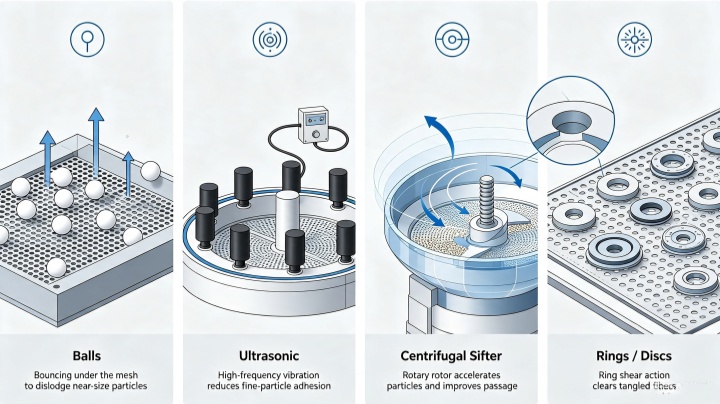
| Technology | How It Works | Best For | Limitations |
| Balls / Sliders | Resilient bodies bounce beneath screen to dislodge particles | Most general applications; cost-effective | May not work for fibrous or sticky materials |
| Mechanical (rings/discs) | Rings with sharp edges shear fibers and scrape material from underside of screen | Fibrous materials, granular particles | Can cause wear; requires proper spacing |
| Ultrasonic Deblinding | High-frequency vibrations make mesh friction-free; breaks static and surface tension | Fine powders, static-prone materials, difficult-to-screen products | Higher cost; requires specialized equipment |
| Centrifugal Force | Rotating paddles push material through mesh; self-cleaning action | Sticky, fatty, light, or fibrous materials | Not suitable for all product types |
When experiencing blinding issues, work through this checklist:
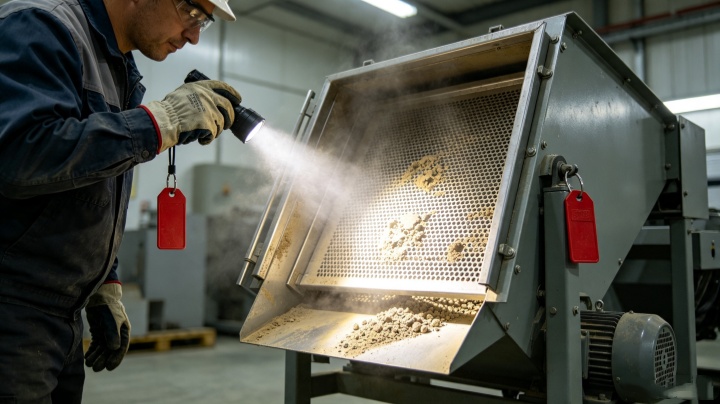
Screen blinding is inevitable with some materials, but it can be managed effectively with the right approach. The key is understanding why your separator is blinding and choosing the appropriate anti-blinding solution for your specific application.
Quick Summary:

Still struggling with screen blinding? Contact our technical team for a free consultation on your specific material and application. We can help you select the right separator and anti-blinding system to maximize your production efficiency.


Address:China,Yanjin county forest park gate to the west 1000 meters north road.


 Online Chat
 Email
Email