


Screen clogging is one of the most frustrating and costly problems in fine powder processing. When your Vibrating Classifier stops performing, production slows down, product quality suffers, and maintenance costs skyrocket. If you are dealing with this issue, you are not alone. Let us walk you through exactly why clogging happens and, more importantly, how to solve it permanently.
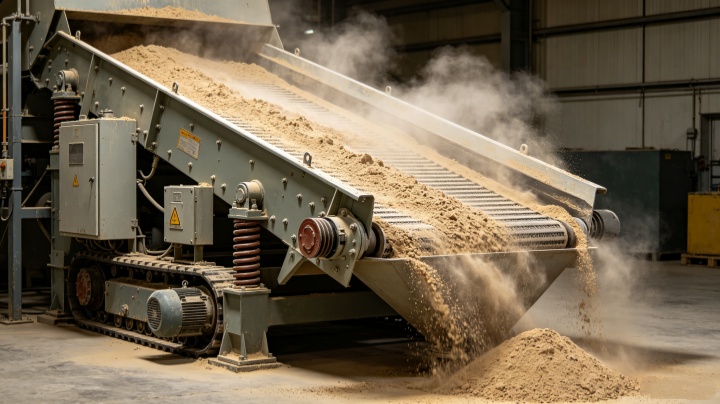
To solve a problem, you first need to understand it. Screen clogging—also known as blinding or plugging—typically occurs in two ways:
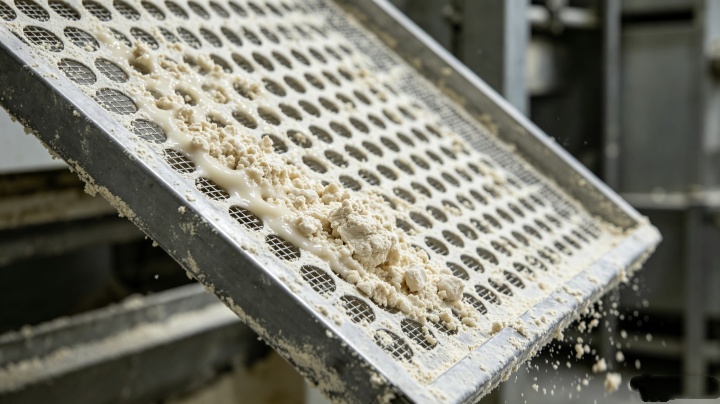
For fine powder applications, the challenge is even greater. High-density metal powders, low-density powders, and materials with static charges tend to cling to screens, while high moisture content creates a viscous covering layer that blocks apertures.
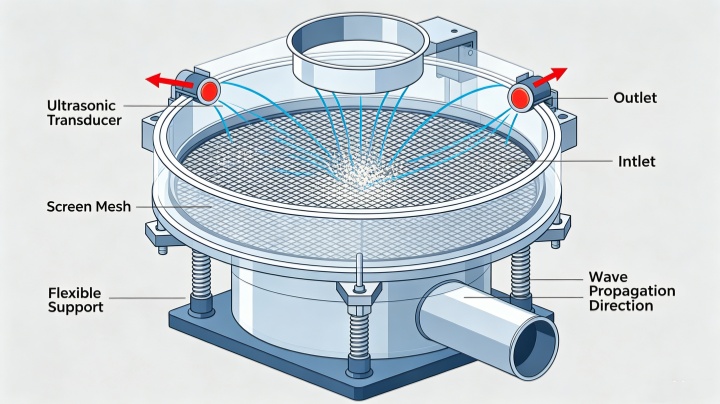
For dry fine powder screening, ultrasonic vibrating screens are widely recognized as the most effective solution for preventing clogging.
Ultrasonic systems convert standard power into high-frequency electrical signals (typically around 18KHz), which are then transformed into mechanical vibrations on the screen surface. This low-amplitude, high-frequency vibration creates a "micro-tremor" on the mesh wires.
| Benefit | Description |
| Prevents wedging | The high-frequency vibration actively dislodges near-size particles before they can become trapped |
| Reduces adhesion | The ultrasonic action breaks down surface tension and electrostatic adhesion |
| Significantly higher throughput | Processing capacity can increase by 50% to 400% compared to conventional vibrating screens |
| Extended screen life | Reduced friction and wear on the screen surface extends service life |
| Ultra-fine capability | Enables screening down to 500 mesh (20 microns) or even finer |
Ultrasonic vibrating screens are particularly effective for:
Industries that commonly benefit include food processing, pharmaceuticals, chemicals, metal powders, ceramics, and new materials.
A significant innovation in vibrating classifier technology is the use of elastic screen surfaces to replace traditional rigid screens.
Research has shown that elastic deformation is the key to restraining aperture blockage. When an elastic screen surface vibrates under simple harmonic excitation, the apertures undergo random elastic deformation. This continuous shape change:
In industrial tailings classification-dewatering applications, this elastic screen technology achieved:
For applications where ultrasonic or elastic screens may not be necessary, several more affordable self-cleaning solutions exist:
Rubber balls or sliders mounted below the screen create mechanical impacts during operation. These impacts "tap out" lodged particles and shear off build-up from the working mesh. Bouncing ball systems are commonly used in dry applications with coarser cut requirements.
These kits incorporate specialized cleaning devices directly into the screen assembly. They can be used in both wet and dry applications across various mesh sizes.
For wet applications, spray systems continuously or intermittently introduce liquid onto the screen surface to:
Sometimes, clogging issues are not about technology but about setup. Before investing in advanced solutions, check these fundamentals:
Incorrect screen cloth tension can severely hamper screening efficiency and contribute to blinding. An under-tensioned screen moves up and down in unison with the material, allowing near-size particles to peg in the apertures.
What to check:
If the vibratory separator is not producing enough vertical amplitude, self-cleaning devices like balls and sliders will not impact the screen effectively. Adjusting the lower motor weights can correct this issue.
For wet classification-dewatering applications, process conditions matter significantly. Research has identified optimal parameters for tailings processing:
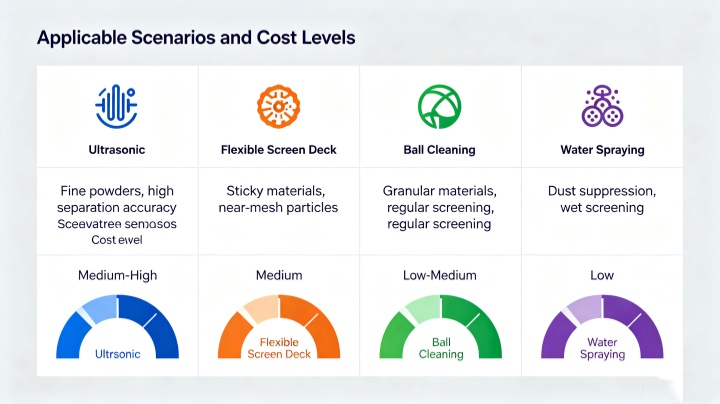
| Solution | Best For | Mesh Range | Cost Level |
| Ultrasonic System | Ultra-fine dry powders, static materials, high-value products | Down to 500 mesh | High |
| Elastic Screen Surface | Wet classification-dewatering, tailings, mineral processing | Medium to fine | Medium |
| Bouncing Balls/Sliders | Dry materials, coarser cuts, budget-conscious operations | Coarse to medium | Low |
| Spray Systems | Wet applications, sticky materials | Variable | Low to Medium |

Screen clogging in vibrating classifiers for fine powder applications is a common but solvable challenge. The right solution depends on your specific material characteristics, mesh requirements, and production goals.
Start with the basics — check your screen tension, motor settings, and process parameters. If basic adjustments don't solve the problem, consider upgrading to advanced solutions like ultrasonic systems or elastic screen surfaces. These technologies have been proven in both laboratory research and industrial production to significantly reduce blinding, increase throughput, and extend screen life.
Still have questions about which solution fits your application? Contact our technical team with your material specifications, mesh requirements, and production capacity needs for a personalized recommendation.
This guide is based on industry research and practical application experience. For specific technical advice on your unique material processing requirements, please consult with equipment manufacturers and conduct on-site testing.
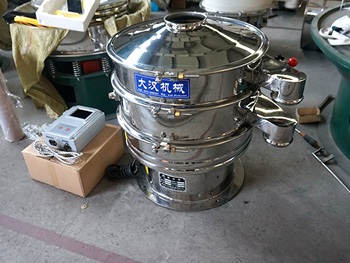
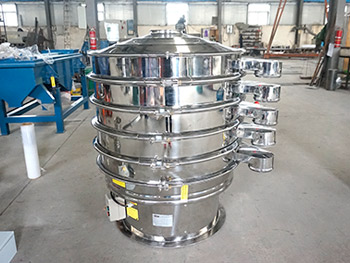
In conclusion, solving screen clogging in a vibrating classifier for fine powder requires a systematic approach. Start with the basics like screen tension and motor settings. If issues persist, advanced solutions like ultrasonic systems or elastic surfaces offer proven results. For more information on our fine powder vibrating classifier models and customization options, please contact our technical team.


Address:China,Yanjin county forest park gate to the west 1000 meters north road.


 Online Chat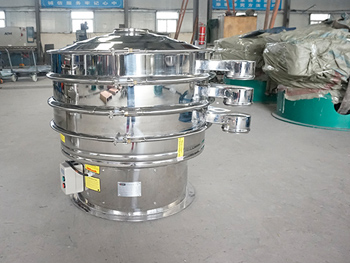
 Email
Email