


A Vibrating Spiral Elevator combines vertical conveying with simultaneous cooling, drying, or dedusting in a single compact unit. It replaces the traditional combination of a bucket elevator plus a separate cooling conveyor or fluid bed dryer, reducing floor space by approximately 70% and eliminating one transfer point where material degradation or contamination can occur.
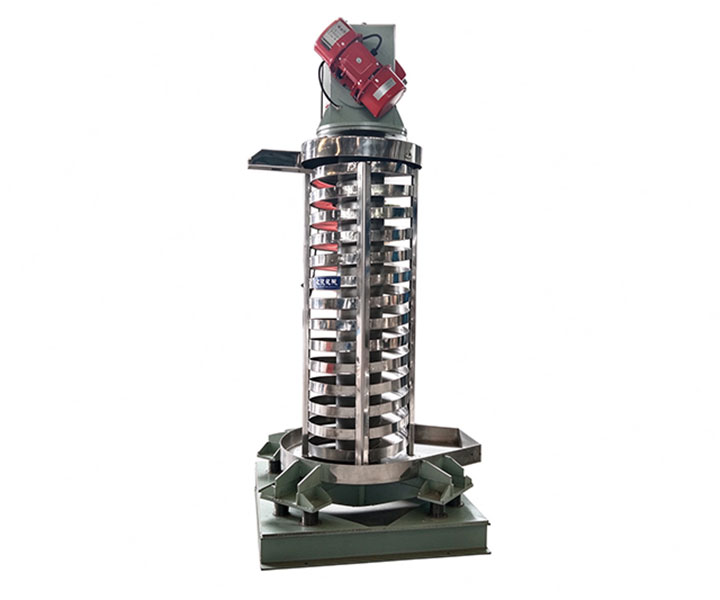
The operating principle uses two counter‑rotating vibration motors mounted at an angle to the spiral axis. This generates a controlled elliptical oscillation that throws material upward in a series of small parabolic trajectories. Each "micro‑throw" exposes the particle surface to air, enabling rapid heat exchange while advancing the material approximately 15–25 mm per vibration cycle. The result is gentle handling with minimal fines generation (0.3–0.8%), even for friable or coated products.
For heat‑sensitive engineering plastics such as PA6, PA66, PBT, and PP with 20–40% glass fiber, the integrated cooling function is particularly valuable. Fresh pellets exiting an extruder at 85–115°C must be cooled to below 50°C before packaging to prevent agglomeration and moisture absorption. The spiral elevator achieves this temperature reduction within the same machine that performs the lift, with no additional conveyor or cooling tunnel required.
| Criterion | Vibrating Spiral Elevator | Bucket Elevator | Pneumatic Conveyor |
| Cooling during lift | Integrated | None | None |
| Particle breakage rate | 0.3% – 0.8% | 1.0% – 2.5% | 3.0% – 8.0% |
| Energy consumption (kWh/t) | 0.8 – 1.2 | 1.0 – 1.5 | 6.0 – 12.0 |
| Floor space (for 5m lift) | 1.0x (baseline) | 1.2x | 2.5x (blower + filter) |
| Cleaning accessibility | Open trough, covers removable | Buckets require disassembly | Piping requires flushing |
The table above illustrates why this equipment is increasingly specified for high‑value materials where product integrity and operating cost matter. Pneumatic conveyors, while fast, consume 5 to 10 times more energy per ton and generate substantially more dust. Bucket elevators, though mechanically simple, offer no thermal processing and require a separate cooling stage downstream.
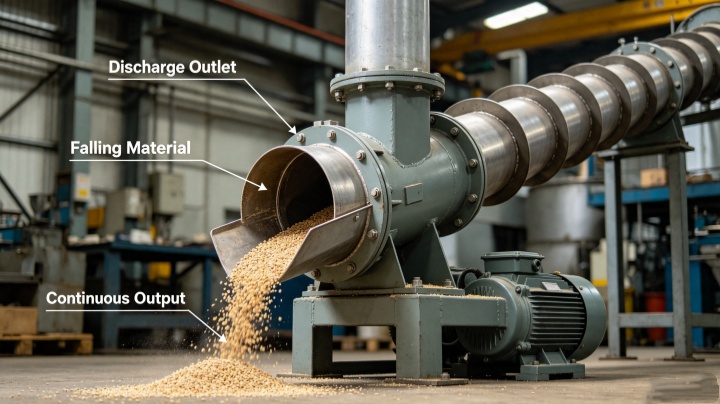
The following table presents standard models and their typical capacities based on plastic pellets with a bulk density of 620–680 kg/m³ and an inlet temperature of 95°C. Actual throughput varies with material density, particle size distribution, and moisture content.
| Model Code | Trough Diameter (mm) | Lift Height Range (m) | Capacity Range (kg/h) | Cooling Delta T (°C) |
| CZT‑500 | 500 | 2.5 – 5.0 | 500 – 1,500 | 35 – 45 |
| CZT‑630 | 630 | 3.0 – 6.0 | 1,100 – 2,500 | 40 – 50 |
| CZT‑800 | 800 | 3.5 – 7.0 | 1,500 – 3,500 | 40 – 55 |
| CZT‑1000 | 1000 | 4.0 – 8.0 | 2,500 – 5,000 | 45 – 60 |
Cooling delta T measured at 25°C ambient with natural convection. Forced‑air injection adds 10–15°C extra drop; water‑jacketed trough adds 15–20°C extra drop.
The CZT‑630 is the most frequently specified model for plastic compounding lines, handling the typical 1,500–2,500 kg/h output of a single twin‑screw extruder. The CZT‑1000 is chosen for larger production lines or for materials with lower bulk density that require greater trough volume to achieve the same mass throughput.
The table below shows measured results from customer installations across different material types. All values recorded under steady‑state operation after 8 hours continuous run time.
| Material | Bulk Density (kg/m³) | Inlet Temp (°C) | Outlet Temp (°C) | Throughput (kg/h) | Lift (m) | Fines (%) |
| PP + 30% GF pellets | 650 | 98 | 43 | 2,200 | 4.5 | 0.4 |
| PA6 pellets | 680 | 108 | 47 | 1,800 | 5.0 | 0.6 |
| ABS pellets | 620 | 92 | 38 | 2,500 | 4.0 | 0.3 |
| PVC resin powder | 550 | 62 | 34 | 1,200 | 3.5 | 0.8 |
Fines generation below 0.8% across all materials confirms that the micro‑throw motion preserves particle integrity. This makes the equipment suitable for coated products, prilled fertilizers, and pharmaceutical granules where dust control is critical.
When specifying a vibrating spiral elevator, these three parameters determine whether the unit will meet production targets or become a bottleneck. We recommend providing these values during initial inquiry.
Measured by angle of repose. Free‑flowing materials (angle below 30°), such as plastic pellets and rounded granules, convey at the higher end of the capacity range. Cohesive powders (angle above 40°), such as certain starches or hygroscopic salts, require larger trough diameters and lower vibration frequencies to prevent bridging. We request a 500g sample for flow testing when the material type is uncommon.
Calculated as mass flow rate × specific heat × required temperature drop. As a guideline, materials with a specific heat above 1.8 kJ/kg·K (e.g., PA6 at 2.1 kJ/kg·K) and throughput above 2,000 kg/h generally require active cooling (forced air or water jacket) to achieve a 50°C drop within a 5‑meter lift height. Natural convection alone is sufficient for lower thermal loads.
Total lifting height, measured from inlet pan to discharge lip, ranges from 3 to 6 meters for standard units, with custom heights up to 8 meters available. Trough pitch (vertical rise per 360° turn) is fixed at manufacture; we calculate the optimum pitch based on your required residence time for cooling – typically 3–5 minutes for plastics and 2–3 minutes for free‑flowing chemicals.
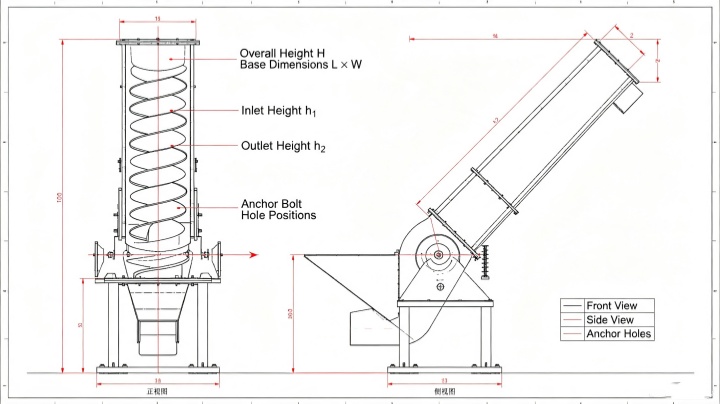
The choice of construction material directly impacts equipment cost, longevity, and regulatory compliance.
Carbon steel is the most economical option for dry, non‑corrosive materials such as minerals, fertilizers, and general industrial powders. Surface finish is painted with a two‑part epoxy coating for corrosion resistance in normal indoor environments.
Stainless steel 304 is the standard for plastics, rubber, and most chemical applications where mild corrosion resistance is sufficient. It offers good resistance to organic acids and oxidizing environments at moderate temperatures.
Stainless steel 316L is specified for food, pharmaceutical, and chemically aggressive environments involving acids, salts, or chlorides. The low carbon content prevents sensitization during welding, maintaining corrosion resistance in the heat‑affected zone. For hygiene‑critical applications, we offer electropolished interior surfaces with a roughness average of Ra ≤ 0.8 μm, preventing product adhesion and facilitating clean‑in‑place procedures.
Each unit delivered includes the following components, fully assembled and tested at our facility before shipment. Field assembly is limited to bolting the unit to the customer's foundation and connecting inlet/outlet chutes.
Mechanical components: Spiral trough assembly (one continuous welded spiral, no bolted joints), central support column with internal stiffening ribs, base plate with mounting holes and leveling screws, and four compression springs with preload adjustment nuts.
Drive system: Two vibration motors mounted for synchronized counter‑rotation, with adjustable eccentric weights on each motor for amplitude tuning. Motors are from OLI or equivalent manufacturers, rated for continuous duty at 380V/50Hz or 460V/60Hz as specified.
Access covers: Removable covers for all access sections, secured with quick‑release clamps. Open models include partial covers; fully enclosed models include gasketed covers for dust‑tight operation.
Documentation: General arrangement drawing, electrical schematic, parts list, and operation manual in English.

The following upgrades are available for specific process requirements. Pricing is quoted per option upon request.
Forced‑air cooling system – A blower assembly with ducting directs a controlled stream of ambient or chilled air upward through the spiral column, counter‑flow to the material path. Increases cooling delta T by 10–15°C. Air can be filtered to HEPA standards and dehumidified for moisture‑sensitive products.
Water‑jacketed trough – A jacketed outer shell circulates chilled water around the lower spiral section, providing active cooling for high‑temperature materials such as PBT and PET exiting at 140–160°C. Increases cooling delta T by 15–20°C and accelerates quenching to prevent crystallization degradation.
Variable frequency drive (VFD) – Allows on‑the‑fly adjustment of vibration frequency to vary residence time. Useful for production lines handling multiple material types with different cooling requirements.
ATEX certification – Explosion‑proof motors, grounding straps, and anti‑static covers for installations in classified areas handling combustible dust (e.g., starch, sulfur, fine organic powders).
To respond with a proposal within one working day, please include the following information in your inquiry. Missing items delay the response while we request clarification.
Material name and form (e.g., PA6 pellets, 3.5mm diameter)
Bulk density in kg/m³ (or let us estimate from material type)
Required throughput in kg/h
Inlet temperature and desired outlet temperature in °C
Required lifting height in meters
Preferred construction material (carbon steel, SS304, or SS316L)
Cooling requirement (natural, forced air, or water‑jacketed)
Electrical supply voltage and frequency
Any special certification needed (ATEX, FDA, etc.)
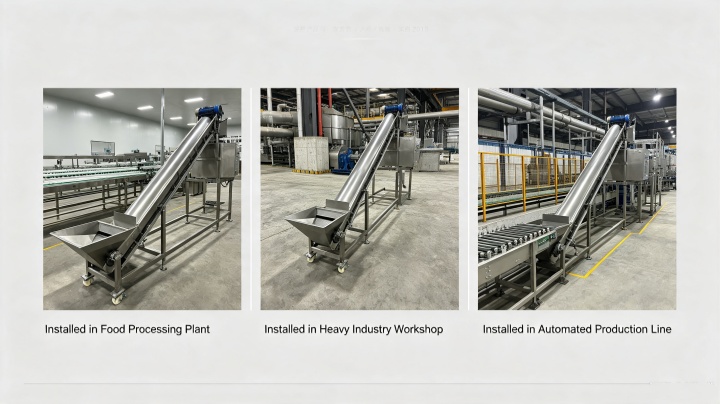
We provide a dimensioned CAD layout drawing with each quotation, showing the elevator footprint, inlet/outlet elevations, foundation bolt pattern, and clearance requirements for maintenance access. This allows your engineering team to integrate the unit into your existing production line with confidence.


Address:China,Yanjin county forest park gate to the west 1000 meters north road.


 Online Chat
 Email