


Selecting the wrong Bulk Material Screening Sifter leads to blinding, downtime, and rejected batches. The right industrial screening equipment, however, boosts purity, throughput, and your bottom line. This short guide walks you through a proven 4-step selection process to find the perfect powder sifter machine or separator for your specific application.
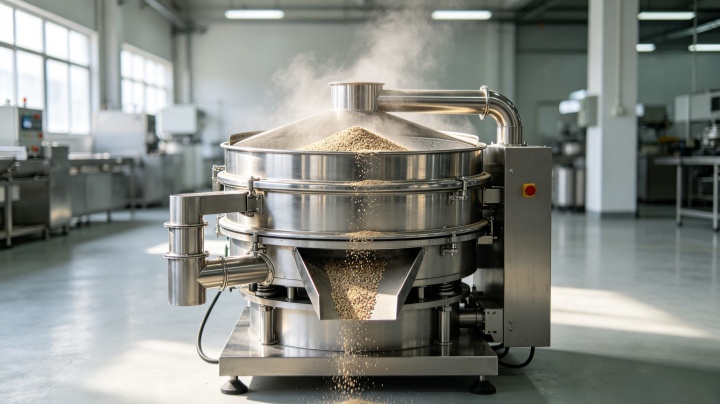
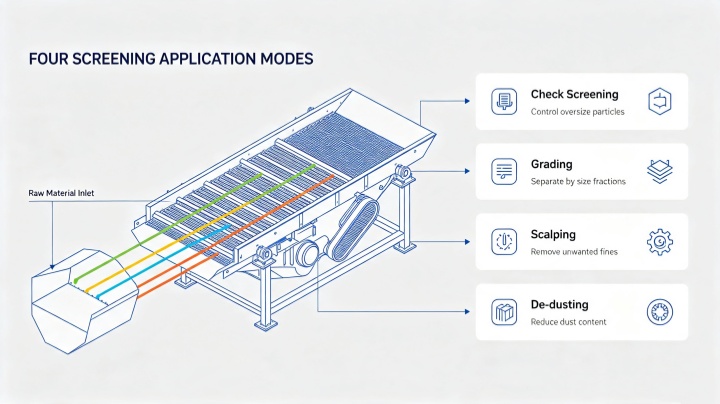
Start by clarifying why you are screening. This single decision eliminates half the options immediately.
Start by clarifying why you are screening your bulk materials. This single decision eliminates half the options immediately and narrows down the type of bulk material screening sifter you need.
| Goal | Purpose | Best For |
| Check Screening | Remove oversize particles and foreign contaminants | Food, pharma, chemicals (safety first) |
| Grading | Split material into 2–5 consistent size fractions | Metal powders, plastics, fertilizers |
| Scalping | Remove a small amount of coarse material at high volume | Mining, bulk chemical handling |
| Dedusting | Remove fine powder ("fines") from granules | Plastics, pellets before packaging |
Your product's physical properties dictate which sifter technology will work—and which will fail.
Your product's physical properties dictate which bulk material screening sifter technology will work—and which will fail. Proper material analysis is the cornerstone of successful industrial screening.
| Property | What to Check | If It's Problematic… |
| Particle shape | Spherical, irregular, flake, or fibrous? | Irregular/flake shapes blind screens faster |
| Friability | Is it easily damaged? | Choose tumbler or vibratory (gentler action) |
| Moisture / fat | Free-flowing or sticky? | Sticky → need centrifugal or ultrasonic deblinding |
| Abrasiveness | Will it wear down mesh? | Use wear-resistant screen material (e.g., stainless, nylon) |
Quick rule: Free-flowing, dry powders → vibratory sifters. Sticky or cohesive materials → tumbler or centrifugal with anti-blinding
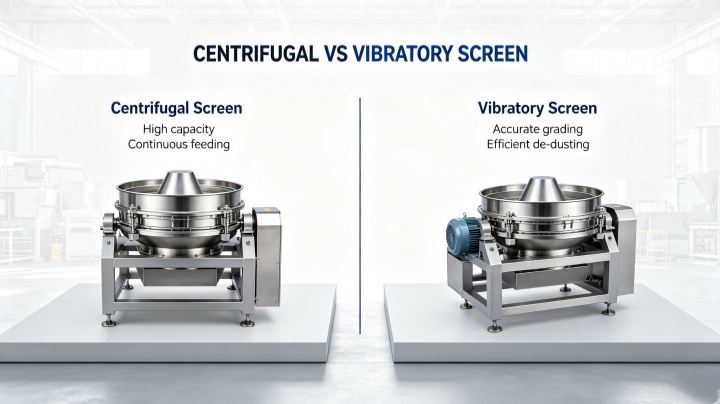
Three main types dominate the market. Here is the plain-English comparison:
Three main types of bulk material screening sifters dominate the market for dry bulk solids. Here is the plain-English comparison to help you decide between centrifugal, vibratory, and tumbler screening machines.
| Feature | Centrifugal (Rotary) | Vibratory | Tumbler |
| Motion | Rotating paddles (600-700 RPM) | High-freq, low-amp vibration | 3D low-freq, high-amp |
| Decks | Single only | Multi-deck (2–5) | Multi-deck |
| Best for | High-volume scalping, pneumatic lines | Grading, fragile materials | Cohesive powders, highest efficiency |
| De-agglomeration | ✓ (gentle) | ✗ | ✓ |
| Footprint | Compact | Compact | Larger |
When to choose each:
Technology alone isn't enough. These operational details affect your daily work and total cost.
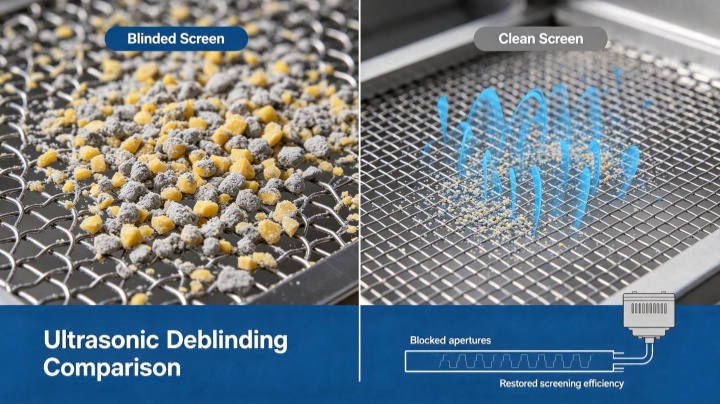
| Problem | Solution |
| Fine powders blocking mesh | Ultrasonic system – vibrates screen at high frequency to keep apertures clear |
| Near-size particles stuck | Bouncing balls – mechanically knock particles loose |
| Sticky / moist materials | Centrifugal sifter – spinning action self-cleans the mesh |
| Your Application | Recommended Sifter | Why |
| Flour policing in pneumatic line | Centrifugal | Compact, pressure-rated, single separation |
| Dairy powder → 3 particle grades | Vibratory (3-deck) | Gentle on fragile product, multiple cuts |
| High-volume sticky mineral powder | Tumbler | 3D motion handles cohesion efficiently |
Never buy without testing. Every powder behaves differently. Reputable suppliers offer lab-scale or on-site testing with your actual material. Use it to verify:
A 2-hour test can save you weeks of production headaches and thousands in wrong purchases.
Q: Check screener or grading sieve?
A: Check = remove contaminants (safety).
Grading = split into multiple sizes (consistency).
Q: When do I need ultrasonic deblinding?
A: When screening very fine powders (< 200 mesh) that block the screen and reduce output.
Q: Centrifugal vs. vibratory – which is cheaper?
A: Centrifugal units are typically lower cost for single-separation applications. Vibratory costs more but offers multi-deck flexibility.
Q: What budget should I expect?
A: Standard models start around $4,000–$5,000. Custom builds, ultrasonic, and ATEX add cost.
Need help narrowing down your options? Contact our team with your material details and throughput targets – we will recommend the right model within 24 hours.


Address:China,Yanjin county forest park gate to the west 1000 meters north road.


 Online Chat
 Email
Email